


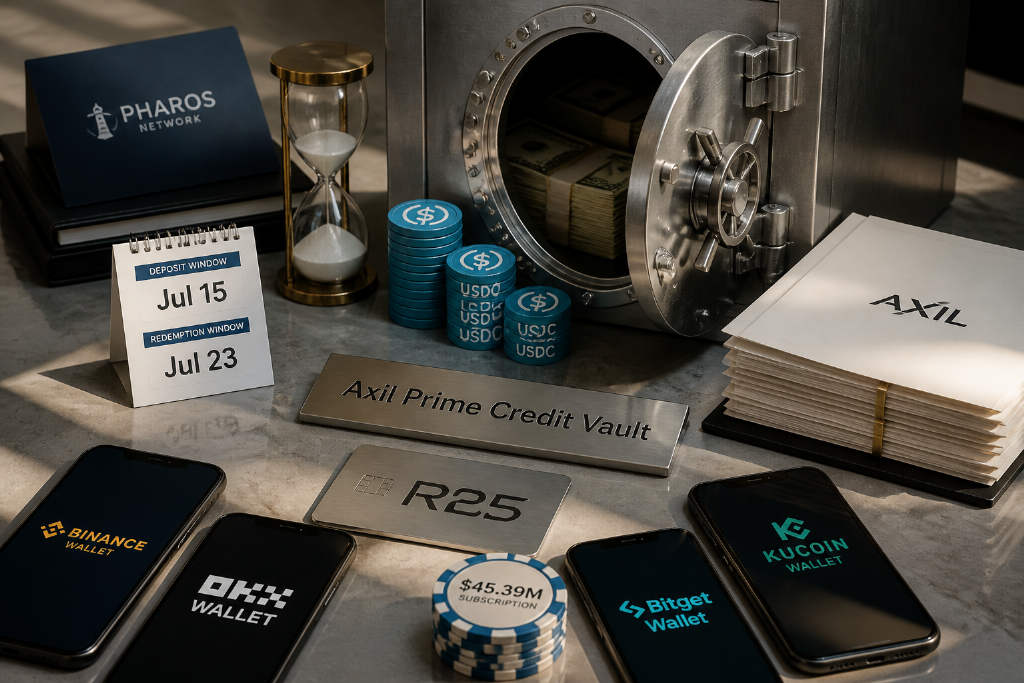
Pharos Network launched the Axil Prime Credit Vault, or APC, with vault infrastructure protocol R25 and credit asset manager Axil on July 15. The product is an institutional-grade consumer credit RWA strategy issued on Pharos and distributed through Binance Wallet, TopNod, OKX Wallet, Bitget Wallet and KuCoin Wallet. It carries a total fundraising cap of 100 million USDC and a target annualized yield of about 14.3%. By the close of the pre-deposit window, it had taken in $45.39 million.
The launch landed at a time when repeated failures in onchain strategy safety this year had pushed users to look for steadier sources of yield. Binance Wallet added $300,000 in PROS incentives on top, turning APC into one of the more discussed RWA vaults in the market.
The timing also created the product’s first public controversy. APC came online during the redemption period for a previous Pharos TGE pre-deposit campaign. That earlier vault required users to submit redemption requests roughly half a month before the lockup ended. Interest stopped accruing on July 20, and redemptions were to be completed within seven days. Users accustomed to DeFi’s T+0 exit model looked back at the rules and found they had missed the window, then began questioning both the redemption schedule and the safety of their funds.
R25 and Axil later held an AMA on Binance Square, with KOLs including Haotian and Tianqing joining the discussion. The session focused on the difference between RWA assets and DeFi vaults, the role of the curator, why consumer credit is worth allocating to, and how risk is managed before and after deployment. In the middle of that debate, some users deposited seven-figure sums on the final day, while others asked the team for early redemption.
On July 23, Pharos said users who had submitted requests on time had received all principal and interest. Funds that missed the deadline were automatically rolled into the next three-month cycle under the vault’s preset rules and continued earning 14% annualized in USDC. That update directly addressed the market’s concerns over fund safety.
The bigger issue was not one redemption queue. Even with RWA TVL now above $38 billion, non-institutional onchain users still struggle with how these products work. Institutionally driven RWA products can offer stable returns and relatively high yields, but they often come with longer lockups and a heavier burden of understanding. The APC debate put that mismatch in plain view.
The RWA trade-off: yield, access and liquidity do not all fit together
The article frames the APC debate around an “impossible triangle” in RWA: high yield, low entry barriers and high liquidity. At this stage, a product usually gets only two of the three.
BlackRock’s BUIDL requires a $5 million minimum and is open only to qualified purchasers, yet it can offer near-instant subscriptions and redemptions through stablecoin rails. APC flips that structure. Its threshold is low enough for ordinary users, but it requires a three-month lockup. The point is not the size of the ticket. Liquidity depends on how quickly the underlying assets can be turned into cash.
BUIDL sits on U.S. Treasuries, which trade in the deepest secondary market in the world. APC sits on tens or hundreds of thousands of emerging-market consumer loans, where there is no guarantee that someone will be ready to buy in size at any moment. In practice, that means high yield and low barriers can coexist, but liquidity is the side that gives way.
The same logic appears in Franklin Templeton’s BENJI. It starts at $20 and supports daily redemption, combining low barriers with high liquidity, but offers only 3% to 5% annualized. Double-digit returns usually require non-standard assets and a lockup. In other words, part of the excess return is the price paid for surrendering liquidity.
That is exactly where APC sits: high yield and low access, at the cost of liquidity. The trade-off itself is not inherently right or wrong. It does, though, explain where the controversy came from. Retail users gained access to assets that had long been reserved for institutions, but they also inherited the institutional rulebook around duration matching. Institutional money is typically committed with a defined timeline from the start. Lockups are an expected cost. Private credit and closed-end funds have always carried redemption limits. Most ordinary onchain users still begin from a different expectation: they want in and out on demand.
That is why much of today’s “retail RWA” is retail only at the distribution layer. Web3 wallets and lower minimums open the door, but the liquidity structure is still designed with institutional logic.
Why redemption cannot work like DeFi
The loudest criticism in this round was simple: why does redemption need to be filed roughly half a month in advance? Pharos responded, and the answer goes to the heart of how RWA differs from DeFi.
For years, most DeFi products trained users to expect instant exits. One click is enough, and anything slower feels broken. That model works because the assets live onchain. There is an active secondary market, market makers are quoting continuously, and the protocol can settle positions internally.
APC does not hold onchain tokens as its underlying asset. It buys claims tied to the real world. User USDC first enters an onchain vault, then is converted into fiat to subscribe to an offchain fund. According to the project’s disclosure, that fund is managed by a licensed institution in Hong Kong, has an underlying asset base of about $300 million, and ultimately allocates to emerging-market consumer credit. To move funds back into a user’s wallet, that route has to run in reverse.
Consumer credit usually settles monthly or quarterly. That cadence sets the product’s liquidity profile. If principal and interest return from the asset side only in fixed portions each month, the product side cannot realistically promise T+0 redemption unless the manager uses its own balance sheet to bridge the gap. That would add a new layer of risk.
Asset liquidation speed is not the only source of delay. A token onchain can prove ownership of a fund share, but it cannot verify whether borrowers are repaying on time. That requires confirmations across custodial banks, licensed fund managers, third-party auditors and local lenders, all of which still operate on traditional finance timelines.
This is one of the defining features of today’s RWA structure. Blockchains were designed to strip out transaction intermediaries. Once a product is anchored to offchain assets, however, it has to reconnect to that trust stack. The length of a redemption window is often just the time needed for that chain to complete one full cycle.
The article cites the Financial Stability Board’s May 2026 report on private credit vulnerabilities, which said more private credit funds are offering redemption options even though the underlying assets do not have equivalent liquidity. That mismatch, the report said, can amplify procyclicality. From a regulatory angle, giving a highly illiquid asset class an anytime exit door is itself a source of systemic risk.
Seen that way, the redemption structure is not merely a design flaw. It is a physical limit set by the asset class. To answer the backlash and better fit user expectations, Pharos extended the new vault’s application window to July 20 through Oct. 16, close to three months. The maturity date remains fixed at 15:00 on Oct. 20, 2026, when principal and accrued returns will be settled and distributed together.
Where the 14.3% yield comes from
The division of roles inside APC is clear. Pharos handles distribution and settlement. Axil acts as credit manager and vault operator, building the portfolio and running the strategy. R25 provides the infrastructure that connects onchain funds with offchain assets. The full strategy name is Axil Consumer Credit Vault - 3M, ticker APC3M, with a three-month lockup.
The target annualized return of 14.3% comes from two sources. About 11.3% is tied to interest cash flow from the underlying consumer credit assets. Roughly 3% comes from PROS token incentives. Base returns accrue daily in USDC and can vary, while PROS is used to top the strategy up to its target yield.
That matters because many onchain high-yield products lean heavily on token emissions. If the token price falls, realized returns shrink fast. APC’s main return stream is tied instead to monthly interest paid by real borrowers. It is a cash-flow product, not a crypto-native yield strategy. Two products can both advertise 14%, but one backed by token incentives and one backed by repayment bills do not carry the same resilience.
In the prior vault cycle, annualized returns stayed around 14% across three months. After performance fees, net annualized return came to 12.6%. As of late July, TVL in the strategy pool stood at $53.51 million. Axil’s parallel six-month product, VRPCS, targets 15% annualized, and its full $10 million capacity had been filled.
The underlying bet is emerging-market consumer credit
APC buys consumer credit assets in emerging markets, mainly small personal loans and retail loans spread across several fast-growing developing countries. For Chinese-speaking users, the article likens the model to familiar consumer finance mechanics: small-ticket, short-duration lending built on behavioral data tied to spending.
After the AMA, Axil published a long explanation of why it is willing to put the entire allocation into consumer credit. The case rests on three points.
The first is diversification. The International Monetary Fund’s April 2024 Global Financial Stability Report highlighted private credit risks tied to smaller borrower bases, layered leverage and opaque valuations, with a focus on mid-sized corporate loans where one default can seriously damage a pool. Consumer credit has the opposite structure. Borrowers are numerous and spread across jobs and regions. Under Axil’s disclosed portfolio standards, no single loan exceeds 0.1% of the pool, and the asset base spans from thousands to hundreds of thousands of loans.
The second is data density. Hundreds of thousands of monthly repayments generate a large and constantly refreshed stream of data points. The article cites a 2020 Review of Financial Studies paper by Tobias Berg of the Frankfurt School of Finance & Management and Manju Puri of Duke University, among others. It found that a model built only from users’ online behavioral traces produced an AUC of 69.6%, above the 68.3% achieved using only traditional credit scores, and that combining the two lifted the figure to 73.6%. The sample came from developed markets, but the result still supports the idea that behavioral data can supplement conventional credit checks, especially for borrowers with thin formal records, a common feature in emerging markets.
The third point is spread. Developing economies tend to have faster GDP growth and rising consumer finance demand, while credit penetration remains relatively low. The article cites the World Bank’s 2025 Global Findex Database, which said about 1.3 billion adults worldwide still do not have a bank account. That supply gap leaves room for higher lending rates. In parts of Asia, relative default rates are lower, and the difference between those rates forms part of the product’s safety cushion.
How the risk controls are built
The article also notes that the Financial Stability Board estimated global private credit had reached $1.5 trillion to $2 trillion by the end of 2024. That market carries borrower credit risk, opaque valuations, high concentration in some portfolios, leverage and uneven regulatory visibility. Turn those vulnerabilities around, and they become the checklist for what an RWA credit product needs to manage.
Axil describes its framework with four pillars: safety, stability, liquidity and alpha. The team executing that framework spans both Web2 and Web3 and includes members from BlackRock, Hong Kong Exchanges and Clearing, CICC Capital, HSBC and Ant Group.
Asset selection works across three layers: country, institution and product. At the country level, Axil looks at GDP growth, how complete the legal framework is and political stability. At the institutional level, it requires local lending and collection licenses, more than 10 years of operating experience and mature AI large-model risk controls. At the product level, it favors small, short-duration loans with moderate interest rates.
Diversification is not only a matter of capping single exposures at 0.1%. The portfolio is also spread across multiple countries and staggered vintages. By spacing out loan maturities, the strategy is designed to avoid large clusters of loans coming due at the same moment that local macro conditions weaken, helping smooth overall risk.
Credit enhancement adds several layers of defense. Licensed lenders provide pledged collateral equal to 120% of loan principal. APC holds senior claim rights. The pool also includes a 12.5% junior tranche, which absorbs default losses first. On top of that, the original rights holder provides a commitment letter on principal and interest payments, plus pledged receivables and pledged bank accounts as additional support.
Monitoring continues at daily, weekly and monthly frequencies, with data tracked down to the level of individual loans. Apex serves as an independent third-party auditor and issues weekly proof-of-reserves reports to confirm asset authenticity and compliance.
Overcollateralization, senior-junior structuring and jointly controlled accounts are not inventions unique to onchain finance. They are standard tools used in structured finance for years. Axil’s own framing is that risk management is not about pretending risk does not exist. It is about identifying what can be understood, measured and priced.
What Pharos got right, and what it did not solve
The article says Pharos handled several things correctly. The return stream was not mainly dressed up through fresh token issuance. Most of it corresponded to actual borrower repayments. The credit enhancement structure relied on tools that have been tested repeatedly in traditional finance rather than on a new onchain mechanism. And when redemption pressure appeared, the team did not use its own capital to mask the liquidity mismatch. It followed the preset contract rules and rolled missed funds forward automatically.
The gaps are also clear. First came communication. The redemption rules were on the product page and in official notices, but the team did not reach users proactively at the critical moment. Explanations came after doubts had already spread across social media. In onchain products, the product itself is only half the work.
Second is verifiability. The audit may be third-party, but the auditor still reviews materials provided by the manager. Users do not have an independent channel to verify disclosed default rates or recovery rates. The onchain side is transparent. The offchain side still runs on trust. That is not unique to Axil; it remains a ceiling for much of the current RWA market.
Third is sample size. Consumer credit is procyclical by nature. Delinquency rates can stay low when the economy is healthy and then surface together during a downturn. APC’s prior cycle lasted only three months, and emerging markets did not go through a systemic credit contraction in that period. The track record has not yet faced a real stress test.
Pharos is trying to compete below the token layer
The article then zooms back out to Pharos itself. The chain was founded by former core members of Ant Group’s blockchain team and is positioned as an inclusive Layer 1 for RealFi. Its mainnet, Pacific Ocean, went live on April 28, 2026. The project lists performance metrics of 30,000 TPS and one-second finality, integrates ZK-KYC/AML at the protocol layer and includes USDC together with its official Cross-Chain Transfer Protocol, CCTP. Total funding has reached $52 million, and the post-money valuation at one point was close to $1 billion.
Those figures alone are not unusual in today’s Layer 1 market. The article argues that Pharos stands out more on distribution. APC appeared in the wealth-management sections of several major wallets on day one, and Binance Wallet added a $300,000 PROS reward boost.
Wish Wu, Pharos co-founder and CEO, said institutional and professional investors always get first access to the best private credit opportunities. Pharos, he said, wants to bridge the gap between RealFi value and real users, without leaning on point farming or inflationary token yields.
The asset pipeline is still expanding beyond APC. Through its RealFi alliance, Pharos has brought in Chainlink and Centrifuge as infrastructure components, while Binance Wallet handles distribution. A pilot energy RWA project with GCL New Energy (0451.HK) extends the asset mix from consumer credit to real-economy industry.
That shift also raises the profile of managers such as Axil. It is neither the issuer nor the distribution channel. Its role is closer to that of a traditional fund manager: source assets, run due diligence, package risk, return, duration and liquidity into a strategy, then use onchain rails to deliver it. In Axil’s phrasing, bringing real-world assets onchain involves much more than wrapping an asset in a token. The hard work happens below the token layer.
The lesson from this episode is not simply whether 14.3% is high. It is whether users can judge where that 14.3% comes from, who takes the first loss and under what conditions the money comes back. The article closes by arguing that the RWA market is moving away from a simple race over headline yields and toward a comparison of which assets can stand up to deeper scrutiny and which products explain their rules earlier. Yield can be written into a launch notice. Asset quality still needs time and a full cycle to prove itself.