

Last week, prediction market heavyweights Polymarket and Kalshi each hit important milestones. Polymarket opened its Perps Beta to a select group of users, planning to expand access over the next four weeks. Meanwhile, Kalshi received approval from the U.S. Commodity Futures Trading Commission (CFTC) to list its Bitcoin perpetual futures contract, BTCPERP.
Odaily Planet Daily has previously discussed this convergence: prediction market platforms are moving into perpetual contracts, while exchanges are increasingly cutting into event-based trading. The boundaries between the two are blurring. In our earlier analysis of the CFTC approval, we examined what the first U.S.-regulated crypto perpetual contract means for the American compliance market.
Now, both trajectories have concrete landing points — one is running a small-scale product test, the other has secured regulatory clearance first. The paths differ, but the signal is the same: prediction market platforms are no longer content with just event trading. They are now stepping into the higher-frequency, more standardized derivatives market.

Polymarket Perps Beta: Testing First, Liquidity the Real Test
Polymarket VP of DeFi Engineering Josh Stevens posted on X that Polymarket Perps Beta is live on polymarket.com for a select group of users and will gradually expand access over the next four weeks. He added that some applicants had previously been added to the test list via direct message, and a small number of additional spots may be released later, though no more testers will be added at this stage.
So far, Polymarket has not disclosed the full list of trading pairs, leverage multiples, margin rules, or funding rate mechanisms supported by Perps. This indicates the Beta is more of a small-scale product test than a full-scale launch for all users. What Polymarket needs to confirm right now is not how much volume it can generate in the short term, but whether this new trading functionality can run stably.

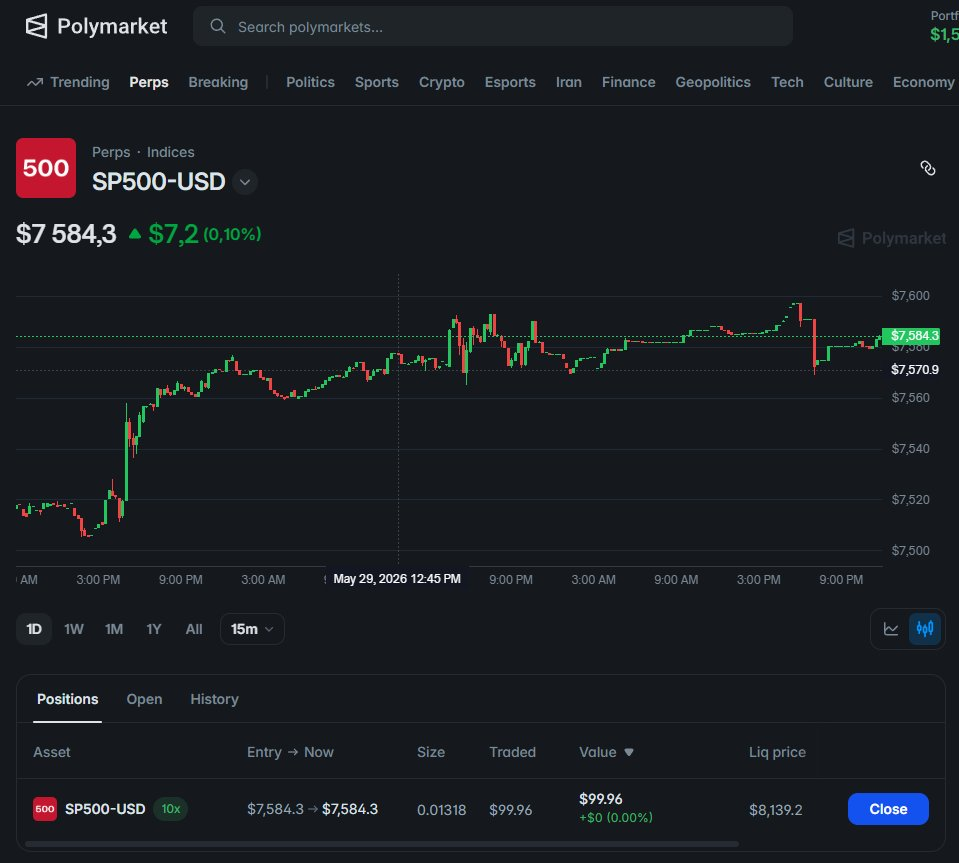
According to feedback from early testers on X, the Beta version already supports basic position opening. One user mentioned opening a BTC leveraged long position on the test interface, and screenshots show assets like cryptocurrencies and indices appearing in the interface. These are still early-stage test observations, and the final trading pairs and features will need further official disclosure.
Among the earliest user feedback, test qualifications and KYC requirements stood out. The Beta phase is only open to select users, with early applicants needing to request access via X direct messages, and some testers required to complete KYC identity verification. While some community members suggest restrictions might ease after the official launch, at this stage, complaints have already surfaced around mandatory verification, inability to secure early access, and concerns about whether this affects future airdrops or points.

A more fundamental concern is liquidity. A perpetual contract is not finished just because you can open a position — what really determines the experience is order book depth, slippage control, and execution stability during volatile market conditions. As one community member bluntly put it, Perp liquidity is the real test.
Another issue is user habits. Polymarket's original core users are accustomed to binary event contracts — buying Yes or No and waiting for event settlement. But Perps introduce leverage, liquidation, funding rates, and ongoing position management. For experienced contract traders, this mechanism is familiar territory, but for the large influx of users coming from prediction markets, the learning curve and risk of losses will be significantly higher. Additionally, Polymarket has previously drawn user complaints about latency, order lags, and ghost fills, raising concerns that similar issues in a Perps environment could be far more damaging than in regular prediction markets. Polymarket Perps is truly in a break-in phase.
Kalshi's BTCPERP Approval: Regulation First, Evolving Into a Compliant Derivatives Exchange
Unlike Polymarket's small-scale testing phase, Kalshi's progress unfolded more directly on the regulatory front. On May 29, the U.S. CFTC approved Kalshi to list its Bitcoin perpetual futures contract, which references the spot price of Bitcoin and will be listed as a futures product. According to the announcement, the CFTC reviewed the certification under Section 5c(c)(4) of the Commodity Exchange Act and Regulation 40.3, determining that BTCPERP complies with applicable requirements and core principles for designated contract markets (DCMs).

The significance of this step is not simply that Kalshi added a BTC contract, but that it placed a product long confined to offshore exchanges and crypto-native platforms into the framework of a U.S. regulated exchange. Perpetual contracts are among the highest-volume, most familiar derivatives in the crypto market, yet such products have long been absent from the onshore U.S. compliance market. Kalshi's approval effectively cracks open the door for a U.S. compliant version of crypto perpetuals.
This continues Kalshi's consistent playbook — not rushing to grab users with aggressive products and then backfilling compliance, but securing regulatory permission first and then leveraging its compliant identity to expand trading categories. In the past, Kalshi used its DCM status to package event contracts covering politics, economics, weather, and sports as regulated financial products. Now, it is beginning to replicate this path for crypto perpetual contracts. In other words, Kalshi no longer wants to be just a prediction market — it is aiming for something broader: a compliant derivatives exchange.

However, a regulatory passport also means clearer boundaries. While approving BTCPERP, the CFTC also noted that perpetual contracts are not suitable for all asset classes; for assets not yet covered, market participants must still submit certifications under Regulation 40.3. This means Kalshi can leverage regulatory certainty to build an advantage, but it will struggle to rapidly roll out a large number of trading pairs the way offshore exchanges or crypto-native platforms can. Its expansion will be slower and more tethered to the regulatory calendar.
This is precisely the difference between Kalshi and Polymarket. Polymarket's approach leans more toward validating market demand first and then gradually addressing compliance boundaries; Kalshi prioritizes carving out regulatory space and then using regulatory certainty to fuel product expansion. The former's advantage lies in crypto-native traffic and product speed, the latter's in its U.S. compliance identity and institutional narrative. The BTCPERP approval is not just Kalshi adding a new trading category — it is a signal of its identity shift. Kalshi is moving from being a prediction market platform toward becoming a regulated derivatives exchange.
The Perps Road: From Event Traffic to Trading Flow
Polymarket and Kalshi advancing perpetual contracts simultaneously is not fundamentally about adding a new feature to prediction markets — it is about pushing the business boundary further toward exchanges. Prediction markets themselves do not lack trading scenarios. Elections, sports, macro data, crypto prices, corporate events, and breaking news can all be packaged into tradable markets, and both Polymarket and Kalshi have already proven that event trading is a sufficiently lucrative business. But perpetual contracts unlock another layer of incremental opportunity: they are more standardized and more readily absorb the capital and trading habits of sophisticated traders. For these platforms, launching Perps is not because prediction markets are not profitable enough — it is because they want to build a more mature contract business alongside event trading.
This path, however, is not easy. Upon entering perpetual contracts, Polymarket and Kalshi's competitors are no longer just other prediction markets, but mature crypto trading platforms like Hyperliquid, Binance, OKX, and Bybit. Users will directly compare liquidity, slippage, matching stability, leverage experience, and risk control capabilities. A prediction market's brand and traffic will not automatically translate into competitive strength in contract trading. The real test of perpetual contracts is not whether platforms can list more new trading pairs, but whether they can convert event-driven traffic into trading flow. Only when users are no longer opening the platform just for a major event, but are willing to trade volatility and manage positions there over the long term, will prediction market platforms have truly begun to grasp what the exchange business is all about.