

Over the span of just a few days, two leading prediction market platforms pushed into the perpetual futures arena with markedly different strategies. Polymarket quietly rolled out a beta version of its Perps product to a select group of users, while Kalshi secured formal approval from the U.S. Commodity Futures Trading Commission (CFTC) to list Bitcoin perpetual contracts under its regulated exchange framework. Together, these moves signal that prediction market platforms are no longer content to remain limited to event-driven binary trading but are moving aggressively into the higher-frequency, standardized derivatives market.
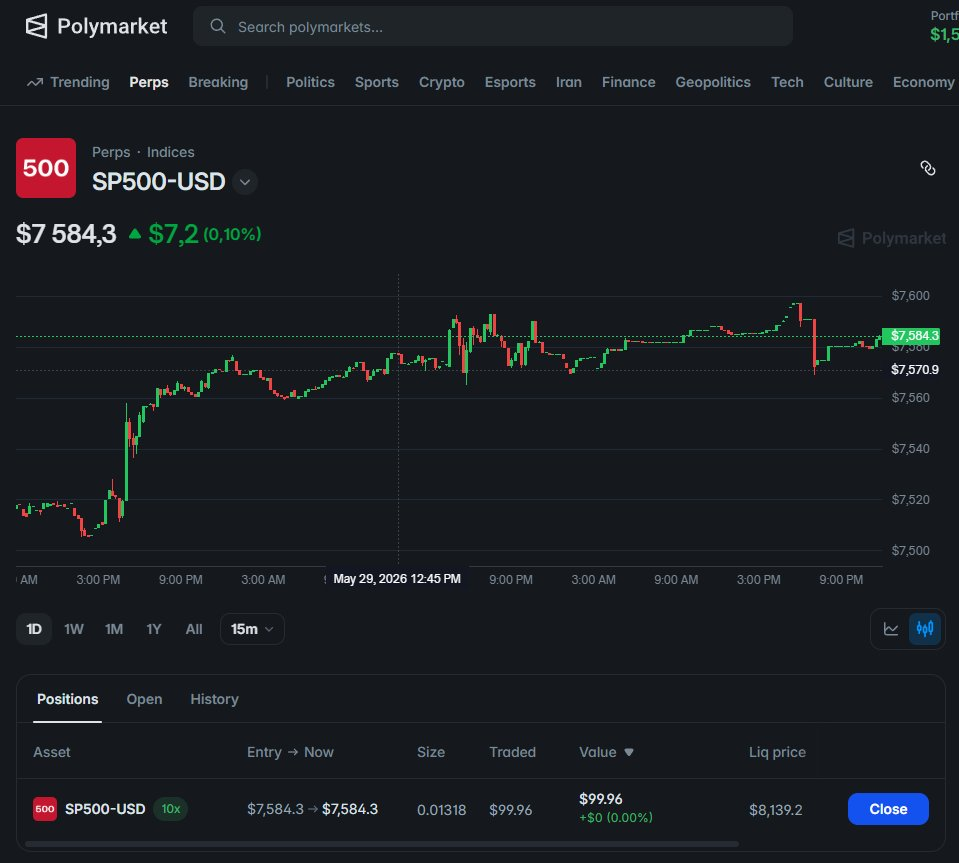
Polymarket Perps Beta: Early Testing and Friction Points
Polymarket’s Vice President of DeFi Engineering, Josh Stevens, announced on X that the Polymarket Perps Beta had been made available to a subset of users, with access set to expand gradually over the next four weeks. He noted that some applicants had already been added via direct message and that a few additional spots might be released, but for now, no new testers are being added.

The platform has yet to disclose the complete set of trading pairs, leverage limits, margin rules, or funding rate mechanisms for Perps. This suggests the primary goal of the beta is not to generate immediate volume but to verify system stability. Early testers have reported opening BTC leveraged long positions in the interface, and screenshots indicate availability of various crypto assets and indices, though the final list remains subject to official confirmation.
Community feedback has centered on access and KYC requirements. Since the beta is limited, early applicants had to reach out via X private messages to secure a spot, and some users were also required to complete identity verification. Whispers about potential changes in the official launch have done little to soothe frustration over the gatekeeping and speculation about whether participation might affect future airdrops or loyalty points.

More fundamental concerns revolve around liquidity. The true test of a perpetuals exchange lies in order-book depth, slippage control, and execution stability during volatile market conditions. As one community member put it bluntly, “Perp liquidity is the real test.” Beyond liquidity, user behavior presents another hurdle. Polymarket’s core audience is accustomed to buying Yes or No on binary event contracts and waiting for settlement, not managing leveraged positions with liquidation risks, funding rates, and ongoing margin adjustments. While professional traders are familiar with these mechanics, a large portion of prediction market users will face a steep learning curve and significantly higher downside risk.
Technical stability also remains a concern. Polymarket has previously drawn criticism for latency issues, delayed orders, and ghost fills. If similar problems emerge in the context of leveraged perpetuals, the consequences could be far more damaging than in standard prediction markets. As a result, the current beta phase is very much a shakedown period, with access control, liquidity, leverage risk, and trade execution reliability all needing to be resolved before any full-scale launch.

Kalshi’s BTCPERP Approval: Regulatory First Mover Advantage
While Polymarket is still fine-tuning its product in a closed beta, Kalshi secured a milestone at the regulatory level. On May 29, the CFTC completed its review under Section 5c(c)(4) of the Commodity Exchange Act and Regulation 40.3, and officially approved the listing of Bitcoin perpetual contracts (BTCPERP) on Kalshi. The contract is cash-settled based on the spot price of bitcoin and will trade as a futures product on Kalshi’s designated contract market (DCM).
The approval’s broader significance lies in the fact that it brings a product category long dominated by offshore and crypto-native platforms into the framework of a U.S. regulated exchange. Perpetual futures are among the highest-volume instruments in the crypto market, yet compliant U.S. markets have lacked a comparable offering. Kalshi’s BTCPERP opening represents the first step toward filling that gap with a regulated alternative.

This move follows Kalshi’s established playbook: secure regulatory permission first, then expand the product suite from a position of compliance. In the past, Kalshi used its DCM license to reframe event contracts—covering politics, economics, weather, and sports—as regulated financial products. Now it is applying the same template to crypto perpetuals. In doing so, Kalshi is steadily evolving from a prediction market into a broader regulated derivatives exchange.
A regulatory green light, however, comes with defined boundaries. The CFTC explicitly noted that perpetual contracts are not appropriate for all asset classes, and any additional products must still be submitted for review under Regulation 40.3. This means Kalshi can build competitive differentiation around regulatory certainty, but it is unlikely to match the speed with which offshore exchanges roll out dozens of new trading pairs. Its expansion path will be slower and more closely tied to the regulatory calendar.

Different Paths, Same Destination: Toward the Exchange Business
The simultaneous moves by Polymarket and Kalshi into perpetuals are not merely about adding a feature to prediction markets; they represent a fundamental push of the business boundary toward full-fledged exchange territory. Prediction markets already generate meaningful volume from elections, sports, macro data, crypto prices, and breaking news, but perpetuals unlock an additional layer of revenue: a more standardized product that fits the capital and trading habits of professional market participants. The strategic logic is not that event trading is unprofitable, but that offering perpetuals on top creates a second, more mature line of contract-based business.
Yet entering perpetuals means the competitive set changes entirely. Polymarket and Kalshi are no longer just up against other prediction markets; they are now competing with established crypto trading platforms like Hyperliquid, Binance, OKX, and Bybit. Users will compare liquidity, slippage, matching engine stability, leverage features, and risk controls directly. Brand recognition and traffic from prediction markets will not automatically translate into competitiveness in leveraged derivatives.

The real test, therefore, is not whether these platforms can list more trading pairs, but whether they can convert event-driven visitors into perpetual traders who regularly manage positions and trade volatility. Only when users open the platform not just for a major event but for ongoing exposure to market moves will prediction market platforms truly have set foot inside the exchange business.