



Pons has emerged as the clear leader among token launch platforms on Robinhood Chain, overtaking rivals in both issuance and trading activity within roughly two weeks.
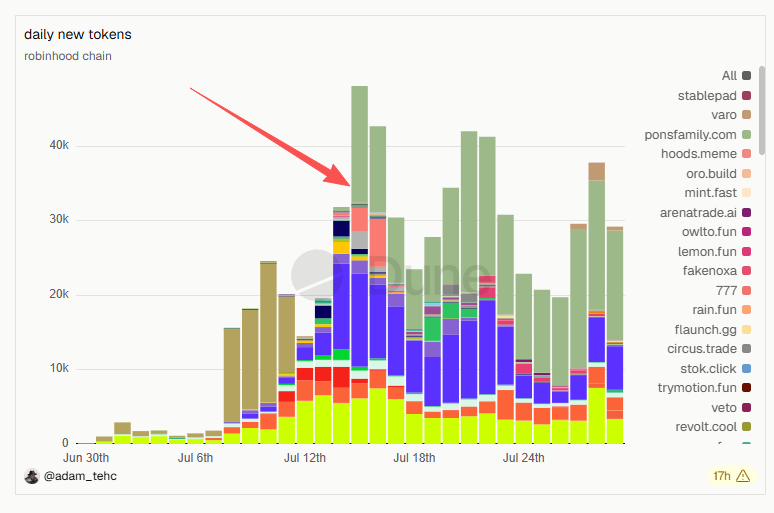
According to Dune data cited by Odaily, Pons issued more than 15,000 tokens on July 15, the first time it ranked No. 1 among token launch platforms on Robinhood Chain. It has kept the top spot in daily token creation since then and has widened the gap with platforms such as Flap.
When NOXA stopped issuing new tokens, Flap was the first platform to absorb that traffic. On July 14, Flap created more than 11,000 tokens in a single day, accounting for more than 35% of all token launches on the chain that day. Bankr, Klik and trench.today also captured part of the flow. Two weeks later, the market structure looked very different.
Pons moved ahead in both launches and trading
The shift was not limited to token creation. Trading volume for tokens launched on Pons also accelerated in mid-July. On July 18, daily trading volume on the platform reached $40.7 million, topping NOXA’s $37.4 million for the first time. Pons has remained in first place since then. Its cumulative trading volume has now passed $1.5 billion.
On July 26, Pons accounted for 77.1% of the total trading volume across token launch platforms on Robinhood Chain, while second-place NOXA held just 6.6%. At that point, Pons was no longer simply the platform issuing the most tokens. It had also become the venue handling the large majority of trading volume in that segment.
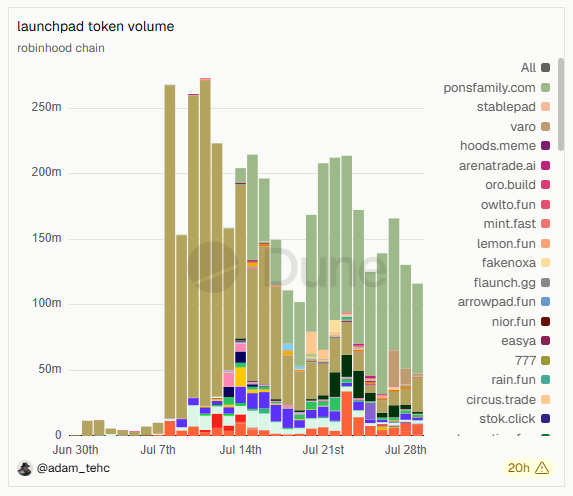
That marks a clear handoff in platform leadership, from Flap initially picking up demand after NOXA’s exit to Pons eventually moving in front on both issuance and trading.
A launch flow compressed into one transaction
Pons is a token issuance and trading platform built specifically around Robinhood Chain. It is operated by Pons Labs and is not an official Robinhood product. Users can create and trade tokens inside the platform, and every action is signed by the user’s own wallet. Pons does not custody user assets.
Each new token on Pons currently has a fixed total supply of 1 billion. Creation costs 0.0005 ETH, and the platform charges a 1% trading fee. A creator only needs to enter the token name, ticker, image and social links to launch.
Unlike the bonding-curve model commonly used by Pump.fun and Four.meme, the current version of Pons deploys the token contract and a Uniswap V3 trading pool in the same transaction, with liquidity locked immediately. Once live, the token trades directly against WETH. There is no need to wait for a bonding curve to sell out, and there is no later migration step to an external DEX.
When the WETH paired in the pool reaches the default threshold of 4.2 ETH, the token is marked as “graduated,” but the original pool does not change and trading continues in that same pool. Pons also places a protection window over the first two blocks after launch, limiting per-wallet purchase size and position share to reduce the risk of a small number of addresses sweeping supply at the open.
The mechanism itself is not especially complex. Its appeal comes from keeping the process short. Creators do not need to prepare initial liquidity, and they do not have to manage any post-bonding-curve migration. Traders can discover, buy and sell tokens in the same place. In Robinhood Chain’s early stage, many projects and traders were looking for exactly that mix of low cost, fast issuance and immediate trading. By compressing the path from token creation to open trading into a single on-chain transaction, Pons gave itself a base for attracting issuers, bots and short-term capital quickly.
PONS became a focal point for the platform’s narrative
Pons’ widening lead was tied not only to product mechanics and usage growth, but also to a sharp rise in its platform token, PONS.
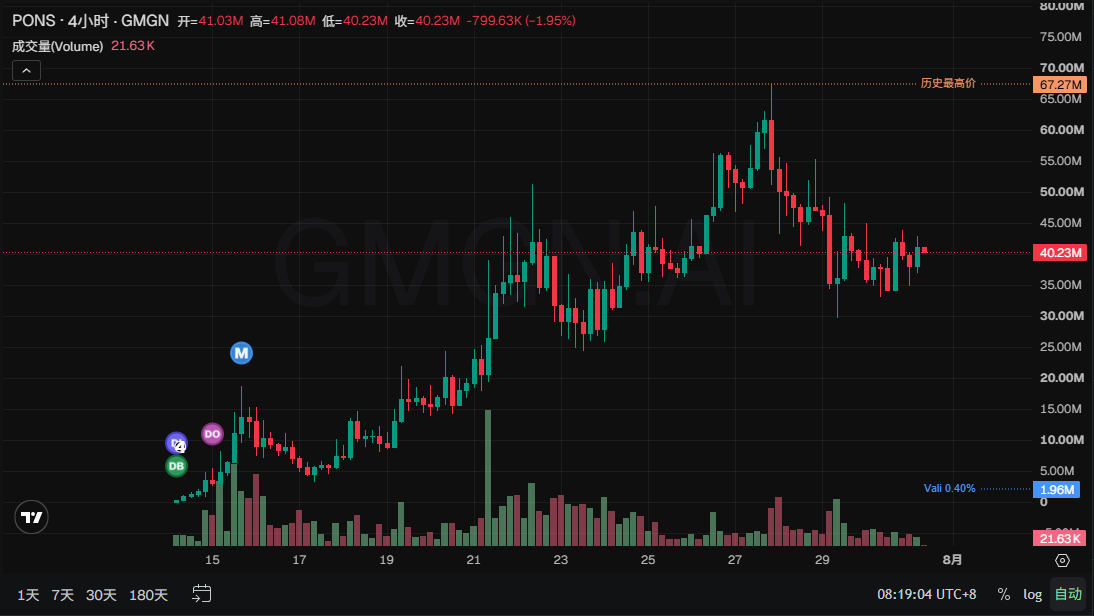
GMGN data shows PONS had a market capitalization of less than $5 million on July 16. It then climbed quickly and at one point exceeded $67 million, a gain of more than 15x for the period. The token later pulled back, and its market capitalization now stands at about $40 million.
For tokens issued through the newer Pons contract, trading fees are split between the creator and the protocol at 70% and 30%. Under the older contract, the split was 90% and 10%. Of the protocol share, 80% is used to buy back and burn PONS in the market, while the remaining 20% goes to infrastructure and team operations. On July 28, the project said 22% of PONS total supply had already been burned.
Compared with the tens of thousands of new tokens issued each day, PONS is easier for the market to recognize and trade as a single expression of the Pons narrative. As the token rose, more capital began paying attention to the launch platform behind it and moved into Pons in search of new projects. Rising platform volume then generated more fees and more buyback funding, adding another layer of support to PONS. In that setup, PONS functions not only as the platform token but also as an entry point for attracting new users and fresh capital.
V2 points beyond Meme tokens toward RWA
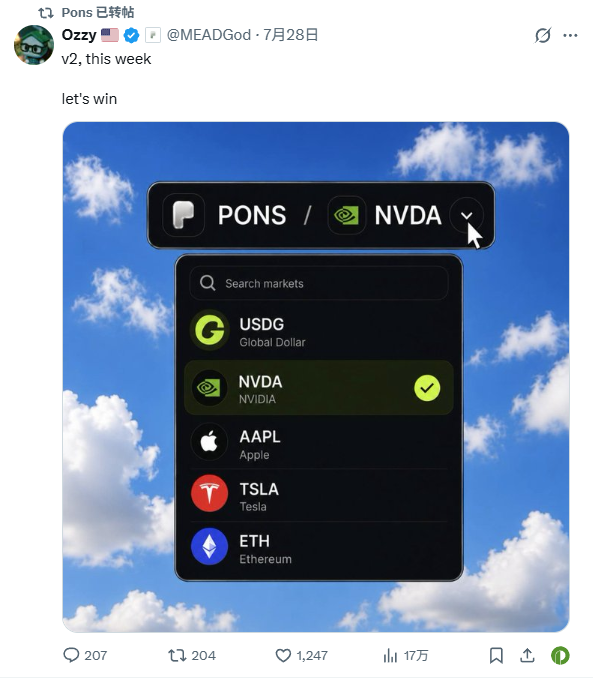
Odaily said Robinhood Chain’s distinguishing features compared with other public blockchains lie in stock tokens and on-chain finance. Pons’ planned V2 is starting to extend in that direction as well. Based on the project’s disclosure, the platform will support paying trading fees to token creators and CTO operators using ETH, USDG or RWA assets.
Pons initially built up users and trading volume through Meme tokens launched on the platform. V2 is an attempt to connect that issuance model with stablecoins and RWA assets on Robinhood Chain. If that plan moves ahead as described, Pons’ role would shift from a pure token launch venue to a broader platform tied to more asset types and revenue settlement scenarios.