
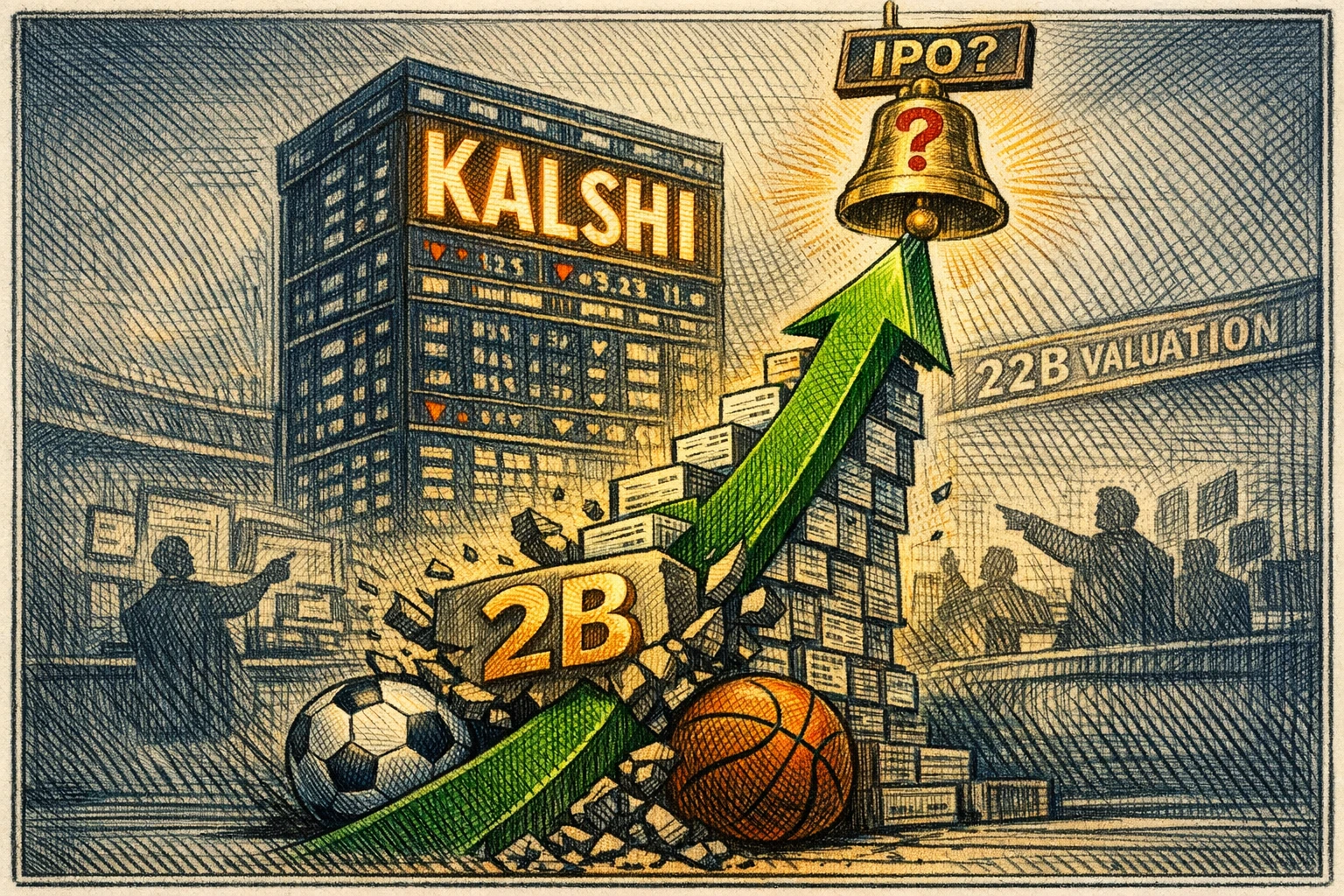
Tech outlet The Information reported that regulated prediction market leader Kalshi has hit $2 billion in annualized revenue, roughly triple its level from November last year. The surge is driven by traders piling into bets on NBA games and the 2026 World Cup. The report also noted that Kalshi has held early, informal discussions regarding an initial public offering (IPO), though the company stresses it has ample private funding and is not rushing to list.
Valuation Doubles in Six Months, Institutional Volume Up 800%
Kalshi's growth trajectory was evident in its latest fundraising round. On May 7, the firm announced a $1 billion Series F round at a $22 billion valuation, led by hedge fund Coatue, with participation from Sequoia, Andreessen Horowitz, IVP, Paradigm, Morgan Stanley, and ARK Invest. That valuation was double the $11 billion it commanded during its Series E round five months earlier. Over the same period, annualized trading volume jumped from $52 billion to $178 billion — a more than threefold increase — while institutional trading activity surged 800%.
“Few sectors have grown this fast in recent years, except AI. Event contracts have the potential to become a trillion-dollar market, and we are still in the early stages of this transformation,” Kalshi CEO Tarek Mansour said during the May fundraise.
World Cup Betting Fuels Battle With Polymarket
A large chunk of Kalshi's $2 billion revenue milestone comes from sports. The 2026 World Cup sent betting volume through prediction markets, intensifying competition with its biggest rival Polymarket. Combined trading volume on the two platforms for World Cup champion predictions exceeded $2 billion, with Spain leading at 17% implied odds. In app downloads from June 1-15, Kalshi captured 42.3% of new installs and Polymarket 31.2% — together over 70%, triple the figures for DraftKings and FanDuel. According to Binance Research, the total prediction market trading volume hit a record $31.2 billion in May, with Kalshi commanding a 58% share and Polymarket 28%.
The two platforms take different approaches. Kalshi leverages its CFTC-regulated status to target the compliant U.S. market, while Polymarket operates on-chain. This summer's World Cup has turned into a direct test of both models.
IPO Rumors Tempered, Regulatory Friction Grows
Kalshi's rapid growth has naturally sparked IPO speculation, positioning it as one of the most talked-about potential public listings in finance. Yet the company has consistently played down the timeline, stating it has sufficient capital and no set listing schedule. No S-1 filing, ticker symbol, or pricing range has appeared.
On the regulatory front, speed has brought friction. The CME recently threatened to sue after the CFTC allowed Kalshi to launch bitcoin perpetual contracts. Meanwhile, Kalshi and Polymarket jointly challenged Kentucky's 14.25% prediction market tax, calling it unconstitutional.