
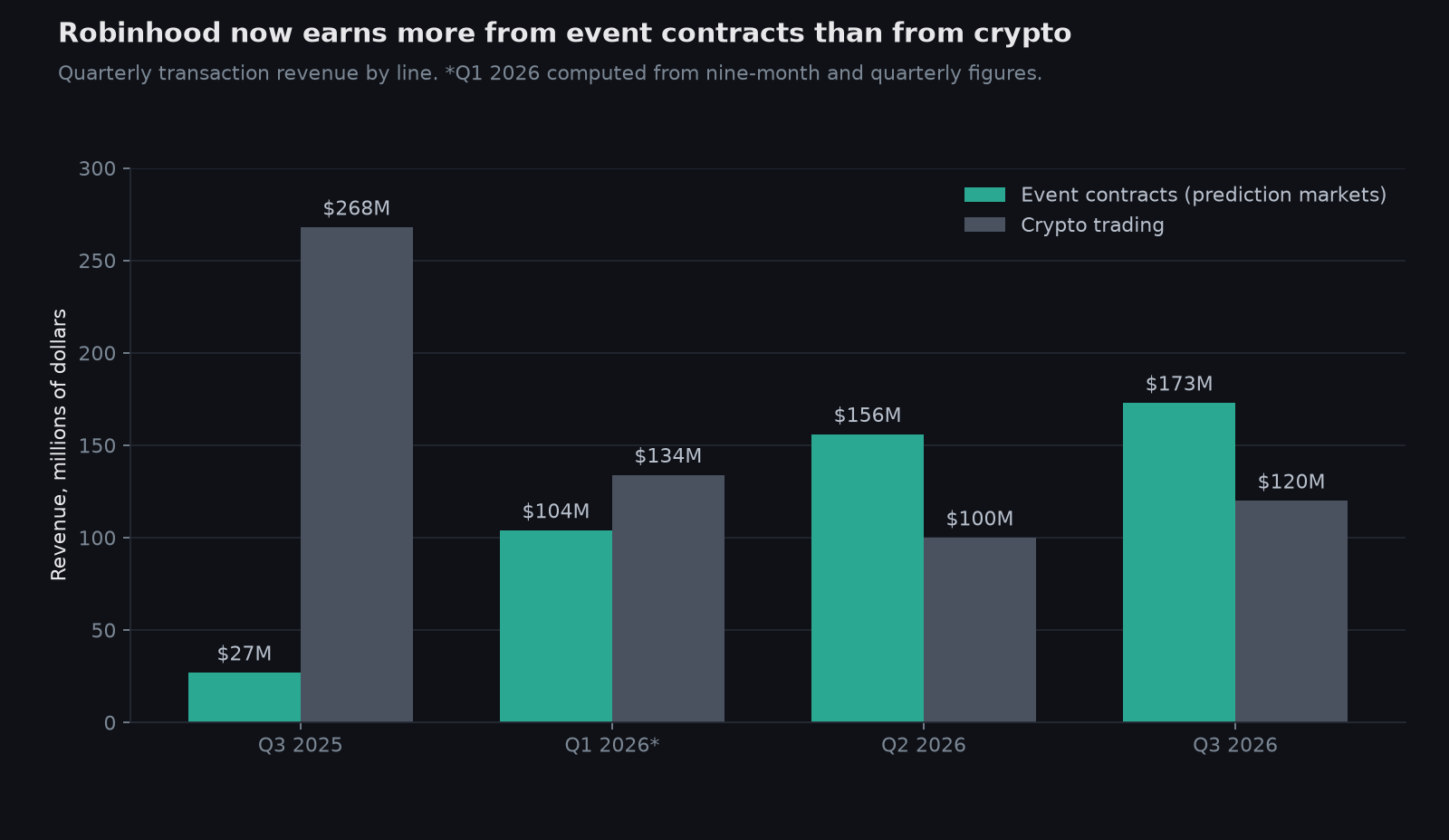
Sports wagering has powered the recent expansion of prediction markets, but the same product is now at the center of a growing regulatory fight across the United States. Robinhood reported $173 million in revenue from event contracts in the latest quarter, compared with $120 million from crypto. The company said most of that growth came from sports wagers.
Event contracts allow customers to bet on the outcome of a game, an election or another event. Exchanges such as Kalshi list the contracts as derivatives under federal commodities law and argue that the classification places them outside state gambling laws. State regulators and attorneys general disagree. A growing number of states are shutting off sports contracts, calling them unlicensed sports betting.
Two of the three federal appeals courts that have considered the question have sided with the states. Robinhood has agreed to stop offering new sports contracts in Michigan and Ohio, as it did in Nevada last year. Coinbase will stop offering the contracts in Ohio on Nov. 13. On Monday, Robinhood sued Missouri after the state threatened to go to court within days.
Washington, D.C., is moving in the other direction. On Nov. 5, the Commodity Futures Trading Commission, the federal regulator overseeing these markets, told exchanges that they may not block customers by state. The interpretation takes effect Tuesday. The companies are now caught between a federal regulator that wants them to serve customers in every state and courts that have ordered them out of some states.
For investors, the question is how much of the business depends on federal law prevailing. The issue comes after sweeping midterm elections that returned Democrats to power in several states. The dates under watch include the CFTC's December deadline and a possible Supreme Court decision in January on whether to take up the dispute.
Robinhood's event-contract revenue grew sixfold in a year
Event contracts moved from a side product to one of Robinhood's main revenue lines in a single year. Company filings show that the business generated $27 million a year earlier and $173 million in the third quarter of 2026, equal to about 12% of total net revenue. Crypto trading revenue fell to $120 million from $268 million in the same quarter.
Coinbase sells Kalshi's contracts to its customers and says the business has passed $200 million in annualized revenue. Coinbase uses that run-rate in place of a quarterly figure. Based on Coinbase's third-quarter pace, event contracts account for about 4% of its revenue. The company's mix also depends less on sports. Chief Financial Officer Alesia Haas said on an earnings call that more than 50% of contracts traded were non-sports contracts.
Kalshi is privately held. It was valued at $40 billion in a $1 billion funding round that closed on Oct. 29. An analysis of Kalshi's trading data put its October volume at a record $98.2 billion.
Polymarket, Kalshi's main rival, entered U.S. sports later. Its federally regulated U.S. app began opening to a waitlist in December 2025, nearly a year after Kalshi's first sports listings went live. It has since become part of the same state-level disputes. Wisconsin sued Polymarket in April, Kentucky sued in June and New York sued in September. Polymarket is suing Ohio rather than stop offering sports contracts there.
A chart comparing Robinhood's quarterly revenue from event contracts with crypto trading revenue uses the company's filings with the U.S. Securities and Exchange Commission. First-quarter 2026 revenue was computed from the company's nine-month and quarterly figures. The chart does not show the fourth quarter of 2025.

Two of three appeals courts have sided with the states
The federal appeals courts have mostly sided with the states. In April, the Third Circuit found that Kalshi had a reasonable chance of winning its argument that federal commodities law overrides New Jersey's gambling law. The Ninth Circuit reached the opposite result for Nevada in August.
In September, the Sixth Circuit held that federal law neither expressly nor impliedly preempts Ohio's or Tennessee's gambling laws. On Nov. 3, the Second Circuit refused to pause New York's and Connecticut's actions against Kalshi and Coinbase while the appeals continued.
States have used those rulings to pressure the companies to leave their markets. A Michigan court ordered Kalshi to block residents from trading sports contracts, with fines of up to $500,000 a day. Robinhood, Coinbase and Polymarket each agreed to halt sports contracts in the state.
Ohio's casino regulator sent cease-and-desist letters to 10 operators in October. A federal judge in California barred Kalshi from offering sports contracts on two tribal lands. Arkansas sued Kalshi on Nov. 4. Attorney General Tim Griffin said Arkansas law is concerned with substance, not semantics.
Robinhood's agreements with the states trade a halt on new sports contracts for each state's promise not to enforce its gaming laws while the appeals proceed. The company has warned investors that it may stop offering certain new event contracts in more states.
The legal record includes federal appeals court rulings on sports event contracts offered by Kalshi, Robinhood, Coinbase and Crypto.com, along with petitions pending before the Supreme Court.
The next questions concern what the CFTC's interpretation actually requires of exchanges and brokers such as Robinhood, and how those requirements interact with court orders already in force. The dispute also raises questions about what Democrats in Congress can and cannot do to prediction markets and CFTC Chairman Mike Selig.
The Supreme Court could decide whether to take up the cases, with the earliest possible action in January. The timing matters to Robinhood and Coinbase because both companies now have material revenue tied to event contracts. Robinhood's event-contract line has surpassed its crypto-trading revenue, while Coinbase says its event-contract business has passed $200 million in annualized revenue. Neither company has disclosed a complete breakdown of sports-contract revenue.




