

For years, crypto’s idea of mainstream adoption was usually measured through familiar indicators: how many people held Bitcoin, how many addresses interacted with on-chain protocols, and how many users started using wallets, exchanges and DeFi.
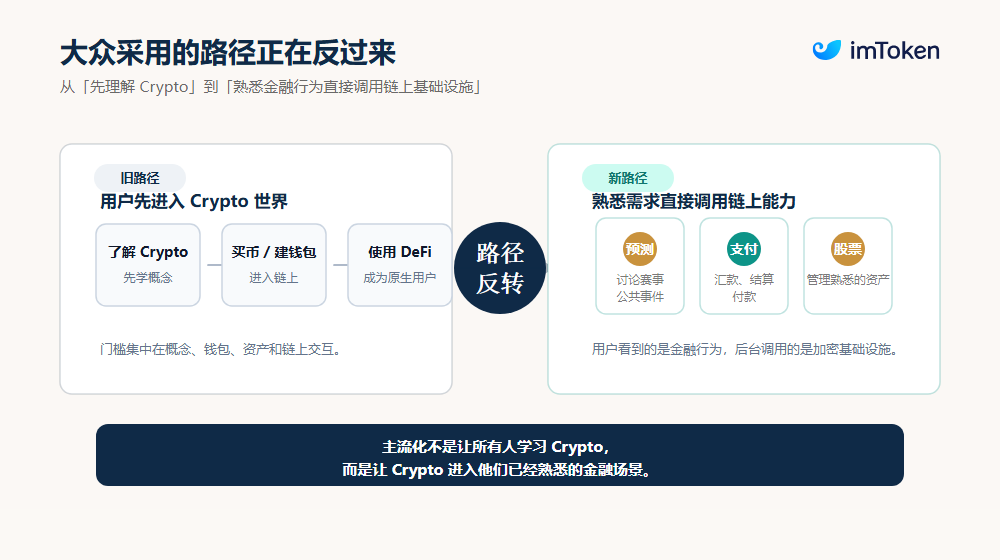
That framework assumed a fairly linear path. First, ordinary users would learn what crypto is. Then they would buy digital assets, create wallets and gradually move into the on-chain world.
Recent changes suggest that path may be reversing. Users do not necessarily need to understand blockchains before they come into contact with crypto infrastructure. Instead, existing needs such as prediction markets, cross-border transfers and stock trading are beginning to absorb crypto technology on their own. These are different sectors and they are not converging in the same way, but they point to the same shift: crypto is moving from a new financial system that users have to enter deliberately to infrastructure that traditional finance and mass-market applications can use directly.
Prediction markets are shifting from on-chain event trading to probability pricing
Prediction markets are not new. In the early days of Ethereum, Augur became the network’s first dApp and offered an early proof that any event with an objectively verifiable outcome could be turned into an on-chain contract. Real-money trading would then express the market’s judgment about the future.
For a long stretch, though, prediction markets were mostly reduced to the label of “on-chain gambling.” They never truly moved beyond the crypto-native crowd. Early users of platforms such as Polymarket were mostly people already familiar with wallets, stablecoins and on-chain trading. The barriers were clear: the tools themselves were not easy for mainstream users, and even when Polymarket briefly broke through on the back of events such as the U.S. presidential election, its core participants were still largely crypto-native traders.
The article argues that the 2026 FIFA World Cup in the United States, Canada and Mexico offers a more mainstream lens through which to view the category. Compared with monetary policy, economic data or political elections, football matches need very little explanation. Questions such as who advances from the group stage, which team reaches the semifinals, or whether a player can finish as top scorer are already part of everyday discussion among fans. Prediction markets simply convert those scattered opinions into prices that can move in real time.
That is why a regulatory shift alone is unlikely to be enough if prediction markets are to break into the mainstream. They also need a public event large enough and intuitive enough to draw broad participation. The World Cup fits that description.
The article ties this idea to a broader pattern in crypto. Past breakout moments often came when a technically demanding system was paired with a low-friction use case. NFTs broke out when on-chain assets were linked to profile pictures, art and community identity. Memecoins spread quickly because they compressed complicated financial behavior into simple emotion and cultural symbolism. By the same logic, the gateway for prediction markets may not be macro data or complex political contracts. It may be sports, entertainment and other topics people already want to talk about.
The World Cup stands out for three reasons. It has broad global consensus, because even non-experts understand basic outcomes such as winning, losing, qualifying and taking the title. It produces a high-frequency information flow, with lineups, player form, injuries, tactical changes and match progress constantly reshaping expectations. And it carries strong social dynamics: watching football naturally comes with group chats, reposts, debate, argument and emotional spillover.
At the same time, the competitive boundary around prediction markets is widening. The category is no longer defined only by vertical platforms such as Kalshi and Polymarket. It is increasingly being integrated into traditional brokerages, crypto exchanges and even media products.
The reason is straightforward. Traditional finance already has plenty of risk-pricing instruments, including options, futures and interest-rate swaps, but these products usually carry a steeper learning curve, and ordinary users often cannot read a market view directly from the price. Prediction markets compress complicated questions into a far more intuitive probability.
That may be the key to their place in mainstream financial infrastructure. What they offer is not just another way to bet. They offer a low-threshold, continuously updated tool for pricing expectations.
The path is still disputed. The article notes unresolved questions around how events should be defined and settled, whether insiders should be allowed to participate, whether contracts tied to financial events could amount to insider trading, and whether sports contracts should fall under federal derivatives oversight or state gambling rules. As the market has expanded, some Wall Street firms have already started restricting employee participation in prediction-market trading tied to economic data and corporate events.
Even so, the article says the process of gaining mainstream acceptance is also the process by which prediction markets move from an open experiment in event trading toward financial infrastructure.
Stablecoins are moving from crypto assets to payment and settlement rails
If prediction markets represent one route into the mainstream, stablecoins represent another. They are gradually disappearing behind more familiar payment products.
For most crypto users, stablecoins have long served as trading instruments. People use USDT or USDC to buy and sell other tokens, move funds between exchanges or place capital into DeFi protocols in search of yield. As a result, issuance size has long been treated as the main measure of stablecoin competitiveness.
The next phase may look different. The question may no longer be only who controls the largest on-chain supply, but who can move fastest on compliance and embed stablecoins into real-world payment, settlement and cross-border transfer scenarios.
One recent case highlighted in the article is Open USD, launched by Open Standard with participation from more than 140 payment, banking, technology and crypto companies.
Unlike the conventional model, in which reserve income is largely captured by a single issuer, Open USD allows partner companies to mint and redeem at no cost and plans to distribute reserve-generated revenue, after management fees, to partners that help drive its usage.
Descriptions from Visa and Stripe characterize OUSD as shared infrastructure for the global movement of money. What matters here, according to the article, is not simply that another dollar stablecoin has entered the market. The more important change is the attempt to alter the economic structure that has defined stablecoins for years. Historically, issuers have kept most of the returns generated by reserve assets, while wallets, exchanges, payment firms and fintech platforms have borne the cost of user acquisition, product integration and distribution.
If reserve income starts tilting more toward distribution channels and usage scenarios, the logic of competition around stablecoins changes as well. That helps explain why the entry of firms such as Stripe, Visa, Mastercard and Zelle may matter more than the addition of just one more on-chain dollar asset.
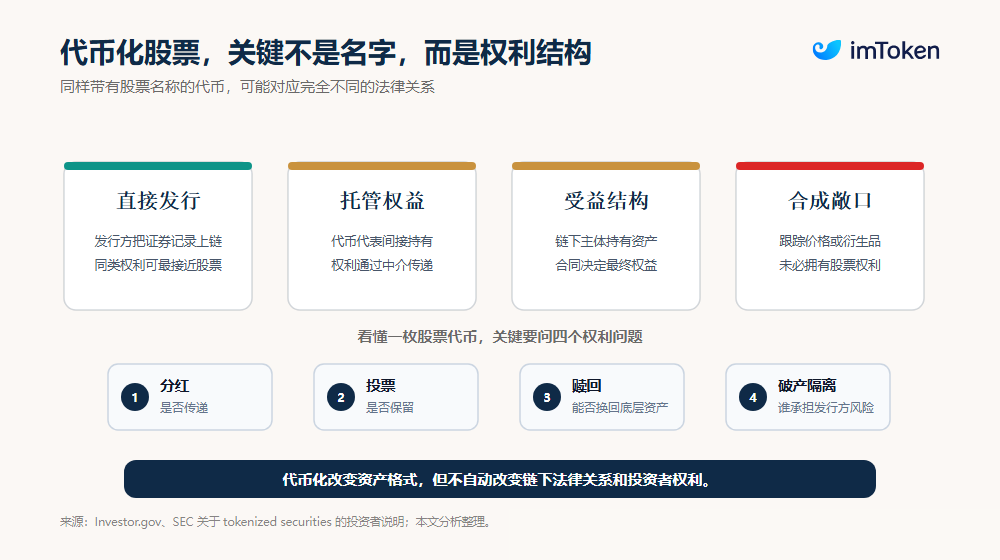
At a more basic level, stablecoins are shifting from crypto products that users must hold and manage themselves into money-movement components that traditional businesses can call directly. What users see may be cross-border remittances, merchant settlement, business payments, payroll or a payment card. What runs in the background may be stablecoins and public-chain settlement networks. End users may already be using the settlement capacity of stablecoins without realizing they are there.
At the same time, stablecoin products that lack meaningful distribution channels and real use cases are starting to leave the market. The article uses that point to argue that issuance alone does not automatically create value.
As the underlying technology becomes more standardized, the real barriers may increasingly come from licensing, regulatory fit and the ability to plug into a business scenario that keeps generating transaction demand.
That also means stablecoins may ultimately find themselves competing not only with other stablecoins, but with card networks, cross-border remittance systems, bank deposits and corporate treasury infrastructure.
Tokenized stocks bring traditional assets into on-chain accounts
Compared with prediction markets and stablecoins, tokenized stocks present a more direct form of convergence. This is not about introducing a crypto-native product to traditional users. It is about moving stocks, ETFs, funds and other conventional assets into accounts that were previously used mainly to store and trade crypto assets.
Over roughly the past half year, nearly all major crypto trading platforms have been accelerating their push into the space, according to the article. At the same time, Intercontinental Exchange, the parent company of the New York Stock Exchange, has made a strategic investment in OKX. The two sides plan to work around regulated U.S. crypto futures, ICE market products and tokenized stocks tied to the NYSE. As of publication, OKX had just announced plans to launch tokenized U.S. stock products.
From a market-structure perspective, the symbolism is strong. In the past, crypto exchanges usually tried to give users stock exposure through synthetic assets, perpetual contracts or third-party issuers. Now, the operator behind a traditional exchange is directly participating in product design, pricing data, compliance and on-chain market infrastructure.
The same shift is also appearing at the user-entry level. Beyond specialist applications, players across trading platforms, wallets and on-chain DEXs are trying to expand into unified financial accounts that can hold and trade crypto, stocks and even commodities. The article names Robinhood and Interactive Brokers as examples of this broader move.
Tokenized stocks, however, are also where conceptual confusion can emerge most easily. A token carrying the name of Apple, NVIDIA or Tesla does not automatically mean the holder directly owns the common stock of that company. Depending on the product, the token may represent direct ownership of real shares, beneficial interests created through an SPV that holds the shares, a debt instrument backed by an issuer promise, or simply a derivative that tracks the stock price.
Those structures can differ sharply on dividends, voting rights, redemption rights, bankruptcy remoteness and investor protection. Even if a token moves on a public blockchain, the legal relationship that determines the holder’s ultimate rights often still sits off-chain, within the issuing entity, the custodian and the legal contracts. The article notes that most current RWA systems use hybrid architectures.
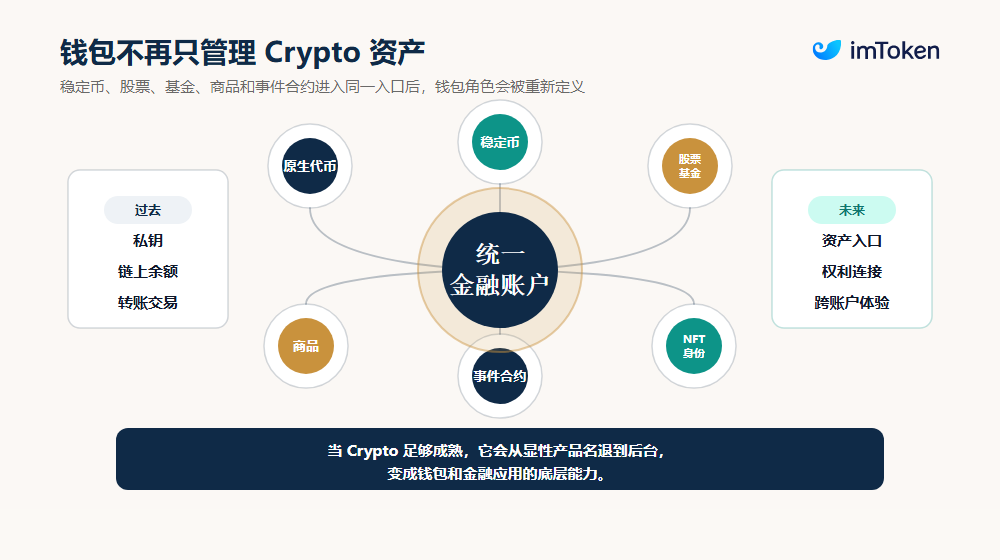
As a result, tokenization does not automatically create liquidity, nor does it automatically grant users the same rights as conventional shareholders. Even so, the article says those limits do not prevent tokenized stocks from becoming an important entry point.
If compliance, custody and shareholder-right issues are addressed over time, stocks will no longer need to exist only inside brokerage accounts. They could sit in the same on-chain account as stablecoins, be split into smaller units, trade across regions and time zones, and eventually be used in collateralization, lending, automated investing and programmatic asset allocation.
At that point, wallets and trading platforms would no longer be competing only on crypto custody and trading. They would be competing to become the single interface through which users manage global assets.
Crypto may become mainstream by fading into the background
In its closing section, the article compares this process to a scene in The Heaven Sword and Dragon Saber, where Zhang Sanfeng repeatedly asks Zhang Wuji how much of tai chi he still remembers, until Zhang replies that he has forgotten it all, at which point he has finally grasped its essence.
The parallel is clear. Crypto may reach maturity not when everyone remembers the terms blockchain, wallet and stablecoin, but when users stop noticing the technology altogether and it disappears behind the product experience.
The article breaks the current shift into three distinct paths. Prediction markets carry a crypto-born product logic into the mass market by turning events and uncertainty into tradable probabilities. Stablecoins embed on-chain settlement into payments, remittances and business fund flows so users can access a new money network without understanding blockchains. Tokenized stocks bring traditional assets into on-chain accounts and gradually turn wallets, exchanges and public chains into new issuance, trading and settlement channels for securities.
These correspond to three layers of penetration: products, money and assets. For the industry, that may define a new path to mass adoption. Instead of asking every user to become a crypto user first, on-chain technology adapts itself to financial needs people already understand.
The role of the wallet would change with that transition. Once a wallet contains not only native tokens and NFTs, but also stablecoins, stocks, funds, commodities and event contracts, it no longer handles just private keys and on-chain balances. It also has to lower the usability barrier for different asset types and connect on-chain and off-chain account systems more effectively.
The article gives imToken as an example. If someone can use imToken to send instant remittances to relatives overseas, trade the probability of an event there, or buy a small fraction of a U.S. stock, that person may not think of the activity as “using crypto” at all.
And it may be precisely in that state, when the technology no longer needs constant emphasis, that crypto can move from a relatively separate niche market into the broader worlds of finance and commerce.