
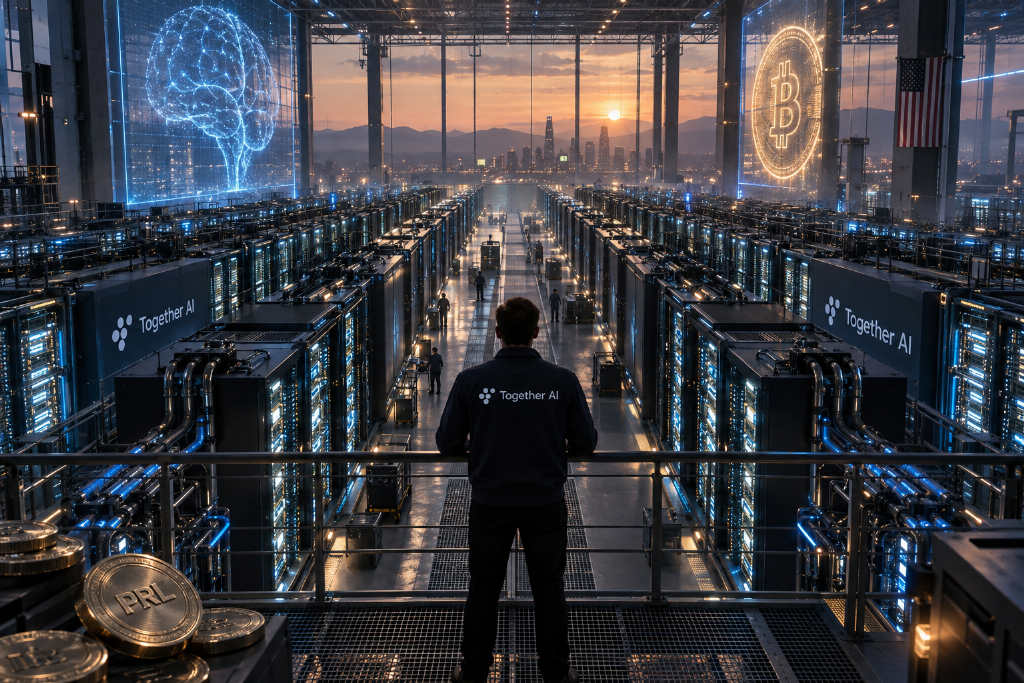
PRL has become one of the standout tokens in the AI crypto segment. According to CoinGecko data cited in the source material, Pearl Research’s token was trading at about $1.95 as of Oct. 14, up roughly 64% over seven days and nearly 261% over the past 30 days, with a circulating market capitalization of about $650 million. What the market is pricing in is not just momentum. It is Pearl’s attempt to make GPUs mine a blockchain while running AI workloads at the same time.
That mechanism is called Proof of Useful Work, or PoUW. Pearl’s premise is that the same GPU hardware can perform matrix multiplication tied to AI workloads and, at the same time, produce verifiable work for a Layer 1 blockchain. In theory, that opens the door to two revenue streams from one machine: AI compute income and PRL block rewards. Pearl has framed that ambition as becoming “Bitcoin for the AI era.”
PRL’s rally has put AI compute mining at the center of the trade
The token’s move over the past month does not appear to be explained by one isolated event. The source points instead to a cluster of technical and market developments that pushed investors to revisit Pearl’s positioning.
Since September, Pearl has rolled out its Pearl Inference service and advanced floating-point compute upgrades. The project plans to use formats such as FP8 to support a broader range of AI models and high-performance GPUs, with the goal of bringing PoUW closer to real-world inference demand. Pearl has also moved into verifiable AI inference, aiming to provide proofs tied to AI computation itself.
On Oct. 7, Pearl held its first Pearl Connect event during TOKEN2049, with support from No Limit Holdings. Combined with its earlier low-cost inference service launched with Together AI, those developments increased Pearl’s visibility among crypto investors and reinforced the view that the project may be trying to move beyond GPU mining into AI compute infrastructure.
Even so, the technical roadmap is still in progress and the business side remains only partially proven. Token structure has likely magnified the move as well. About 344 million PRL are circulating today, equal to just 16.4% of the token’s 2.1 billion maximum supply. With a relatively tight float, concentrated buying can drive sharp price appreciation. The same setup also means future mining emissions could weigh on the market as more tokens enter circulation. At current levels, the source says PRL’s fully diluted valuation is approaching $4 billion, setting a high bar for execution.
How Pearl tries to turn AI workloads into mineable blockchain work
To understand Pearl, it helps to start with Bitcoin mining. Bitcoin miners deploy large amounts of hardware to run hash computations, compete for block production and collect rewards. That proof-of-work model secures the network, but the output of the computation is usually not useful for other commercial purposes. A great deal of electricity is consumed, and the end product is network security.
Pearl is trying to change that equation. It is a Layer 1 blockchain built around PoUW, replacing conventional hashing with matrix multiplication. Matrix multiplication is one of the core operations behind AI training and inference. Large language models generating answers and image models producing visuals both rely on GPUs to process similar calculations at scale. Pearl’s design is meant to let a GPU perform those operations while generating a proof that the blockchain can verify.
For GPU operators, that changes the economics. Hardware that previously earned money only by selling AI compute cycles could add a second source of income in PRL. If that extra reward exceeds the added cost, operators could widen margins or pass savings on to customers through lower AI pricing.
The project is being developed by Pearl Research Labs. The source names Omri Weinstein and Ilan Komargodski as part of the core team, describing them as having backgrounds in algorithms, cryptography and computer science research. Pearl’s choice to work at the consensus layer is central to its pitch: it is not merely renting out GPU capacity, but trying to make blockchain incentives and AI workloads compatible in one system.
Another project with a related thesis is FLOP Network. Both aim to connect GPU compute with blockchain rewards and create extra economic value from AI computation, but they do it differently. Pearl uses PoUW and brings matrix multiplication into the mining layer itself. That means miners may still be able to earn PRL for completing required computations even when no real customer is paying for those tasks. FLOP, by contrast, uses Proof of Useful Inference, or PoUI, and allocates compute around real inference requests from AI agents. Miners complete the work, submit verification proofs, then receive FLOP payments and block rewards.
Pearl is more focused on making AI-compatible computation secure a blockchain. FLOP is more directly trying to bind real inference demand to token payments and miner compensation. In practical terms, Pearl needs to prove that mining power can keep serving real AI business. FLOP needs to prove that paid demand from AI agents, inference verification and the compute marketplace can function in production. The source also notes that FLOP’s disclosures remain mainly at the white paper and development stage, which limits direct comparison with Pearl’s live network and commercial partnership footprint.
Together AI offers Pearl an early commercial case
Any new mining mechanism eventually has to answer a simple question: will anyone pay for the underlying service? Pearl’s partnership with AI cloud provider Together AI is presented in the source as an early attempt at commercialization.
In May 2026, according to the provided material, Together AI launched a Gemma model service that incorporated Pearl’s mining mechanism. When users called the AI model, the backend GPUs processed inference requests while also participating in Pearl mining and potentially earning PRL block rewards. Together AI said expected mining income allowed it to offer more than 25% discounts on the relevant model API pricing.
The business logic is clear. A traditional AI cloud platform has to cover GPU purchases, power and operating costs through user fees. After integrating Pearl, the same hardware stack may add token income on top. As long as mining rewards exceed the extra operating burden, the provider can either lower prices to win customers or keep more profit.
There is an important limit here. The source explicitly says the more-than-25% discount came from subsidizing compute with token rewards. It does not mean the underlying compute cost itself fell by 25%. The price advantage is linked, at least in part, to PRL incentives.
Pearl’s hoped-for loop is straightforward. Lower inference prices attract more users. More real demand draws in more GPUs. A bigger compute base can strengthen blockchain security. If ecosystem growth also increases demand for PRL, miners may earn more, which could attract even more hardware.
Whether that loop holds up depends on the scale of real business and the durability of mining rewards. If PRL rises, providers may have more room to subsidize prices. If the token falls or mining difficulty climbs, rewards per unit of compute may shrink and the pricing edge could narrow. The Together AI tie-up shows that Pearl has found a path to embed mining rewards into an actual AI service. It does not yet prove a mature, durable commercial flywheel.
The core dispute: are these calculations really tied to paying AI demand?
The strongest part of Pearl’s pitch is also where the sharpest criticism lands. A miner completing matrix multiplications that look like AI workloads does not automatically mean the computation came from a real customer request. It also does not mean anyone paid for it.
If GPU cycles are being spent on actual model inference requests, the work may generate service revenue. If miners are generating tasks themselves only to earn PRL, the network is still mining for mining’s sake, even if the math resembles AI computation.
The source cites an independent paper on Pearl’s cuPOW protocol that raised exactly this issue. The researchers found that miners could generate random matrices and submit valid proofs of work without running a full AI model. Some mining software reportedly did not even include AI inference code, yet could still mine and receive rewards. That suggests Pearl is currently verifying whether the required computation was completed, not whether the computation was actually used by a paying customer.
That does not mean Pearl’s technical direction lacks value. For a proof-of-work chain, any computation that satisfies security requirements and can be verified efficiently can help secure the network. Pearl’s contribution is that it makes mining computation compatible with AI-style workloads, which creates a path for real inference jobs to plug into mining.
But there is a gap between making real business possible and saying the entire network is creating commercial value. If a large share of miners are generating synthetic matrix tasks to collect PRL, the economic model still looks closer to conventional mining. The chain issues tokens to incentivize miners, and miners may sell those rewards to pay for hardware and electricity. The dual-income model only becomes meaningfully different if more of the compute comes from paid requests by enterprises and developers.
That is why Pearl cannot be judged on token price, network hash rate or miner count alone. The more important measure is how much of the compute actually produces revenue. The source argues that the project needs to disclose more on the share of real inference work within all mining activity, as well as paid customer numbers, model call volume and service revenue. Without that data, it is difficult to tell whether network growth comes from AI demand or from miners chasing a token rally.
Even if real business expands, Pearl still has to compete with traditional cloud providers on inference speed, service stability and sustained pricing. If competitiveness fades once PRL-based subsidies are reduced, the business model comes under pressure. Pearl has shown a technical route to let AI computation participate in blockchain mining. It still has to show that those computations can keep serving real customers over time. Without steady paying demand, a large compute network may end up looking like a conventional mining operation with a different kind of workload.
Token supply is now central to the investment case
Pearl’s long-term business potential still has to pass through the token market. Even if real AI activity grows, investors need clarity on how PRL is issued, how much new supply is still ahead and whether business value can reach the token itself.
The source says PRL has a maximum supply of 2.1 billion and no typical team pre-mine or venture capital allocation. Tokens are issued mainly through mining over time. Unlike Bitcoin’s approximate four-year halving cycle, PRL uses a smoother declining issuance model, with block rewards gradually falling. Under the official design, about half of the total token supply will be released in roughly four years.
That lowers the risk of concentrated unlocks from insiders and institutions, but it does not remove sell pressure. Miners still have to pay for GPUs, electricity and operations, which can force ongoing token sales. Based on third-party platform estimates cited in the source, about 1 million PRL are being newly issued each day. At $1.8 per token, that equals roughly $1.8 million in new token value per day. New issuance is not the same as immediate market selling, but when demand is not strong enough, a steady flow of fresh supply can still cap price performance.
As of Oct. 14, PRL’s circulating supply stood at about 344 million, or 16.4% of the maximum, with a circulating market cap near $650 million and a fully diluted valuation approaching $4 billion. That gap between circulating and diluted value captures the difference between today’s float and the future maximum supply. A low circulating ratio can magnify gains in the short term. As more tokens reach the market, the current valuation has to absorb a much larger supply base.
No pre-mine does not automatically mean broad token distribution. The source notes that mining difficulty was lower during Pearl’s early mainnet phase, allowing some early miners to accumulate substantial PRL at lower cost. That makes early miner holdings, exchange inflows and mining pool concentration important variables for judging future sell pressure.
A deeper issue is value capture. Right now, PRL mainly functions as a block reward and network incentive token. It is not described in the source as a direct voucher for GPU usage time. Fees paid by AI customers for inference also do not automatically create PRL buy pressure. That means even if Pearl succeeds in serving more AI customers, the token still needs a clearer source of demand if it is to capture the economic value of ecosystem growth.
In that sense, a nearly $4 billion fully diluted valuation embeds two expectations at once. First, the market expects Pearl to scale real AI compute business. Second, it expects that business to support sustained demand for PRL over time. If business growth does not translate into token value while mining supply keeps increasing, the current valuation could face repricing.
Commercial promise is visible, but the valuation already demands proof
Pearl has shown technical differentiation and an initial commercial example through Together AI. At the same time, the source makes clear that market pricing is running ahead of fully verifiable business results. PRL’s sharp move reflects optimism around AI compute mining. A fully diluted value near $4 billion means the project now has less room for vague progress and more need for measurable execution.
Two tracks matter most from here. On the business side, the market needs to see whether the share of paid inference work, customer growth, model usage and service revenue can continue to rise. On the token side, investors will be watching new mining supply, changes in miner holdings and whether PRL can build a more explicit value-capture mechanism.
If real business growth can gradually reduce reliance on token subsidies and establish steadier token demand, Pearl’s long-term valuation may find stronger support. If not, PRL remains exposed to the same factors highlighted in the source: expectations pulled too far forward after a fast rally, ongoing miner selling and limited liquidity. Pearl has already shown it can command attention. The next test is whether revenue and token economics can catch up with that attention.