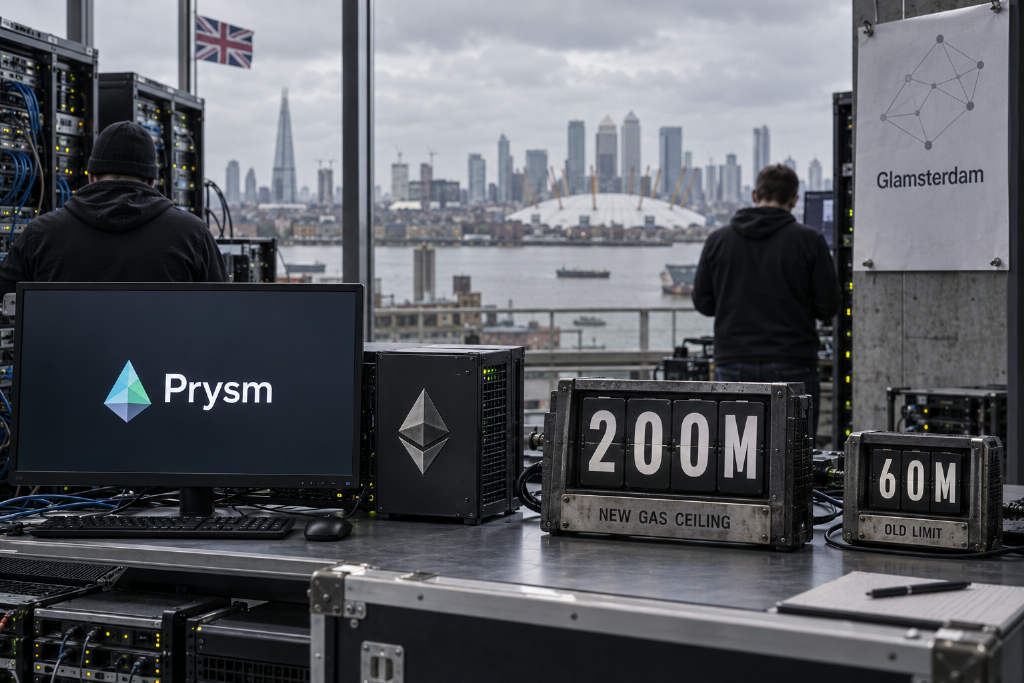
Ethereum developers released Prysm client version 7.2.1 on Monday night with a built-in 200 million gas limit setting, aiming to get the update deployed before Tuesday’s Glamsterdam upgrade test on the Sepolia testnet. Glamsterdam is Ethereum’s next major upgrade and will be activated on Sepolia first, where developers rehearse protocol changes using tokens with no real-world value. One key part of the test is raising Sepolia’s gas limit from roughly 60 million to 200 million. Gas measures how much computational work a single Ethereum block can include, so a higher limit allows the network to handle more transactions and more complex activity at the same time, while also increasing hardware demands for machines running Ethereum. Prysm is client software used by validators. Because the previous release was completed before the Sepolia configuration included this setting, validators running older versions would still produce blocks at a 60 million gas limit unless they manually changed the parameter, which could weaken the capacity test. Validators on the latest version will automatically begin proposing 200 million gas blocks when Glamsterdam activates on Sepolia at 13:53:36 UTC on Oct. 6. The 200 million setting applies only to Sepolia for now, and Glamsterdam has not been activated on Ethereum mainnet.
Ethereum developers released Prysm client version 7.2.1 on Monday night with a built-in 200 million gas limit setting, aiming to complete deployment before Tuesday’s Sepolia testnet exercise for the Glamsterdam upgrade.
Glamsterdam is Ethereum’s next major upgrade and will be activated first on the Sepolia testnet, where developers rehearse changes using tokens that carry no real value.
Sepolia test will raise the gas limit
Part of Tuesday’s test involves lifting Sepolia’s gas limit from about 60 million to 200 million. Gas is the unit Ethereum uses to measure how much computational work can fit into a single block. A higher limit lets the network process more transactions and support more complex activity at the same time, but it also raises the requirements for the computers that run Ethereum.
Older Prysm versions may blunt the test
Prysm is client software used by Ethereum validators. Its previous release had already been finalized before the setting was added to the Sepolia configuration, so validators running the older version would still build blocks with a 60 million gas limit unless they manually changed the parameter. That would reduce the effectiveness of the capacity test.
Validators running the latest version will automatically start proposing 200 million gas blocks when Glamsterdam activates on Sepolia at 13:53:36 UTC on Oct. 6.
Testnet only at this stage
Ethereum has been increasing block capacity in stages to find how far it can go before running a validator becomes too demanding or too expensive. The 200 million setting applies only to Sepolia, and Glamsterdam has not been activated on Ethereum mainnet.
This article was originally published by Bit.Fan. For more cryptocurrency news and market insights, visit www.bit.fan. Disclaimer:
The market information, project data, and third-party content displayed on this platform are for industry information sharing only and do not constitute any form of investment advice or return commitment.
Cryptocurrency trading carries high risks. Users should fully assess their risk tolerance and make independent decisions. All profits, losses, and legal responsibilities are borne by the users themselves.