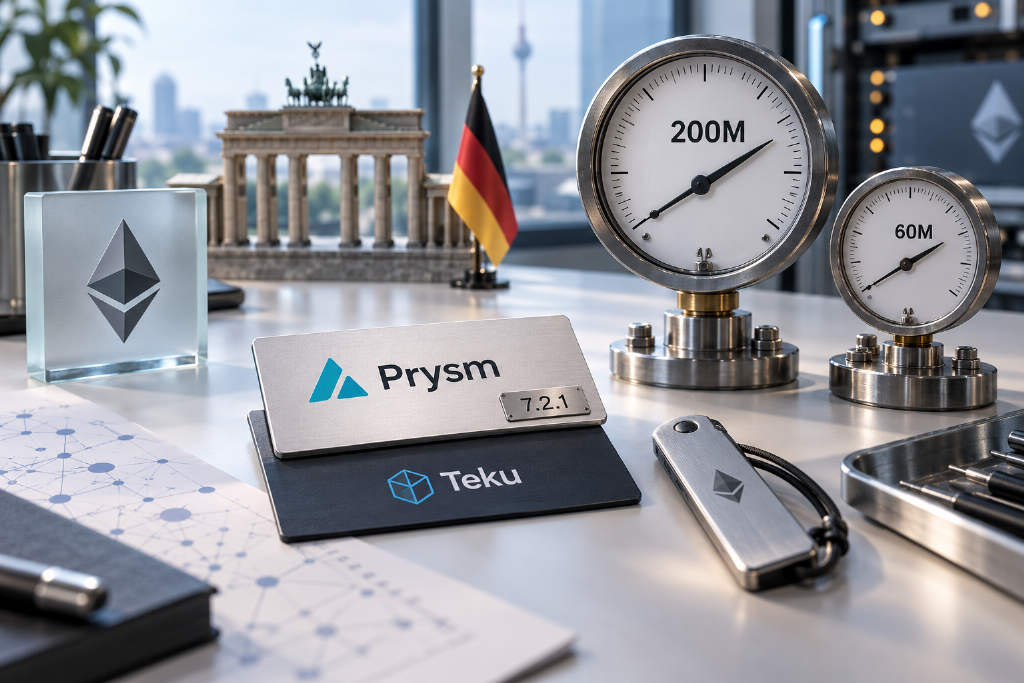
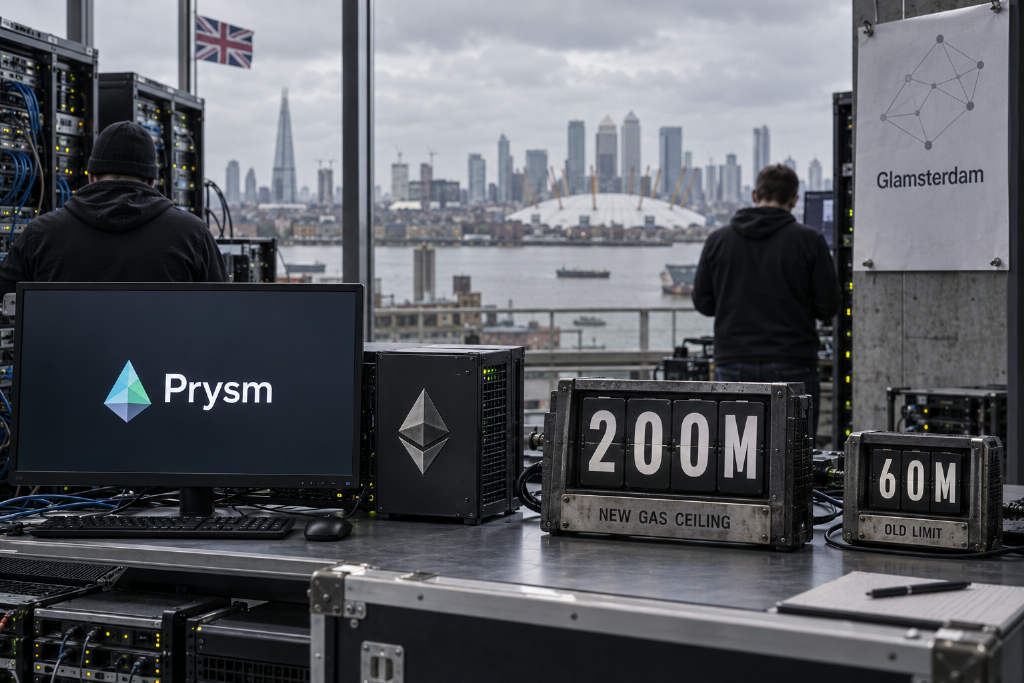
Ethereum2026-10-06 10:00:52Prysm releases 200M gas limit fix hours before Glamsterdam goes live on SepoliaOffchain Labs released Prysm v7.2.1 on Monday, just hours before Ethereum’s Glamsterdam upgrade is set to activate on the Sepolia testnet. The update changes Prysm’s default behavior so validators move to a 200 million gas limit once the fork is live, replacing the 60 million default used by v7.2.0 unless operators manually set a higher number. The Ethereum Foundation said Glamsterdam will activate on Sepolia at epoch 353,024, or 13:53:36 UTC on Oct. 6, and noted that the network’s shared configuration had already been updated on Sept. 24 to target a 200 million gas limit at the fork. The change arrived after Prysm had already shipped its Sepolia-ready release, which left validators needing manual configuration if they wanted the higher limit. Prysm 7.2.1 also enables partial data columns by default and fixes a bug affecting construction of the first post-fork block in some scenarios. Teku remains in a different position: according to the foundation, Teku 26.9.1 still defaults to a 60 million gas limit after activation, and validators must use a command-line flag to reach 200 million. The foundation also said activation dates for Hoodi and mainnet have not yet been decided.20
Ethereum2026-10-06 08:11:11Ethereum ships emergency Prysm 7.2.1 fix as Sepolia gas limit rises to 200 millionEthereum developers released Prysm 7.2.1 late Monday ahead of the Glamsterdam upgrade on the Sepolia testnet, fixing a bug that could have left some validators producing blocks with the old gas limit. Without the patch, validators that did not manually change their settings could have kept operating at roughly 60 million gas, weakening the test by mixing lower-capacity blocks into an upgrade meant to measure network stability under much larger blocks. The new Prysm release automatically raises the maximum block computation target to 200 million gas on Sepolia. The change matters because gas defines how much computation a block can carry. A higher cap allows more transactions and onchain activity in a single block, but it also increases resource demands for execution nodes. Glamsterdam, Ethereum’s next major upgrade, combines the Amsterdam execution-layer changes with the Gloas consensus-layer changes. Its key items include EIP-7732, which brings enshrined proposer-builder separation, and EIP-7928, which introduces block-level access lists. Sepolia will be the first test network to deploy those changes. For developers and stakers running local Sepolia nodes, the immediate task is to confirm Prysm has been updated to version 7.2.1 or later.20
Ethereum2026-10-06 04:50:48Ethereum fixes Sepolia issue ahead of Glamsterdam test as gas limit is set to rise to 200 millionEthereum developers completed an emergency software update ahead of the Glamsterdam upgrade test on the Sepolia testnet, fixing an issue that could have caused some validators to produce undersized blocks. The upcoming test will raise Sepolia’s gas limit from about 60 million to 200 million, a change meant to verify Ethereum’s ability to handle more throughput in a future network upgrade. Sepolia will be the first test network to deploy the changes tied to Glamsterdam, which is described as Ethereum’s next major upgrade. Gas measures the amount of computation an Ethereum block can process. A higher gas limit allows each block to include more transactions and more complex on-chain operations, while also increasing the computational load on nodes. To prepare for the change, validator client Prysm released version 7.2.1 on Monday night with support for the 200 million gas limit configuration. Earlier versions were released before Sepolia’s parameter change, meaning validators that did not manually update their settings could have continued operating under the old 60 million gas limit. According to CoinDesk, the update is intended to ensure validator nodes can participate in the Glamsterdam test as expected.20
Ethereum2026-10-06 04:49:05Ethereum Issues Last-Minute Prysm Fix Ahead of Sepolia Glamsterdam Test and 200M Gas TrialEthereum developers released a late software update for Prysm just hours before the Glamsterdam upgrade test on the Sepolia testnet, aiming to prevent part of the validator set from proposing undersized blocks. The issue centered on Sepolia’s planned jump in block gas limit from about 60 million to 200 million, a change meant to test whether validators can reliably process blocks that are more than three times larger than the network’s previous default. Prysm version 7.2.1, published late Monday, includes the 200 million gas setting. Validators that stayed on the earlier release would have continued producing 60 million-gas blocks unless operators changed the configuration manually, which would have weakened the capacity test. Glamsterdam is Ethereum’s next major upgrade, and Sepolia is the first network where developers are rehearsing the change using tokens that carry no real value. The upgrade is scheduled to activate on Sepolia at 13:53:36 UTC on Oct. 6. Developers are using this step-up approach to gauge how far Ethereum can raise block capacity before validator hardware demands or operating costs become too high. The 200 million gas setting applies only to Sepolia for now, and developers have not yet activated Glamsterdam on Ethereum mainnet.00
Ethereum2026-10-06 04:59:46Prysm rolls out v7.2.1 patch ahead of Sepolia gas limit increase testPrysm, a core Ethereum validator client, has released a v7.2.1 patch to support the upcoming Glamsterdam upgrade rehearsal on the Sepolia testnet. The test will raise Sepolia’s per-block gas limit from roughly 60 million to 200 million gas, a sharp increase designed to examine how validator hardware performs under more than triple the current load. The exercise is also intended to help assess whether similar scaling changes could be feasible on Ethereum mainnet. Officials said the 200 million gas limit is only being applied on Sepolia for now and has not gone live on Ethereum mainnet. The item was carried by Techub News and cited Wu Blockchain as the source noted in the brief.00
Ethereum2026-10-06 04:50:45Prysm 7.2.1 ships with 200 million gas limit ahead of Sepolia Glamsterdam testEthereum developers released Prysm client version 7.2.1 on Monday night with a built-in 200 million gas limit setting, aiming to get the update deployed before Tuesday’s Glamsterdam upgrade test on the Sepolia testnet. Glamsterdam is Ethereum’s next major upgrade and will be activated on Sepolia first, where developers rehearse protocol changes using tokens with no real-world value. One key part of the test is raising Sepolia’s gas limit from roughly 60 million to 200 million. Gas measures how much computational work a single Ethereum block can include, so a higher limit allows the network to handle more transactions and more complex activity at the same time, while also increasing hardware demands for machines running Ethereum. Prysm is client software used by validators. Because the previous release was completed before the Sepolia configuration included this setting, validators running older versions would still produce blocks at a 60 million gas limit unless they manually changed the parameter, which could weaken the capacity test. Validators on the latest version will automatically begin proposing 200 million gas blocks when Glamsterdam activates on Sepolia at 13:53:36 UTC on Oct. 6. The 200 million setting applies only to Sepolia for now, and Glamsterdam has not been activated on Ethereum mainnet.00
Ethereum2026-10-06 04:57:37Ethereum to test Glamsterdam on Sepolia as block gas limit is set to rise to 200 millionEthereum developers pushed out Prysm 7.2.1 just hours before the Glamsterdam upgrade is scheduled to go live on the Sepolia testnet, fixing a validator client issue tied to block gas limit settings. The release is meant to ensure validators can automatically produce blocks with a 200 million gas limit, matching the parameters of the upcoming test. Glamsterdam is Ethereum’s next major upgrade and will first be activated on Sepolia. One of the main changes in this test is a jump in Sepolia’s block gas limit from roughly 60 million to 200 million. Gas measures how much computational work an Ethereum block can carry, so a higher limit allows more transactions and more complex onchain activity to fit into a single block, while also raising hardware and performance demands for validator nodes. According to the schedule, Glamsterdam will activate on Sepolia at 13:53:36 UTC on Oct. 6. Validators running the latest Prysm version will then begin proposing 200 million gas blocks automatically. The test is designed to show whether Ethereum validators can reliably handle blocks more than three times larger than the previous default capacity and help developers assess what block capacity may be suitable for Ethereum mainnet in the future.00