
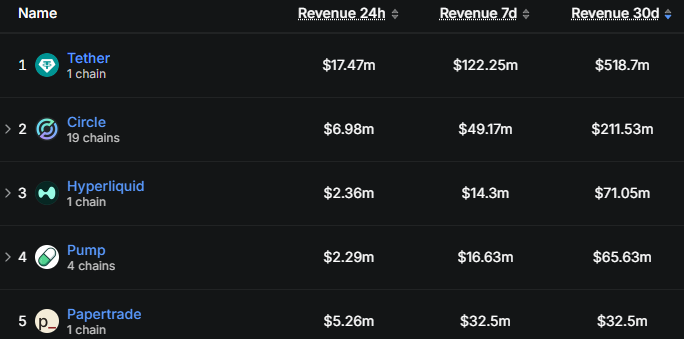
Pump.fun has remained highly profitable even as meme-token trading has cooled. According to the latest data cited from DefiLlama, the platform generated $65.63 million in protocol revenue over the past 30 days, close to Hyperliquid’s $71.05 million. Over the past seven days, Pump.fun brought in about $16.63 million, ahead of Hyperliquid’s $14.3 million.
That stands in contrast to PONS, a token launch platform that briefly became a new meme-trading hotspot during the rise in Robinhood Chain ecosystem activity. As that momentum faded, PONS posted only about $550,000 in protocol revenue over the past seven days, with average daily revenue down about 74% from its 30-day average.
Despite the revenue scale, PUMP still trades at a much lower valuation than HYPE. The article puts their circulating market capitalizations at about $2.325 billion and $18.198 billion, respectively, a gap of nearly eightfold. Using the latest 30-day protocol revenue and annualizing it on a simple basis, the circulating market cap-to-annualized revenue ratio comes out to roughly 3x for PUMP and 21x for HYPE.
Community criticism around Pump.fun has centered on two issues for a long time: no token airdrop for early participants, and the team converting SOL taken from platform revenue. The article says those disputes have not materially changed user behavior around launching meme tokens and trading them, which is why PUMP’s valuation framework is being revisited.
Buyback ratio was cut in half, but daily purchases still sit near $1 million
After buybacks began in July 2025, Pump.fun at one point used 100% of net protocol fees to buy PUMP. In September last year, monthly buybacks reached $55.3 million, above that month’s protocol revenue of $42.8 million.
In April this year, Pump.fun said it would reduce the buyback ratio from 100% to 50%, keeping the other half for the company to fund hiring, marketing and acquisitions. Monthly buybacks fell to $9.2 million in June, then recovered. Over the past 30 days, buybacks climbed back to $30 million, about 3.2 times the June level. The ratio is lower than before, but the actual bid from buybacks has recovered as platform revenue improved.
Official figures cited in the article show Pump.fun has cumulatively bought back and burned about $484 million worth of PUMP, destroying about 171.52 billion tokens, equal to 17.15% of total supply. Recent daily spending on buybacks and burns has stayed around $1 million.
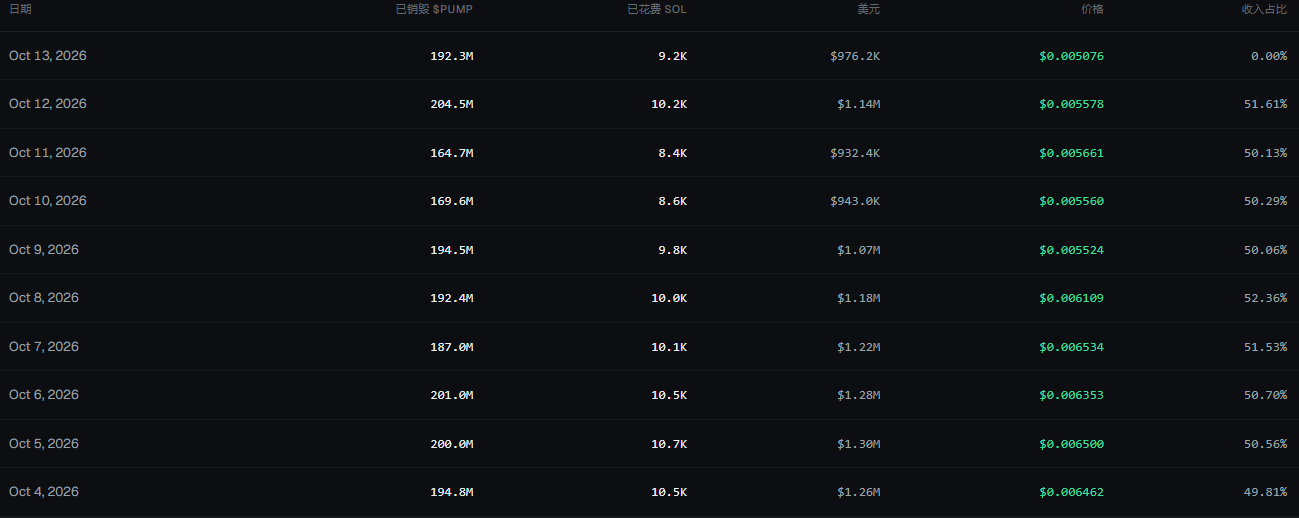
DefiLlama data cited in the report shows buyback-related spending over the past 30 days at about $29.48 million, or roughly $980,000 per day. Based on the current circulating market cap of about $2.325 billion, one month of buyback spending equals about 1.27% of market value.
The article argues that even with the buyback ratio cut to 50%, Pump.fun’s revenue base is still large enough to support around $1 million in daily token purchases. In that setup, revenue funds buybacks, buybacks absorb supply from the market, and burns reduce the token count further.
The first major unlock passed without broad selling in the tracked sample
PUMP’s largest token unlock took place on July 12 this year. Team members and early investors completed a one-year lockup, releasing 82.5 billion PUMP, equal to 8.25% of the initial total supply and about 20.23% of the pre-unlock circulating supply.
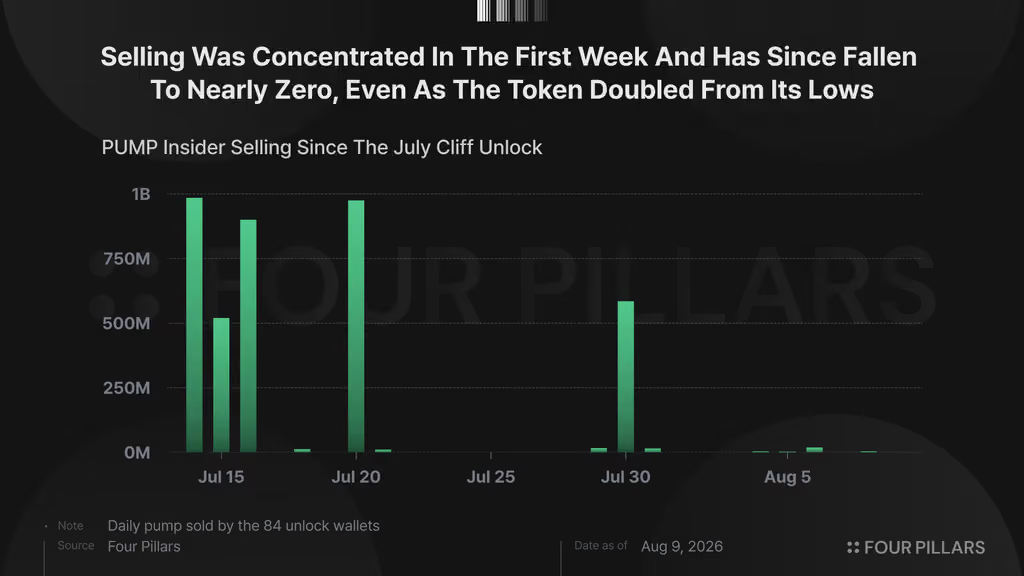
After that first concentrated unlock, crypto research firm Four Pillars tracked the movement of 52.7 billion PUMP, which was ultimately distributed across 84 addresses. In research published on Aug. 12, the firm said that over the following 27 days those addresses sold a combined 4.03 billion PUMP for about $6.97 million, equal to 7.6% of the tracked allocation. Among the 84 addresses, 62 did not sell, while 13 sold everything. The article adds that 84% of the tokens sold in that sample were sold before July 20. Based on that sample, more than 90% of unlocked tokens were not sold during the observation period, and the first unlock did not trigger broad dumping.
Later unlocks are still moving on-chain. On Oct. 13, according to Ember monitoring cited in the article, three team or early-investor wallets transferred 1.458 billion PUMP to Coinbase Prime, worth about $7.58 million. Those three wallets together hold an allocation quota of 70 billion tokens. The transfer represented this month’s unlocked amount and may already have been sold.
The 82.5 billion PUMP unlocked on July 12 accounted for one quarter of the total allocation to the team and early investors. The remaining 247.5 billion tokens are set to unlock monthly over the next three years. Under that schedule, about 6.875 billion PUMP will be released each month, only one-twelfth the size of the first concentrated unlock. The article’s conclusion is that the biggest concentrated unlock for the team and early investors is already behind the market, and the potential selling pressure from future releases is much lower.
Next step: from token launchpad to broader trading app
The report says high revenue and ongoing buybacks are the main support for PUMP at this stage. Whether valuation can expand from here depends on whether Pump.fun can attract more trading users.
One change involves Callout Rewards. Pump.fun founder Alon recently said the platform will reduce the reward weighting for low-market-cap token recommendations, place less emphasis on trading volume, focus more on whether followers actually make money, and cut incentives for low-quality calls. The adjustment targets a core tension in social trading: promoters can earn rewards while followers may end up taking losses. Pump.fun wants the reward system to favor recommendations that keep helping users make money, rather than simply generating more trades.
The other area is product expansion. On Oct. 10, market chatter said Pump was developing a perpetual futures feature powered by Hyperliquid, though the article notes this should not yet be treated as a live product. If launched, users would be able to trade perpetuals in the same app where they launch and trade meme tokens, giving Pump.fun a chance to capture more trading demand.
Those developments have also drawn support from some traders. The article says Ansem previously disclosed swapping part of his SOL holdings into PUMP, citing continued buybacks and growing attention on a cross-chain mobile app. He also said that with features such as custom trading pairs and Callout Rewards, Pump.fun could become infrastructure that other launch platforms build on, gradually taking on a valuation logic closer to an L1, and could develop into a super app in this cycle.
Pump.fun’s revenue engine and buyback program remain at the center of the PUMP debate. The next questions are whether the reward changes can retain traders and whether perpetual futures can open another revenue stream.