
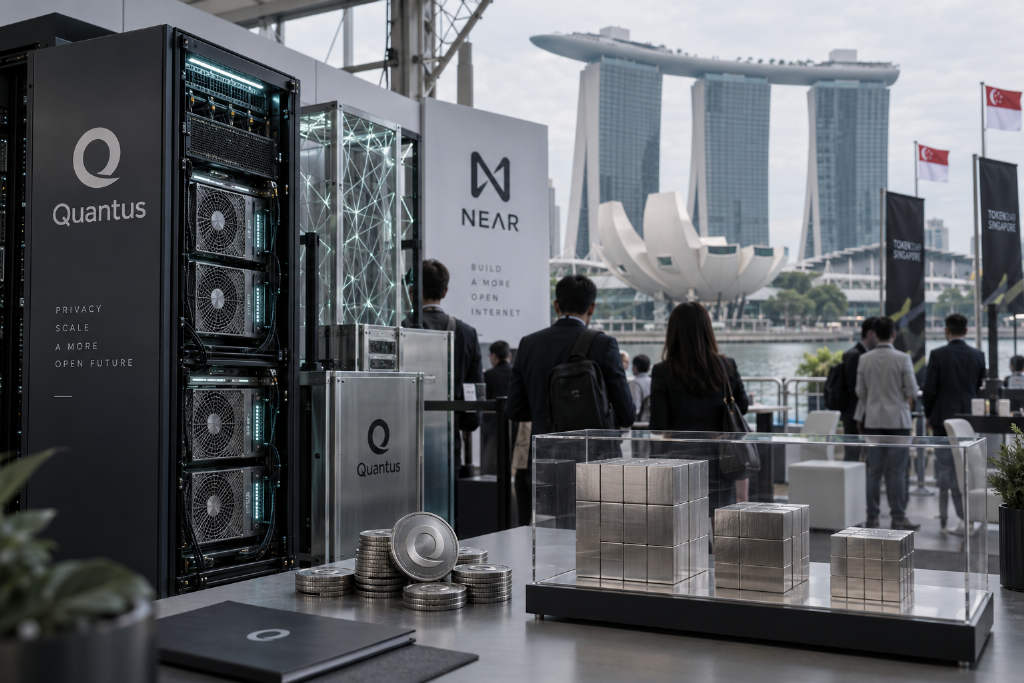
Zcash’s recent rally has put privacy narratives back in focus, and Quantus has emerged as one of the projects benefiting from that shift. The Layer 1 network, which launched its mainnet not long ago, has been framed by some market participants as a post-quantum version of Zcash. Support from figures such as Balaji has added to the attention.
Quantus gained traction soon after mainnet launch
During TOKEN2049 week in Singapore, industry attention has centered on a side event called “Quantum & Privacy Day.” Alongside long-established privacy project Zcash and public blockchain NEAR, Quantus appeared as one of the organizers.
As quantum computing advances, the potential threat it could pose to current network security systems has moved closer to practical discussion from pure theory. That has pushed post-quantum security higher on the crypto industry’s agenda.
Quantus is a proof-of-work blockchain designed from its base architecture around future quantum-computing threats. The project describes itself as “peer-to-peer electronic cash for the quantum era,” with a focus on post-quantum cryptography, privacy and zero-knowledge proofs. Its stated goal is to address quantum-related security risks at the design stage rather than patch them into an existing chain later.
According to the project’s framing, major blockchains such as Bitcoin, Ethereum and Solana rely heavily on elliptic-curve signature schemes that could, in theory, be vulnerable to Shor’s algorithm if sufficiently powerful quantum computers emerge. Quantus instead uses ML-DSA, also known as Dilithium, as its core signature system. The algorithm is one of the digital signature standards selected through the National Institute of Standards and Technology, or NIST, post-quantum cryptography standardization process.
In a recent interview, Quantus co-founder Christopher Smith said Bitcoin’s proposed BIP-360 offers one possible path toward a quantum-resistant upgrade. One of the proposal’s core ideas is to introduce a new post-quantum address type so users can voluntarily migrate assets into a new security model.
Smith argued that the approach still leaves a practical gap because it protects only assets that are actively moved. Under that view, Bitcoin held by Satoshi Nakamoto, as well as coins that have been lost, forgotten or left unmanaged after a holder’s death, may never be migrated even if a post-quantum path is eventually adopted. If sufficiently powerful quantum computers appear, those assets could still be exposed in theory. Smith also said the broader crypto industry has spent the past decade stacking new cryptographic systems on top of one another, creating a structure that is complex and difficult to upgrade in a coordinated way. That, he said, is why Quantus chose to include post-quantum security in the chain’s underlying design from the start.
Its privacy design differs from Zcash’s model
Privacy is the other main narrative behind Quantus. In that respect it shares some similarities with Zcash, since both use zero-knowledge proofs, but the privacy models are not the same.
Quantus says private transfers are handled mainly through Wormhole addresses. After a user sends assets to an encrypted address, the assets are provably burned. The holder then uses a locally generated zero-knowledge proof to remint those assets at any exit address, breaking the direct on-chain link between the sending address and the final receiving address.
Zcash, by comparison, uses zk-SNARKs for private transactions. Its shielded pool hides the sender, recipient and transaction amount, while transparent addresses remain available and users decide whether to move into the shielded pool.
Post-quantum security also creates engineering trade-offs, and data size is one of the clearest. Quantus uses ML-DSA-87 signatures, which are much larger than conventional elliptic-curve signatures. If every transaction were to write a full post-quantum signature directly to the blockchain, the signature data could consume a large amount of block space and weigh on network throughput.
To address that, Quantus introduced what it calls a “ZK + signature aggregation” mechanism. The design uses a STARK-based zero-knowledge proof system and Plonky2 to generate and aggregate proofs across multiple transactions, compressing what would otherwise be a large volume of post-quantum signatures that need to be stored and verified one by one. On-chain, the network verifies the aggregated proof instead of processing every signature individually.
On consensus and token design, Quantus follows a Bitcoin-like proof-of-work route. Its native token, QTC, has a capped supply of 21 million, but no halving schedule. For mining rewards, half of private transfer fees are burned and then reintroduced into future mining rewards according to an exponential curve, in what the project presents as a way to ease the security-budget problem that proof-of-work networks may face.
The Quantus mainnet went live on Sept. 9, 2026. According to data disclosed on its website, the network has more than 8,400 active accounts and more than 260,000 cumulative transactions. It has also been integrated with the NEAR Intents cross-chain trading protocol, becoming the first post-quantum asset on that platform. Users can swap into QTC through cross-chain transfers from multiple assets.
That combination — rising interest in privacy assets such as ZEC and a growing debate around quantum-computing risk — has helped a recently launched project like Quantus move quickly into view.
Backers include names closely tied to the Zcash circle
Beyond the project’s technical positioning, its financing lineup has become a major talking point.
Based on public information, Quantus has completed two funding rounds totaling about $2.42 million. The first round raised $1.65 million at a $40 million token valuation. The second raised $770,000 at a $100 million token valuation. By size alone, $2.42 million is not especially large, but the names involved have attracted attention.
The second round was led by Balaji, with participation from AngelList co-founder Babak Nivi and Mert, founder of Solana ecosystem infrastructure project Helius. Quantus co-founder Joseph Mattia previously said that Balaji also serves as an advisor to the project.
What stands out more is the overlap between Quantus’s core backers and the Zcash community. Balaji is an early Zcash investor and long-time supporter who has repeatedly expressed strong optimism on ZEC and at one point put forward a $100,000 target price. Mert has also voiced favorable views on Zcash on multiple occasions. Another AngelList co-founder, Naval, is likewise an early Zcash investor. He participated in its early financing in 2015 and once said that Bitcoin is insurance against fiat currency, while Zcash is insurance against Bitcoin.
Genesis allocation has become the center of criticism
Quantus’s token model has also sparked debate. One community member joked, “The quantum threat is still on the way, but the large genesis allocation is already in the bag.”
According to the project’s disclosed tokenomics, 27% of QTC’s total supply was minted at genesis. Of that, 23% was allocated to investors, founders and the team, locked for one year after mainnet launch and then released linearly over 36 months. Another 4% was allocated to the company. Within that portion, 1% was liquid at genesis and used mainly for initial liquidity. The remaining roughly 3% is reserved for future company operations and follows the same one-year lock and 36-month linear release schedule.
That relatively large genesis allocation has become the main point of community criticism. In the view of critics, Quantus leans on Bitcoin-like narratives around fixed supply, scarcity and proof-of-work, inviting comparisons to digital gold and fair launch. But unlike Bitcoin, where BTC entered circulation primarily through proof-of-work mining over time, Quantus allocated a sizable share of QTC to investors, founders, the team and the company at genesis. That, in turn, means the project could face potential sell pressure from token unlocks over the next several years.
Quantus has entered a market window with considerable attention through its combination of privacy, post-quantum security and capital backing. That has likely reduced some of the cold-start friction that new projects usually face in awareness and liquidity. Whether its post-quantum design stands up over time, whether its privacy model turns into sustained user demand, and whether network scale, liquidity and ecosystem activity continue to expand remains to be seen in the market.