
Corporate finance platform Ramp said on Oct. 15 that it had raised $1.85 billion in a new funding round that valued the company at $60 billion. The round was led by Dragoneer, with Thrive Capital, Founders Fund, Sands Capital and Avenir Growth also listed as lead investors, while Fidelity, GIC and others participated. After the deal, Ramp said its total equity financing stood at about $5 billion.
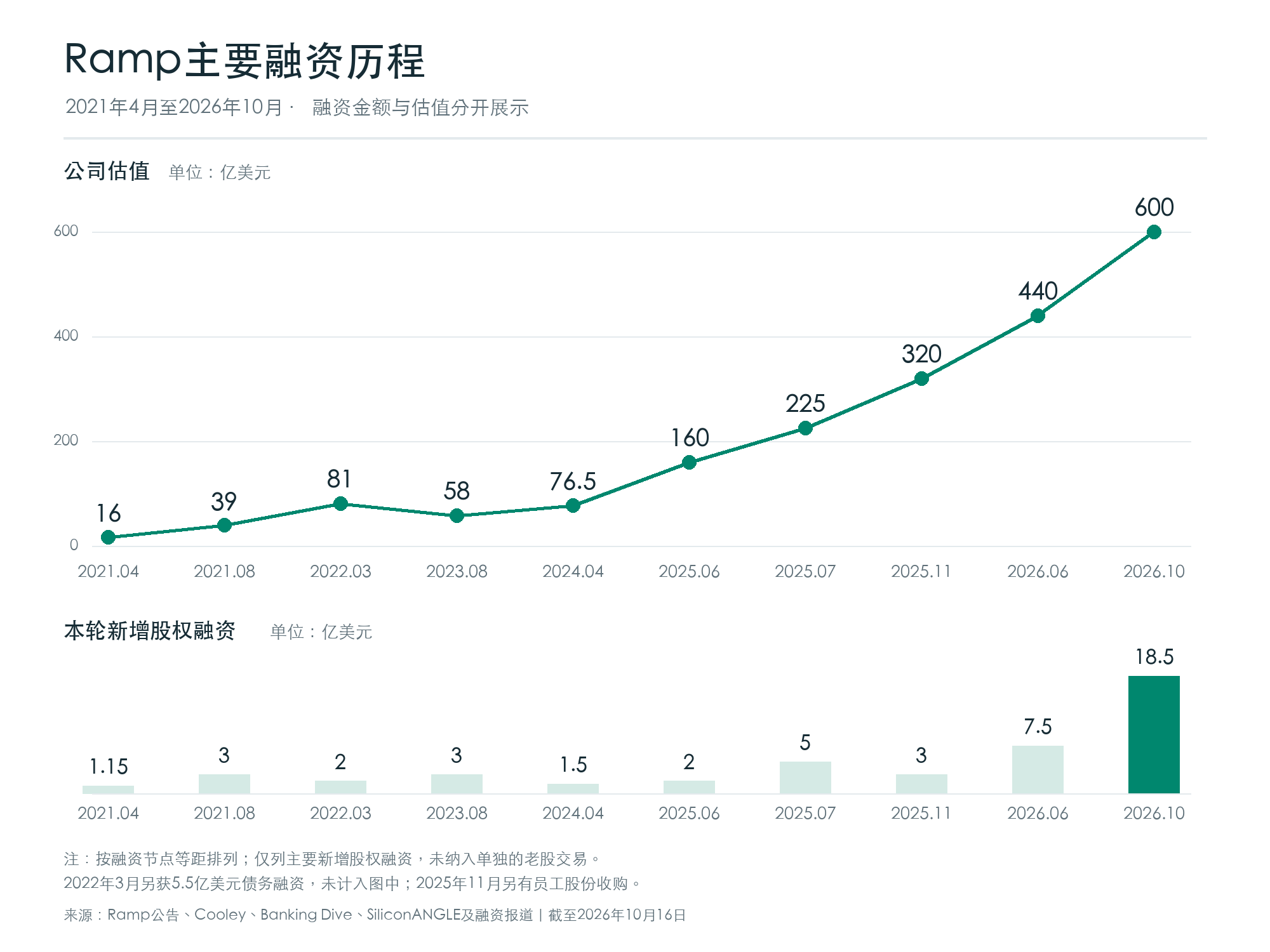
The new round came roughly four months after Ramp’s previous financing. In June this year, the company raised $750 million at a $44 billion valuation. This latest round added $16 billion to that figure. Earlier, in 2025, Ramp raised an additional $200 million, $500 million and $300 million in June, July and November, at valuations of $16 billion, $22.5 billion and $32 billion, respectively.
From corporate cards to a broader finance stack
Founded in 2019, Ramp first offered corporate cards and related expense management software. It later expanded into procurement, travel, vendor payments and accounting automation. Employees can spend on company cards, managers can approve expenses and finance teams can process books inside the same product set. This year, the company also introduced stablecoin accounts and AI cost management for the same business customer base.
Ramp’s three founders — Eric Glyman, Karim Atiyeh and Gene Lee — had previously worked together on Paribus. Glyman and Atiyeh met at Harvard, and later teamed up with Lee to build the consumer tool, which tracked post-purchase price changes and helped users claim refunds under retailer price-adjustment policies. Capital One acquired Paribus in 2016.
After working around corporate card operations at Capital One, the team began studying business payments and reimbursement workflows. In Glyman’s account, they interviewed hundreds of founders after leaving the company and found that payment records were scattered across multiple systems, employees had to submit expenses repeatedly, and finance teams struggled to see departmental spending in time. The three founded Ramp in March 2019 and publicly launched the product in February the following year.

Linking pre-spend controls with post-spend accounting
Ramp connected corporate cards with expense management so businesses could set rules before a payment was made. Administrators can assign cards, spending limits and permissions to employees. After a transaction, finance teams can handle receipts, expense categorization and bookkeeping within the platform. Ramp cards run on the Visa network and require businesses to repay the balance in full on the agreed due date.
One example in the company’s product flow is software procurement. A manager approves a budget first, an employee uses a company card to subscribe, and the expense record then moves into the finance system. If recurring subscriptions, employee reimbursements and vendor invoices are handled in separate tools, finance teams have to reconcile the records again. Ramp passes data across those steps, cuts manual entry and lets administrators keep track of budget usage.
On June 25 this year, Ramp changed management responsibilities. Atiyeh moved from chief technology officer to co-chief executive officer and now leads the company alongside Glyman. Rahul Sengottuvelu, previously head of applied AI, became CTO. Before the change, Atiyeh had also overseen risk, operations and marketing in addition to technology.
Revenue from payments and software, with broader product adoption
Once a customer is onboarded through corporate cards, Ramp can sell procurement, travel and vendor management services to the same account. Employees submit purchase requests, managers approve them against budgets, finance teams schedule payments after receiving invoices, and records are then synced into accounting systems. Vendor information and expense data can be reused across those steps, so businesses do not need to rebuild records for each stage.
Ramp makes money from payments and software services. When customers spend on company cards, the company earns interchange revenue from card transaction fee allocation. It also charges software subscription fees to businesses that need paid features. Ramp said its latest revenue disclosure also includes interest income and other income, net of customer incentives.
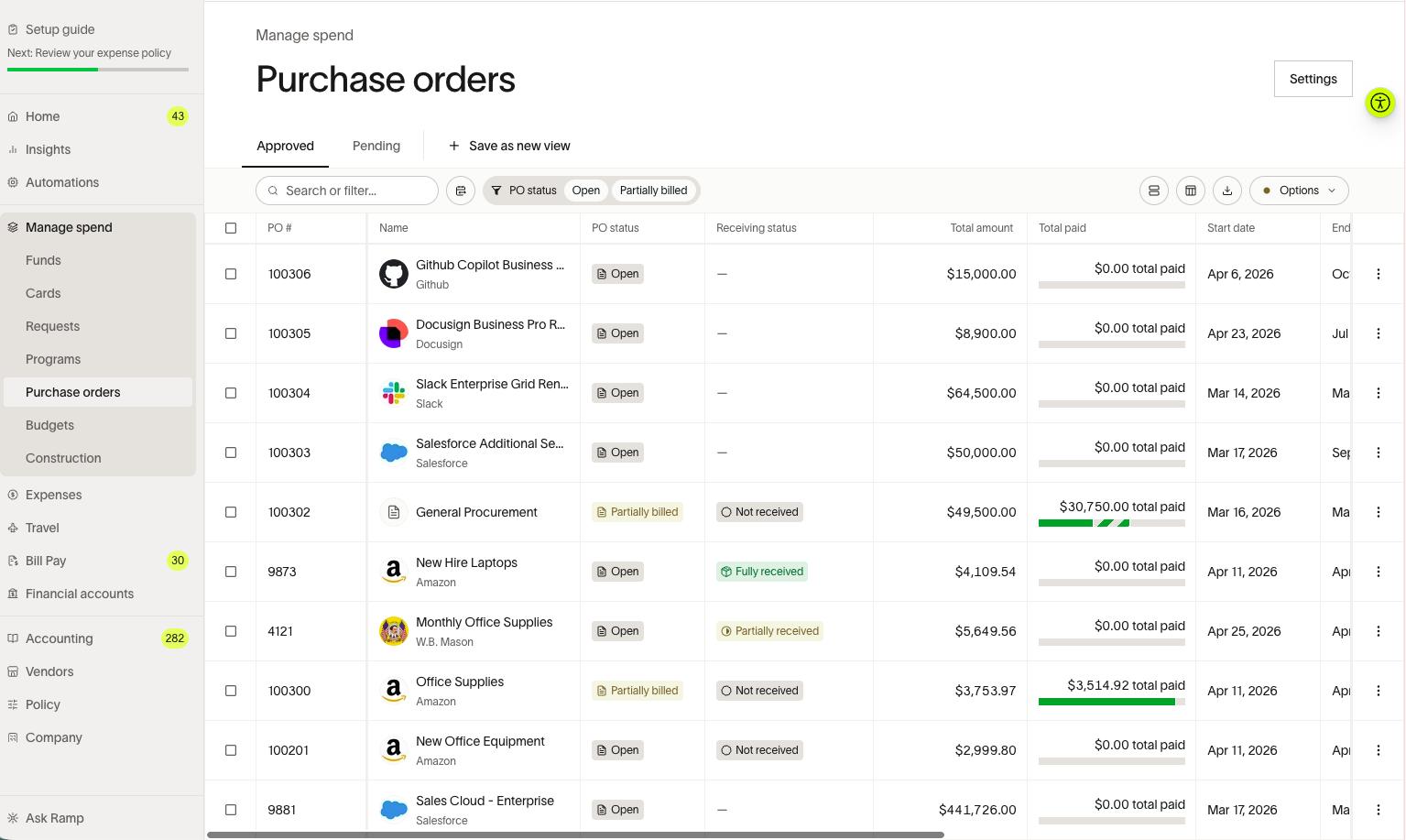
As procurement and payment tools have been added, customers have started using more than one product. In the funding announcement, Ramp said most customers now use at least two Ramp products, and about one-quarter use at least three. For the company, that means existing card customers may also buy more management functions or route vendor payments through the platform.
Ramp’s AI Token Spend Management, launched this year, targets another spending problem. The cost of using AI models changes with usage volume, model choice and task type, and a single vendor invoice often does not show which team actually incurred the expense. Ramp groups costs by team, project and model, and offers overspend alerts, budget limits and suggestions to switch to lower-cost models for finance and business teams to review together.
Stablecoin payments keep the same approval workflow
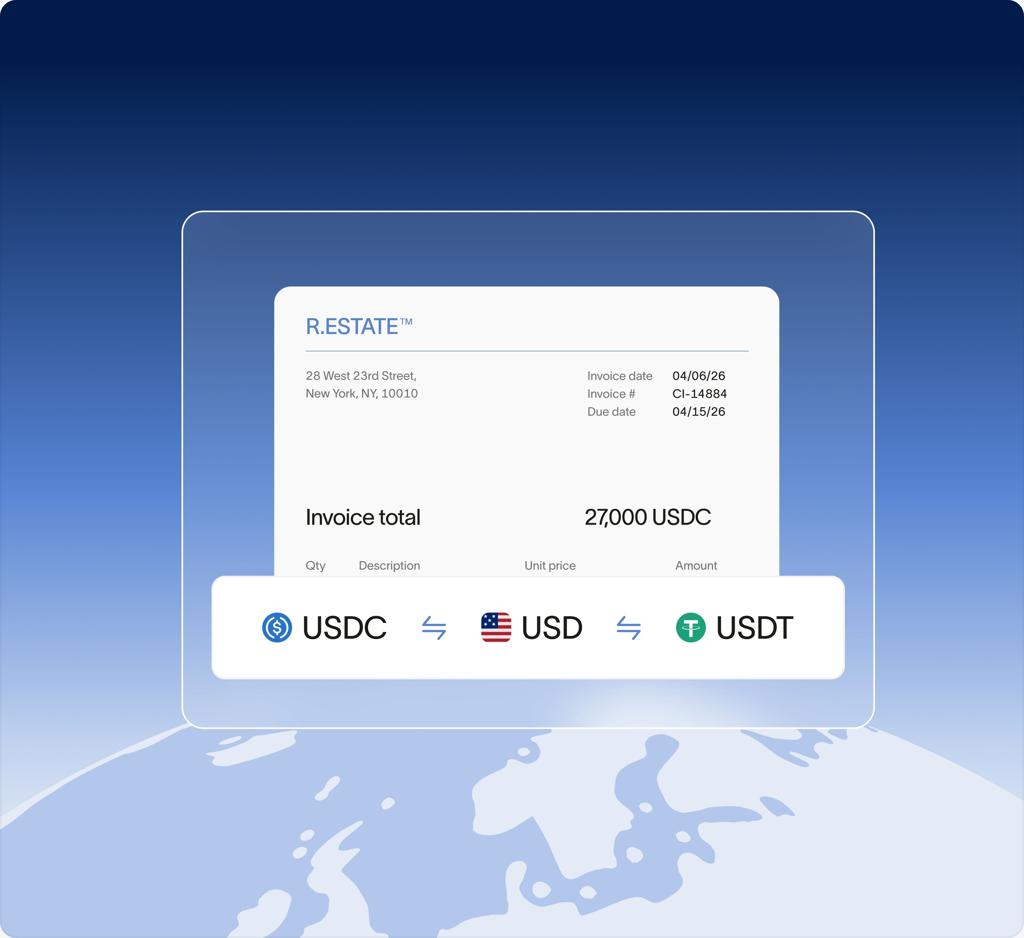
Cross-border payments have also been folded into the system. In July this year, Ramp launched stablecoin accounts and payment functions. Businesses can hold USDC and USDT, or fund payments from U.S. dollar bank accounts and convert before sending directly to a supplier wallet.
If an overseas contractor wants to be paid in USDC, the paying business can choose stablecoins in Ramp Bill Pay and fund the payment from a Ramp account or an external bank account, without going to an exchange to buy tokens itself. Customers that want to keep funds on-chain can open a Ramp Stablecoin Account, deposit supported stablecoins and then use the balance to pay card bills, supplier invoices or employee reimbursements.
Those actions use the same approval and accounting integrations already built into the platform. Custody is provided by Bridge and its affiliates. According to Ramp’s help documentation, payments made from the platform’s stablecoin account are typically processed and delivered within five minutes, around the clock. Payments funded from external bank accounts require the deposit step first. Stablecoin balances are not bank deposits and are not covered by U.S. federal deposit insurance. The service is not yet available to customers in New York.
More than 85,000 customers and over $2 billion in annualized revenue
Ramp’s customer base and transaction scale have grown with the business. In November 2025, the company said it had more than 50,000 customers, more than $1 billion in annualized revenue and more than $100 billion in annualized purchase volume. As of Oct. 1 this year, those figures had risen to more than 85,000 customers, more than $2 billion in annualized revenue and more than $275 billion in annualized purchase volume. Ramp also said it was cash-flow positive. Visa, Uber, Shopify, Robinhood and Notion are among its customers.
Those figures cover Ramp’s overall business. In the latest announcement, the company did not separately disclose stablecoin account balances, transaction volume or revenue contribution tied to those products, leaving the scale of adoption for the new payment option undisclosed for now.
Alongside the funding round, Ramp also shared progress on its accounts receivable product, which covers invoice issuance, collections, payment matching and revenue recognition. A platform that had mainly focused on business spend management is now moving into the process of collecting payments from customers. The accounts receivable product was included in Ramp’s October announcement as part of its near-term launch list.