
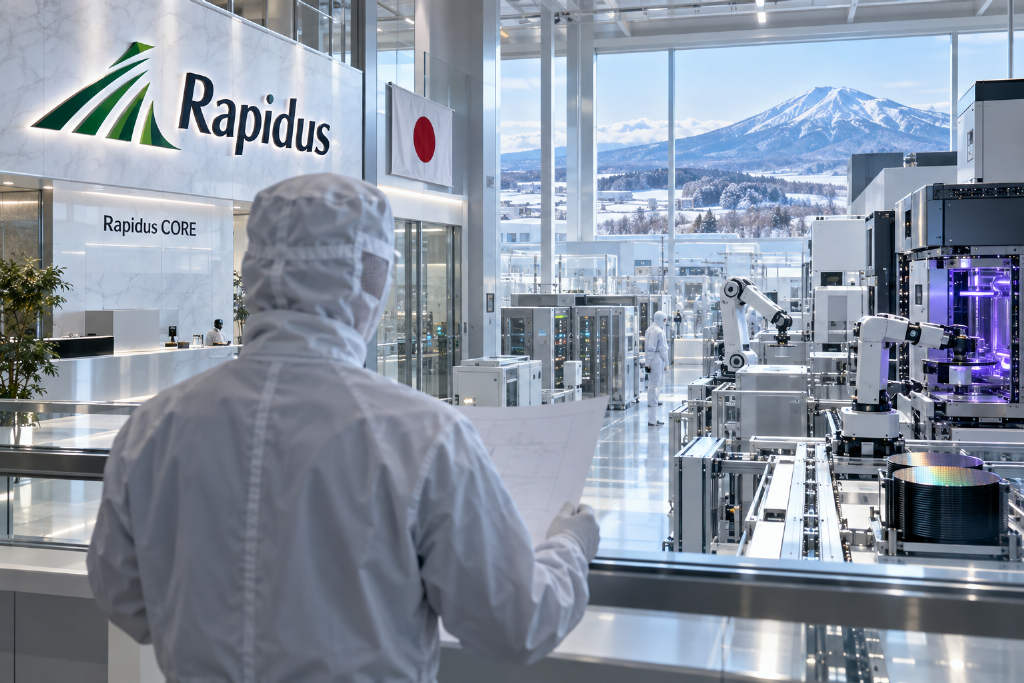
Rapidus has announced the formation of the Rapidus CORE design solutions alliance, a new ecosystem that links global design companies and IT service partners as the Japanese chipmaker tries to secure orders for 2 nm wafer production.
Alliance built to support customers from design through manufacturing
The company said semiconductor development depends heavily on coordination across research institutes, EDA (electronic design automation), intellectual property, chip design, and manufacturing. With the global semiconductor industry facing a talent shortage, Rapidus said the Rapidus CORE alliance is intended to help customers with limited technical resources complete chip design in the early stages, simplify technology transfer, and gradually establish a more complete supply-chain infrastructure.
The initial members are AION Silicon Limited, Cadence Design Systems, Inc., Dai Nippon Printing Co., Ltd., GreatAsic Technology Sdn. Bhd., HCL Technologies Limited, Infinecs Systems Sdn. Bhd., Infosys Limited, MavissDesign Co., Ltd., MosChip Technologies Limited, NSW Inc., Oppstar Technology Sdn Bhd, Quest Global Services Pte. Ltd., SkyeChip Berhad, Synopsys, Inc., TOPPAN Inc., Toshiba Information Systems (Japan) Corporation, and Wipro Limited.
Mass production target remains the second half of fiscal 2027
Rapidus has been positioned by Japan as a core company in the country’s effort to revive its semiconductor industry. The company is aiming to start mass production of 2 nm chips in the second half of fiscal 2027 at its factory in Chitose, Hokkaido.
Its main technology partner is IBM in the United States, and it is also working with imec, the Belgium-based interuniversity microelectronics research center. According to the article’s summary points, the first stage of the Rapidus CORE ecosystem is focused on bringing in global EDA, IP, and design service companies to strengthen customers’ design capabilities.
Funding is in place, but customer acquisition remains the key hurdle
Rapidus has received about $19 billion in support from the Japanese government and has technical cooperation in place with IBM and imec. Even so, the company’s biggest task at this stage is still finding concrete production-line customers.
That challenge is sharpened by the existing position of foundry rivals including Taiwan Semiconductor Manufacturing Co. (TSMC), Samsung, and Intel, all of which already hold critical market share. Rapidus still needs to address production stability, yield, and the cost for customers to shift orders. The article noted that the company has not yet disclosed clear mass-production customer orders, leaving customer willingness to switch and line-yield stability as the main points to watch.