
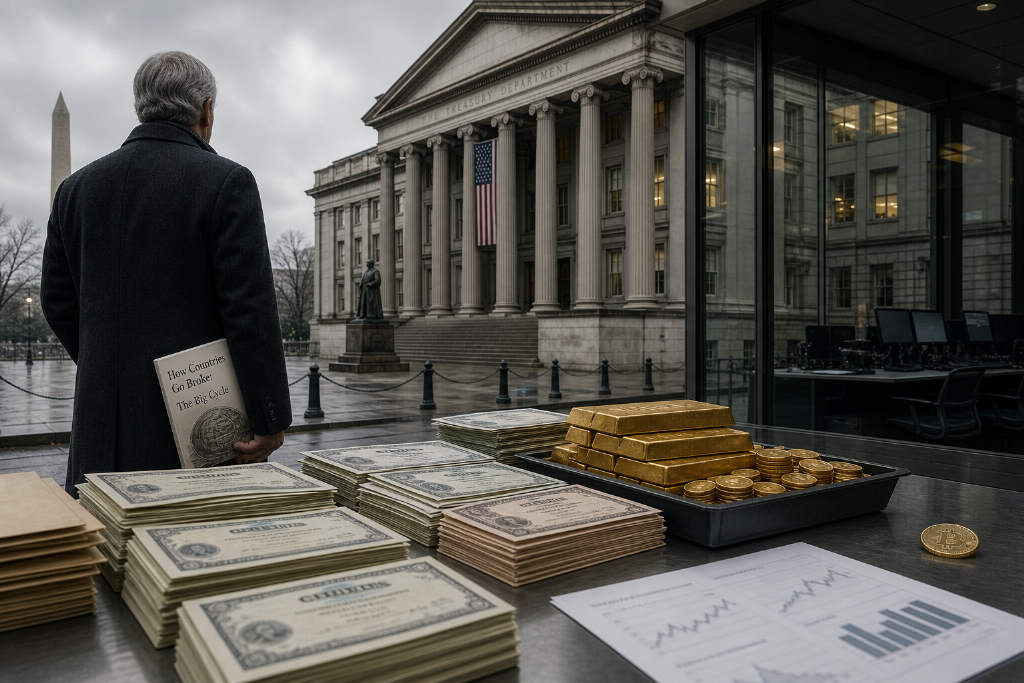
Ray Dalio said a worsening mismatch between supply and demand in the U.S. Treasury market could lead to higher interest rates, a weaker dollar, and debt monetization, adding that recent market and policy moves line up with the debt-cycle pattern he described in How Countries Go Broke: The Big Cycle.
Dalio highlighted three developments. Japan sold part of its U.S. bond holdings and repatriated the proceeds to support the yen and Japanese capital markets while cutting its Treasury exposure. U.S. Treasury yields moved to new highs, led by long-term yields, while the dollar weakened. He also noted that Treasury Secretary Bessent said this week that the U.S. Treasury would buy Treasuries, though Dalio said the size of such purchases would be very limited.
Dalio says the current setup matches his debt-cycle framework
According to Dalio, many people asked whether these events fit the classic framework in his book. His answer: they do.
He said the book lays out how government debt and monetary restructurings usually develop, with debt supply from new borrowing and refinancing rising faster than market demand. In his view, that template can be compared with real-world conditions to gauge what may come next.
Dalio added that readers who need a detailed understanding for market timing should go through the full book, while those looking for a quick version can rely on a shorter summary of the mechanics.
How the mechanism works
Dalio compared central government debt dynamics with the way debt works for an individual or a company. The main difference, he said, is that a central government has a central bank that can print money, which weakens the currency, and it can also raise money through taxes.
He described credit and markets as the economy’s circulatory system. Used well, credit lifts productivity and income, leaving borrowers better able to service principal and interest. Used badly, debt-service burdens pile up and crowd out other spending.
Once those obligations become too large, Dalio said, payment problems come first and refinancing problems follow. Creditors become less willing to roll over maturing debt and instead want to sell their bonds. That creates weak demand and selling pressure in bonds and other debt instruments.
When demand falls short of supply, he said, two outcomes usually follow. One is higher rates, which hurt markets and the economy. The other is central bank money printing to buy debt, which pushes down the currency’s value and leaves inflation higher than it otherwise would have been. Buying bonds with newly created money also suppresses rates artificially and hurts creditor returns.
Dalio said that if selling becomes too large to contain, rates rise. If a central bank already holds a large bond portfolio, higher yields reduce the value of those holdings, create losses, and damage cash flow. If the process continues, he said, the central bank can end up with negative net worth.
When conditions become severe, both the central government and the central bank borrow to pay principal and interest, he wrote. Because private demand is not enough, the central bank supplies the funding by printing money, creating a self-reinforcing loop of rising debt, money printing, and inflation.
Three indicators he says matter most
Dalio said the classic setup can be tracked through three indicators:
- the size of government principal and interest payments relative to revenue;
- the size of government bond sales relative to market demand;
- how much money the central bank prints to buy government bonds.
He said those purchases are used to fill a demand gap in the bond market, much like a large liquidity injection into a system under stress, but they also create more debt and leave the central bank exposed to that debt.
Over a long cycle that can last decades, debt and debt-service burdens tend to rise relative to income until the trend can no longer continue, in his account. The endgame usually comes through one or more of three paths: debt service crowds out other government spending, bond supply overwhelms demand and forces rates sharply higher, or the central bank prints heavily and buys government debt to prevent that rise in rates, producing a major currency decline.
Dalio said bond returns are poor under any of those paths until debt assets and the currency become cheap enough to attract buyers again, or until the government can repurchase and restructure debt at lower cost.
His simplified description of the U.S. fiscal position
Dalio asked readers to think of the U.S. government as a large company in order to understand the financial pressures it faces.
He said that this year the government is taking in about $5.5 trillion in revenue and spending about $7.5 trillion, leaving a budget shortfall near $2 trillion. In other words, spending is roughly 40% above income. He added that room to cut spending is limited because most outlays are either prior commitments or essential expenditures.
On the balance sheet, he said debt has climbed to roughly six times annual income, or about $32 trillion, which he framed as about $240,000 per U.S. household.
Annual interest costs are about $1 trillion, equal to roughly 20% of revenue and about half of this year’s budget deficit, he said. That deficit still has to be financed through more borrowing.
Beyond interest, the government also has to repay about $10 trillion of maturing principal. Creditors need to lend that money back or extend new loans. To avoid default, Dalio said, the U.S. therefore needs about $11 trillion in combined principal and interest payments, equal to about 200% of annual fiscal revenue.
That, in his words, is the current picture.
Debt pressure over the next decade
Looking ahead, Dalio said the government must borrow to cover whatever deficit remains. He noted that there is heavy debate over the size of future deficits, but said that after the recent budget reconciliation bill, most independent assessments project U.S. debt to reach $55 trillion to $60 trillion over the next decade, or about seven times fiscal revenue at that point, with another $25 trillion to $30 trillion of borrowing added in the meantime.
He said that would leave the government facing larger principal and interest burdens 10 years from now, with more pressure on other spending and a greater risk that demand for newly issued debt will fall short.
The “3% three-part solution”
Dalio said he is convinced the U.S. fiscal position has reached a turning point. If it is not addressed now, debt will build to a level that cannot be fixed without what he described as severe trauma.
He argued that the adjustment needs to happen while the system is still relatively strong rather than after it weakens, because borrowing needs tend to jump when the economy contracts.
His answer is what he called a “3% three-part solution,” designed to bring the fiscal deficit down to 3% of GDP through a balanced mix of:
- spending cuts;
- higher tax revenue;
- lower interest rates.
Dalio said all three should happen together so that no single lever has to do too much of the work. If one tool is overused, he said, the adjustment can inflict major damage on the economy. He also said lower rates should come from stronger fundamentals rather than forced intervention, warning that an unnatural suppression of rates by the Federal Reserve would have very bad consequences.
Under his projections, if government spending and tax revenue are each adjusted by about 5% versus current plans, and rates fall by around 1 to 1.5 percentage points, interest costs over the next decade could decline by an amount equal to 1% to 2% of GDP. He said that would also lift asset prices and economic activity, generating more government revenue.
His answers to common questions
Why large government debt crises happen
Dalio said large sovereign debt crises and major debt cycles can be measured clearly through three markers: rising principal and interest payments relative to revenue, debt issuance that outstrips market demand, and a central bank response that begins with rate cuts and ends with money printing to buy government bonds.
In his account, these conditions usually worsen over a decades-long cycle until one or more breaking points appear: debt service consumes too much of the budget, debt supply swamps demand and drives rates sharply higher, or the central bank prints aggressively to fill the demand gap and the currency drops hard. In each case, bond returns remain poor until bond prices become cheap enough to pull buyers back in or the debt is restructured.
He said these measures are easy to track, making it possible to see a debt crisis move closer. When spending financed by debt starts to contract, the economy resembles what he called a debt-driven heart attack.
Dalio also said this pattern has appeared in nearly every country in history, often more than once. He linked the decline of past reserve currencies, including the British pound and the Dutch guilder before it, to the same mechanism, and said his book covers 35 recent cases.
Why the process is still poorly understood
Dalio said he has not found existing work that studies the full process in a complete way. His guess is that reserve-currency countries encounter the breakdown of a monetary order only about once in a generation, while events in non-reserve-currency countries are often dismissed as local problems rather than signs of a broader mechanism.
He said he recognized the pattern by watching sovereign debt markets directly in his investment work, which pushed him to study many historical cases in order to deal better with the 2008 global financial crisis and the European debt crisis that followed.
How worried people should be about a U.S. debt crisis
Dalio said people should be “very worried” because the necessary conditions are already in place. He said earlier warnings were not wrong; they simply came before the situation became as severe as it is now. In his view, had action been taken sooner, the current deterioration might have been avoided.
He suggested the issue has not gained wider attention partly because it is not well understood and partly because early warnings, repeated over time, bred complacency.
Possible triggers, timing, and what a crisis could look like
Asked what could trigger a U.S. debt crisis now, Dalio said it would come from several of the factors he outlined converging at once.
On timing, he said policy choices and outside events can either pull the crisis forward or push it back, including major political change and war. He noted that his own estimate, like that of many others, is for a U.S. budget deficit around 7% of GDP. If that can be reduced to about 3%, he said, the risk would fall materially.
A large external shock would bring the crisis closer, he said. Without one, it could be delayed. If policy is handled well enough, it might not happen at all.
If the current path does not change, Dalio said his guess is that the crisis would arrive in about three years, plus or minus two years, while adding that he likely would not be precise on timing.
Whether history offers successful deficit-reduction examples
Dalio said yes. The closest favorable example to his proposal, he said, was the United States from 1991 to 1998, when the fiscal deficit fell by an amount equal to 5% of GDP. He said his book lists several comparable cases from other countries as well.
Whether reserve-currency status shields the U.S.
Dalio rejected the view that the dollar’s global dominance makes the U.S. largely immune to debt problems or debt crises. If someone believes that, he said, they have not understood the mechanism or learned the lesson from history.
He said every reserve currency in history eventually lost that status. In simple terms, a currency and the debt denominated in it must serve as an effective store of wealth. If they do not, they are devalued and eventually abandoned. The mechanism he described, he said, is exactly how a reserve currency gradually loses that function.
Why Japan is not a reassuring counterexample
Dalio said Japan is a textbook case of the same problem and will continue to show how it works in practice. In his telling, Japanese bonds and other debt assets have been very poor investments because the government is overindebted.
At interest-rate levels low enough to suit Japan, market demand for Japanese debt has been insufficient, so the Bank of Japan has printed large amounts of money and bought large amounts of government bonds.
He said that since 2013, holders of Japanese bonds have lost 51% relative to holders of dollar debt assets and 76% relative to holders of gold. Measured in the same currency, the wages of the average Japanese worker have fallen 55% relative to those of the average American worker since 2013.
Dalio said his book devotes a full chapter to Japan.
Other regions he says also face fiscal strain
Dalio said most economies have similar debt and deficit problems, naming the U.K., the European Union, China, and Japan. He said he expects most economies to go through similar debt adjustments and currency depreciation.
That is why, in his view, gold and Bitcoin, as forms of money not created by governments, may do relatively well.
How investors should respond
As a general rule, Dalio said investors should diversify broadly across asset classes and countries.
He said they should favor countries with healthier income positions and balance sheets, and those not caught in severe domestic political conflict or external geopolitical conflict.
For allocation, he said investors can underweight bonds and other credit assets, overweight gold, and hold a small amount of Bitcoin.
He added that putting a small slice of capital, perhaps 10% to 15%, into gold can reduce portfolio risk, and in his view may also improve returns.
The article was published by TechFlowPost and credited to AB Kuai.Dong, based on public remarks by Ray Dalio.
