



REA, short for Reverse Engineer Anything, is drawing heavy attention after community members began using it to inspect major consumer apps including WeChat, Alipay and Douyin. The article says the project presents itself as a way for an agent to study an app without source code, produce evidence from that analysis, and then build a version for another project.
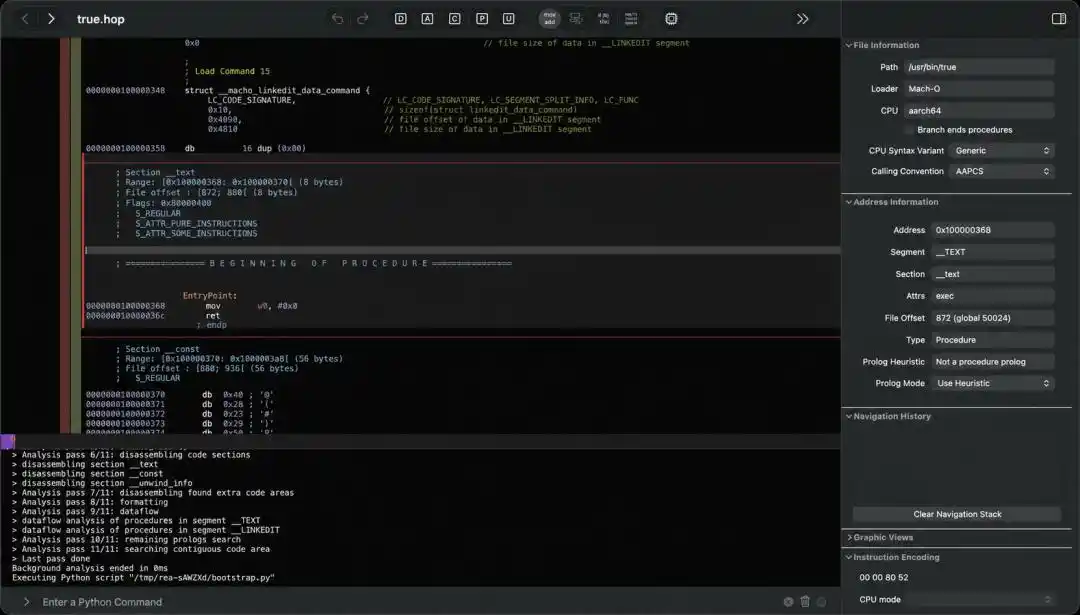
Its rise on GitHub has been rapid. According to the report, REA picked up more than 14,000 stars in a single day and has now reached 41,000 in total, putting its buzz on a level the author compares with OpenClaw earlier this year.
What REA does
The piece describes REA as a toolbox that plugs into an agent, in a way similar to Harness. It had been available on GitHub earlier, but its popularity surged after an Oct. 7 update to version 4.1.0 that added a wide range of new functions, including reverse engineering for mobile apps.
Only a few days later, it had already moved to version 6.1.0 with another large batch of updates. The article says REA can now reverse engineer nearly all software on the market.
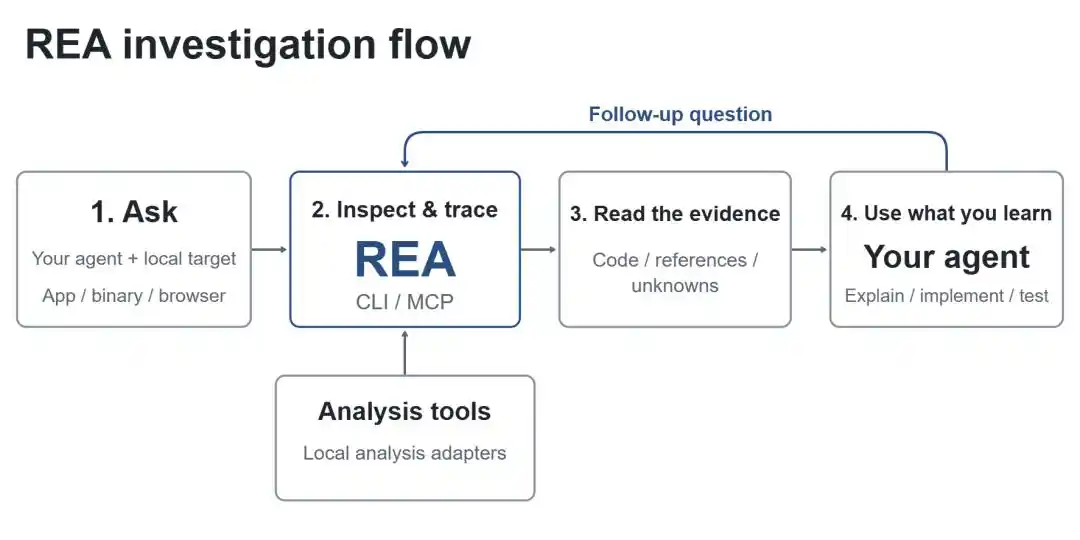
REA connects through the MCP protocol to agents that support local MCP services, including Claude Code, Codex, Cursor and Gemini CLI. Once attached, it hands those agents a broad set of reverse engineering tools. In practical terms, the project packages workflows that reverse engineers would normally run separately and makes them callable by an agent.
The scope listed in the article is wide. For native binaries, it can return pseudocode, assembly, strings, symbols and call relationships. For JavaScript and Electron apps, it can reconstruct modules, import relationships, routes and IPC. It can also inspect websites by collecting page structure, scripts and network requests. The article also lists .NET assemblies, Android APKs, firmware, EVM bytecode and Linux crash records among the supported targets.
Examples shown by the project
The report points to several demonstrations. One involved tracing the audio panning function in the classic game DX-Ball, turning incomplete pseudocode back into C. The reconstructed version passed 3,205 original x86 test cases, and the compiled bytes for 63 functions matched exactly.
Another example focused on Notion’s clipboard bridge. The analysis started from clipboard APIs in the rendering process, moved through preload and IPC, and reached the main process to clarify the format used for rich-text clipboard data.
The article also mentions a reconstruction of bullet-angle calculations in the PC-98 game TH04. It adds that these examples share a common trait: the programs are not especially large and their structures are relatively clear.
REA’s GitHub page includes a disclaimer as well. The project says it is only for lawful reverse engineering research, that users must obtain authorization on their own and comply with the law, and that illegal or unauthorized use is not supported.
The developer behind REA
The project’s author uses the GitHub ID morluto. The article says his research areas include agents, reinforcement learning environments and preference learning. It also quotes him as saying REA was built as a set of tools for agents.
Beyond REA, the report lists several other projects tied to morluto: the pure mathematics tool Jacobian, the code-context tool LeanToken, the runtime performance evidence tool flameox, the pre-contribution research tool GitContribute, the optimization evidence tool SmokingGun, and Preference, described as research infrastructure for trading agents.
The article also says morluto has submitted fixes to a number of well-known open-source projects, including Triton, the MCP TypeScript SDK, Qwen Code, Hermes, OpenClaw and Mooncake.
How the community is using it
Once REA went viral, developers quickly began pointing it at a broad list of software. The article says some used it to reverse engineer Adobe products and then produced graphics and editing apps with similar functions.
The list did not stop there. The report also says community members have used REA on Google’s app suite, as well as Codex and Claude Code. By the time the article was written, WeChat, Alipay and Douyin had also been widely inspected by the community through REA.
Reverse engineering is not automatically illegal
The article spends significant space on legal boundaries. It argues that many people instinctively equate reverse engineering with cracking and assume it is illegal by definition, but the actual line depends on what is done with the results and whether authorization exists.
In China, according to the article, a lawful owner of a copy of software may use it without the copyright holder’s permission for the purpose of learning and studying its design ideas and principles. But directly copying code or assets obtained through reverse engineering, changing them and republishing them would infringe copyright.
The piece says the character of the activity changes if the target is an online system. After analysis, going on to access, attack or scrape another party’s servers could trigger criminal issues tied to illegally obtaining data from computer information systems or damaging such systems.
It also points to similar logic overseas. In the United States, the Digital Millennium Copyright Act restricts circumvention of technical measures while keeping exceptions for security research. In the European Union, the software directive allows limited decompilation for interoperability. The article’s broader point is that the global computing industry generally tolerates research and interoperability, while copying, profit-seeking and unauthorized intrusion are not allowed.
What this means for WeChat, Alipay and Douyin
The report argues that the real core of these mass-market apps is not sitting inside the mobile client. Payment risk controls, account systems, recommendation algorithms, social graphs and content distribution all run on servers. REA analyzes the installation package on a user’s device, not the cloud service behind it.
Even when REA performs packet capture analysis or website analysis, the article says it only sees requests and responses moving between the client and the server. It does not directly reveal the server’s internal logic. In the author’s framing, that means turning these apps upside down still does not expose the recommendation engine itself.
The article notes that major apps already deploy code obfuscation, packing, anti-debugging, integrity checks and dedicated risk-control SDKs. It says Alipay’s client-side protections are known to be strict because of the money involved, that WeChat uses its own protocol encryption and client verification, and that Douyin uses strict request parameter signatures. Those protections were built to resist reverse engineering tools in the first place.
Still, the author does not dismiss the threat. The point made in the piece is that such defenses were largely designed against human analysts, while REA sits behind an agent that can keep working 24 hours a day. One of REA’s main selling points, the article says, is that if someone likes a feature, they can ask an agent to work out how it operates and then build a version of it.
For national-scale apps, though, the article argues features are not the deepest moat. WeChat’s moat is that more than a billion people use it. Alipay’s moat is its financial licenses and merchant network. Douyin’s moat is its content ecosystem and recommendation system. The report says those advantages cannot be copied by decompiling software.
Where REA can do more, in the article’s view, is around the experience layer: specific interaction details, mini-program loading mechanisms, or local caching strategies. Those pieces are much more exposed to client-side analysis.
Where REA could still find problems
The report calls reverse engineering a double-edged tool. It can help security researchers identify weaknesses, but it can also be used by malicious operators to study app interfaces and validation logic.
The article lists several examples of issues REA might help surface: checks that are only enforced on the client, locally stored data that is not encrypted, or interfaces that trust parameters sent by the client by default. The author argues that this is exactly the kind of work agents are good at, because they can scan thousands of functions and call relationships and then produce a list of suspicious points. REA was also designed to return evidence-backed conclusions, which helps with filtering leads.
But the report says there are at least three barriers in practice.
- First, obfuscation and hardening can make the recovered code incomplete and difficult to read, which raises the chance that an agent misreads what it sees.
- Second, the real value of many vulnerabilities sits on the server side. Client-side findings are often only entry clues, and verifying them requires interaction with live online services.
- Third, there is the problem of false positives. REA may flag something as suspicious, but that does not prove a vulnerability is actually exploitable. Many leads will be disproved, and people still need to judge which ones matter.
If a flaw is found, the article groups the impact into three layers
The first layer is client-side logic flaws, such as bypassed local checks, feature switches that can be tampered with, or poor handling of sensitive local data. The article says the effects here are usually limited and show up more in product fairness and user experience. Using Douyin as an example, it mentions inflated activity, cheating or bypassing some restrictions. Large companies can usually patch these issues in a release, and ordinary users may not notice much, though malicious operators could scale the abuse.
The second layer is interface and server-side vulnerabilities, which the article treats as the real danger zone. If an interface suffers from improper authorization, misplaced trust in parameters, or a broken signature mechanism, the impact can move from isolated accounts to bulk exploitation. The examples cited include mass data scraping, credential stuffing, organized abuse of discounts, and in financial settings, even money-related risk.
The third layer is supply-chain and third-party component vulnerabilities. Major apps integrate large numbers of SDKs, open-source libraries and mini-program containers. Reverse engineering tools are especially good at identifying which version of which component is embedded in an app. If a widely used component carries a known flaw, the impact can spread beyond a single app and hit an entire chain of products.
The article notes that REA explicitly says it must be used lawfully. But it also points to a basic problem with open-source tools: the creator cannot control who uses them or what they decide to do next.
The article’s bottom line
For ordinary users, the piece says there is no need for excessive fear. REA does not by itself determine whether an account is safe, and account security still depends mainly on server-side risk control.
For large internet companies, however, the article’s conclusion is direct: REA is a major threat.
The original article was from the WeChat public account Alphabet AI, written by Miao Zheng, and republished by MarsBit.