Reflection releases Beam 1.0 open weights as Nvidia reportedly weighs more funding or a buyout

Reflection releases Beam 1.0 open weights as Nvidia reportedly weighs more funding or a buyout

N
News Editor
2026-10-16 14:57:26
U.S. artificial intelligence company Reflection has uploaded the weights for its first large model, Beam 1.0, to Hugging Face, following through on a preview it made on Oct. 5. The model uses a mixture-of-experts, or MoE, architecture, carries 501 billion total parameters, activates about 23 billion per inference, and supports a 1 million-token context window. Reflection also released BF16, FP8, and NVFP4 versions under the Apache 2.0 license, allowing commercial use and derivative development. Alongside the model, the company open-sourced Mirror CLI, a programming agent framework that supports tool calling, parallel multi-agent task execution, and custom model interfaces. It also introduced DFlash2, an acceleration model that generates multiple candidate tokens in advance and lets the main model verify them. With help from the vLLM team, Beam’s underlying code was optimized, cutting per-step single-request decoding time on eight GB200 GPUs from 8.95 milliseconds to 3.30 milliseconds, or 2.71x the original speed. Artificial Analysis gave Beam 1.0 a score of 30, placing it second among U.S. open-weight models behind Meta’s Muse Spark Open at 39. The Financial Times reported on Oct. 10 that Nvidia, which has already invested about $800 million in Reflection, is discussing either additional funding or an acquisition. Reflection is valued at about $25 billion.

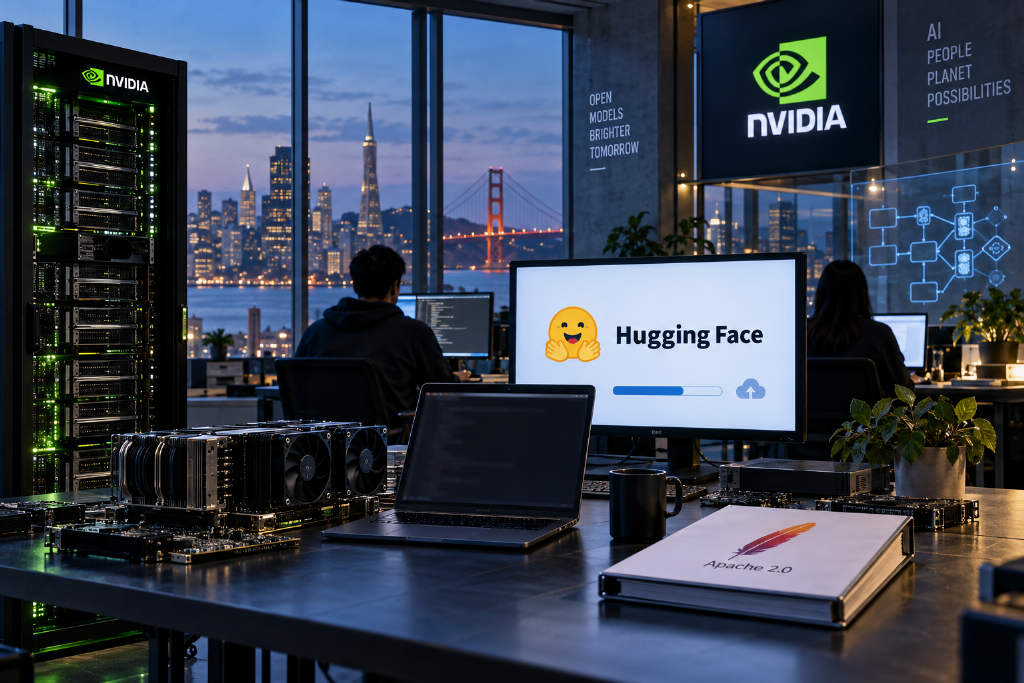
U.S. AI company Reflection has uploaded the weights for Beam 1.0, its first large model, to Hugging Face, delivering on a preview it issued on Oct. 5.

Beam 1.0 ships as an open-weight model under Apache 2.0

Beam 1.0 uses a mixture-of-experts architecture with 501 billion total parameters and roughly 23 billion activated during each inference. The model supports a 1 million-token context window. Reflection released three versions at the same time: BF16, FP8, and NVFP4. The model is distributed under the Apache 2.0 license, which permits commercial use and further development.

Mirror CLI and DFlash2 were released alongside the model

Reflection also open-sourced Mirror CLI, a companion programming agent framework. It supports tool calling, parallel task execution across multiple agents, and custom model interfaces.

The company also released DFlash2, an acceleration model designed to generate several candidate tokens ahead of time and pass them to the main model for verification.

vLLM team helped improve Beam’s underlying code

According to the release, the vLLM team used a programming agent to optimize Beam’s low-level code. On eight GB200 GPUs, per-step compute time for single-request decoding fell from 8.95 milliseconds to 3.30 milliseconds, bringing speed to 2.71 times the initial version.

Artificial Analysis ranked it No. 2 among U.S. open-weight models

The release drew support from more than 40 partners, including Amazon Web Services, Google Cloud, and Nvidia.

In the latest independent assessment from Artificial Analysis, Beam 1.0 scored 30 points, ranking second among U.S. open-weight models. It trails Meta’s Muse Spark Open, which scored 39.

Beam 1.0 also remains behind several Chinese models, including DeepSeek V4 Flash at 39 and Zhipu’s GLM-5.3 at 45.

Financial Times says Nvidia is discussing more funding or a takeover

Reflection is valued at about $25 billion. The Financial Times reported on Oct. 10 that Nvidia, which has already invested about $800 million in the company, is discussing either a further investment or an acquisition of Reflection.

This article was originally published by Bit.Fan. For more cryptocurrency news and market insights, visit www.bit.fan.
100

Disclaimer:

The market information, project data, and third-party content displayed on this platform are for industry information sharing only and do not constitute any form of investment advice or return commitment.

Cryptocurrency trading carries high risks. Users should fully assess their risk tolerance and make independent decisions. All profits, losses, and legal responsibilities are borne by the users themselves.