
Ren Shaoqing, one of the authors of ResNet, has formally founded a company to enter the embodied intelligence robotics sector.

Quantum Bit said it learned and confirmed that Ren, a prominent AI scientist, ResNet co-author, director of the Institute of General Artificial Intelligence at the University of Science and Technology of China, senior vice president of NIO, head of its smart-driving business, and a 2023 Future Science Prize laureate, has set up a company focused on embodied intelligence robotics.
According to LatePost, NIO CEO William Li told staff at an internal all-hands meeting for the company’s smart-driving unit that Ren, who leads NIO’s intelligent driving business, had established an independent company for physical AI foundation models and embodied intelligence.
The report said NIO will make a strategic investment in the new company and will also pursue business cooperation with it. Ren’s new venture has completed registration and is already valued at a unicorn level, meaning more than $1 billion, though the company name and specific financing details have not been disclosed.
Ren remains at NIO as the structure stays unclear
The article said the exact operating model behind Ren’s move into embodied intelligence robotics is still not fully clear. While he has started a robotics company, he remains employed at NIO.
A person close to NIO management said the carmaker has long tracked frontier AI technologies and has built its industrial layout through both in-house research and open collaboration. In recent years, NIO has kept investing in key technologies such as chips and operating systems and has made progress there, while also supporting innovative companies through strategic partnerships and industrial coordination in areas that include embodied intelligence, algorithm models, smart hardware, new energy, and computing infrastructure.
The report added that, internally, NIO sees smart driving as one of the most mature large-scale deployment scenarios for AI in the physical world. It also sees continuity between smart driving and embodied intelligence in core capabilities such as perception, prediction, planning, control, world models, and reinforcement learning. Over the past two years, more talent from autonomous driving and intelligent driving has moved into robotics, a shift the report linked to that technical transfer.
The article noted that NIO’s wording around Ren’s change in status has been somewhat ambiguous. It said that if Ren had left to found the company outright, that would not necessarily be positive for NIO at a time when the company has momentum. On the other hand, if the new venture is treated as an incubated or internal innovation business linked to NIO, the high-investment and long-cycle nature of embodied intelligence robotics could still put pressure on the automaker just after its financial turnaround.
The report also pointed to XPeng, described as an early backer of embodied intelligence robotics, which recently announced its first round of external independent financing ahead of its next quarterly earnings release, framing that as a clear signal of financial independence for its robotics business. By comparison, NIO was not the earliest to test embodied intelligence robotics, but the company’s internal thinking and public comments on the direction had already been made clear.
According to the article, when NIO’s financial performance was under pressure in 2025, both William Li and Ren separately told Quantum Bit that the next stage for AI-plus-automotive at NIO would lean toward robotics rather than Robotaxi. Ren’s move into a new company is described there as a sign that NIO has started testing the embodied intelligence robotics path.
World models sit at the center of the technical path
NIO had already begun internal research on world models in the second half of 2023, the report said. In July 2024, Ren represented NIO at its Tech Day event and unveiled NWM, short for NIO World Model. The model started mass-production rollout in 2025 and was upgraded this year into a framework combining a world model, supervised fine-tuning, and closed-loop reinforcement learning.
Ren has repeatedly said that world models are a shared foundational paradigm for autonomous driving and robotics. The article said the spatial-temporal cognition, long-horizon reasoning, and closed-loop optimization capabilities built on the vehicle side can be transferred directly into physical AI and embodied intelligence scenarios. It presented that as part of the technical backdrop for the company Ren has now founded.
The report described Ren as one of the earlier hands-on believers in world models in the industry and said that stance was a key reason NIO’s smart-driving business was able to catch up quickly. It also said world models are becoming a new direction for the convergence of robot brains. NIO’s own business scenarios, supply chain, and manufacturing capabilities were described as naturally suited to forming a deployment loop for robotics.
The article added that people familiar with Ren may know that although he entered entrepreneurship directly after earning his doctorate by becoming a co-founder of Momenta, his personal style and strengths are closer to the role of a chief scientist or CTO.
Academic record and career background
Ren was born in Bengbu, Anhui, in 1988. He graduated from Bengbu No. 2 High School in 2007 and entered the University of Science and Technology of China to study information security.
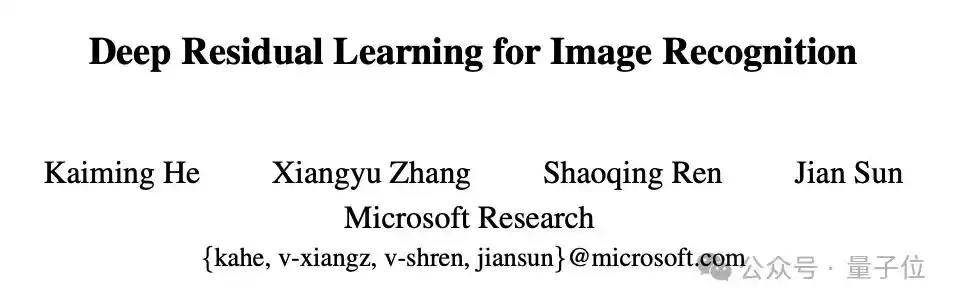
In 2016, under the supervision of Sun Jian, one of the authors of ResNet, Ren received a jointly trained doctoral degree from the University of Science and Technology of China and Microsoft Research Asia. Ren himself was one of the four authors of ResNet.
The article described ResNet as a landmark work in deep learning because it fundamentally solved the vanishing-gradient problem in training deep neural networks. That made it practically possible to build high-performance, very deep neural networks and had major impact in fields such as computer vision and autonomous driving, where perception is critical. The work won the CVPR 2016 Best Paper Award and has now been cited more than 340,000 times. Its core authors are Kaiming He, Xiangyu Zhang, Ren Shaoqing, and Sun Jian.
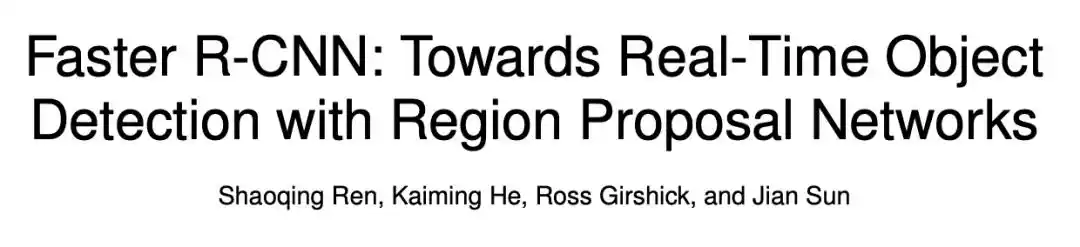
Ren was also the first author of Faster R-CNN. The report said the method is an efficient two-stage object detection algorithm that solved the time-consuming candidate-region generation problem in earlier detection methods and achieved a strong balance between speed and accuracy. It has been widely used in autonomous driving, security, and medical imaging analysis.
After completing his doctorate, Ren joined autonomous driving startup Momenta as R&D director and co-founder. In 2020, he formally joined NIO. He first served as chief expert for autonomous-driving R&D and assistant vice president, mainly overseeing the self-driving algorithms team. He was later moved to vice president of smart-driving R&D and reported directly to William Li.
At the end of 2024, NIO restructured its smart-driving R&D department and set up a new technical committee. Ren directly managed that team and led the large-model division, expanding his scope of authority again. The article said that after Ren took over NIO’s smart-driving R&D system, the company became the first globally to bring a world model into vehicles at scale and, combined with NIO’s in-house chips, helped the automaker achieve a sharp improvement in smart driving. It described that work as one of the key contributions behind NIO’s move from losses to profit and its first profitable period in 2025 and 2026.
Following that progress with world models, Ren was promoted to senior vice president at NIO.
USTC return and embodied intelligence research
The article also said Ren has continued to support his alma mater, the University of Science and Technology of China. In September 2025, he returned to USTC to recruit students and took roles as chair professor, doctoral supervisor, and director of the Institute of General Artificial Intelligence. Earlier, he donated the full amount of his Future Science Prize award money to the university.
On Ren’s academic webpage at USTC, the main research areas listed now include embodied intelligence, specifically artificial intelligence, world models, embodied intelligence, autonomous driving, computer vision, deep learning, and AI for Science.
According to the achievements cited in the article, as of March 2026, Ren’s academic papers had been cited more than 490,000 times, ranking first among scholars in China and among the top three Chinese scholars globally.
The awards and distinctions listed for him include the 2023 Future Science Prize in Mathematics and Computer Science, the 2025 Wu Wenjun AI Science and Technology Progress First Prize, the CVPR Best Paper Award, the 2025 NeurIPS Test of Time Award, the 2025 Helmholtz Prize for 10-year impact at ICCV, the Software-Defined Vehicle Innovator Award, global championships in the ImageNet and MSCOCO competitions, and third place overall in the AI 2000 global AI scholar ranking.
The original article was published by the WeChat account Quantum Bit and written by Yu Yang.