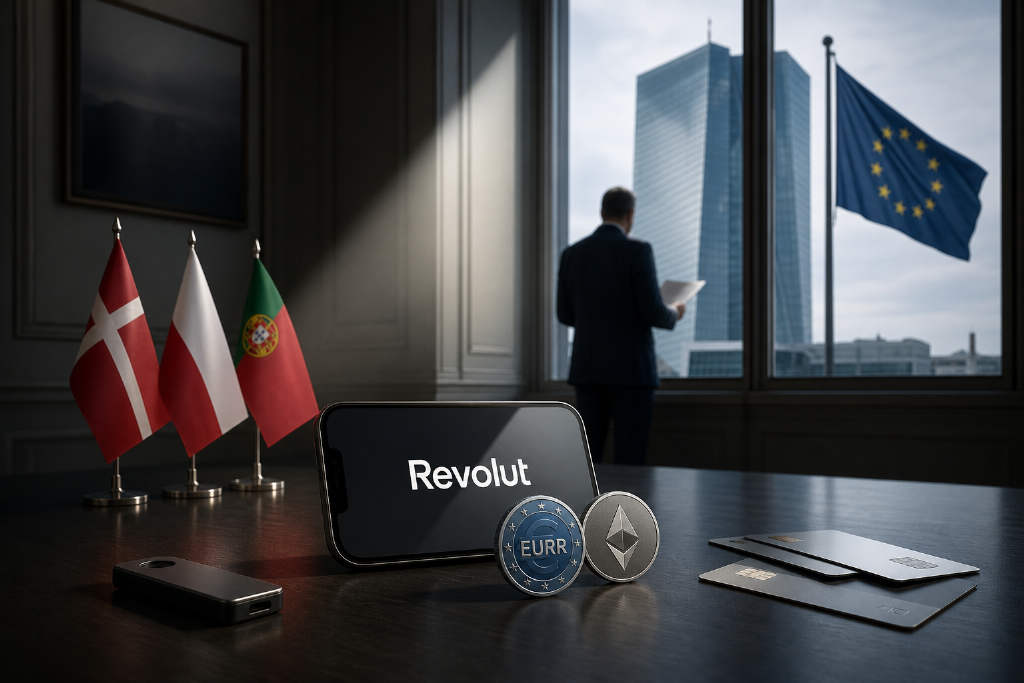
Revolut has begun a phased rollout of its euro-denominated stablecoin EURR to eligible users in Denmark, Poland, and Portugal, with plans to extend access across the European Economic Area. The token runs on Ethereum and is designed for on-chain transfers between fiat, crypto assets, external wallets, and supported blockchain networks. EURR is issued by Bridge Building, a Stripe-owned company, rather than directly by Revolut. At the same time, the European Central Bank said the digital euro remains under development and would represent public money, while EURR is a privately issued stablecoin intended to maintain a value of 1 euro. ECB Executive Board member Piero Cipollone said the digital euro would offer the highest level of privacy supported by current technology, with offline payments visible only to payer and payee, while banks in online transactions would still have access to information needed for anti-money laundering compliance.
Revolut has started a phased rollout of the euro stablecoin EURR to eligible users in Denmark, Poland, and Portugal, and plans to expand availability across the European Economic Area.
EURR is deployed on Ethereum and can be used for on-chain transfers between fiat currencies, crypto assets, external wallets, and supported blockchain networks. The token is issued by Bridge Building, a Stripe-owned company, not directly by Revolut.
The move comes as the European Central Bank continues work on the digital euro. The ECB-issued digital euro would represent public money and is still in development, while EURR is a privately issued stablecoin designed to hold a value of 1 euro. Both are aimed at meeting demand for instant fund transfers on digital platforms.
ECB Executive Board member Piero Cipollone said the digital euro would provide the highest level of privacy supported by current technology. In offline payments, only the payer and the recipient would be able to see the transaction. In online transactions, participating banks would still be able to access the information required for anti-money laundering compliance.
This article was originally published by Bit.Fan. For more cryptocurrency news and market insights, visit www.bit.fan. Disclaimer:
The market information, project data, and third-party content displayed on this platform are for industry information sharing only and do not constitute any form of investment advice or return commitment.
Cryptocurrency trading carries high risks. Users should fully assess their risk tolerance and make independent decisions. All profits, losses, and legal responsibilities are borne by the users themselves.