
Riot Platforms has secured a 20-year AI data center compute hosting agreement with Anthropic valued at $9.1 billion, a deal that points to a broader shift in how parts of the bitcoin mining sector may be priced by investors.
Bloomberg reported that Anthropic, the company behind Claude, signed the long-term arrangement with Riot as major AI labs race to secure power and infrastructure. Riot shares rose more than 25% in after-hours trading after the news.
191 megawatts for Anthropic, with rollout extending to 2028
On Aug. 11, Anthropic and Riot reached the AI data center, or AIDC, agreement to support rising compute demand from Claude users. Riot said it will provide 191 megawatts of capacity, which it said is roughly equal to powering about 143,000 homes at the same time. The contract runs for 20 years.
SEC filings show the capacity will not arrive all at once. The first 96 megawatts are expected to be delivered in December next year, while full deployment is scheduled for June 2028.
For leading AI labs, certainty of compute supply has become critical. Training and inference demands keep climbing, and the output and scheduling capacity of a single cloud provider is becoming harder to rely on for the largest workloads.
Rather than build data centers itself, Anthropic has been using a lighter-asset model built around 15- to 20-year build-to-suit leases that lock in power, sites and compute over long periods.
Anthropic’s infrastructure push already spans several partners
The report says Anthropic’s buildout goes well beyond public cloud relationships with AWS and Google Cloud. It also includes:
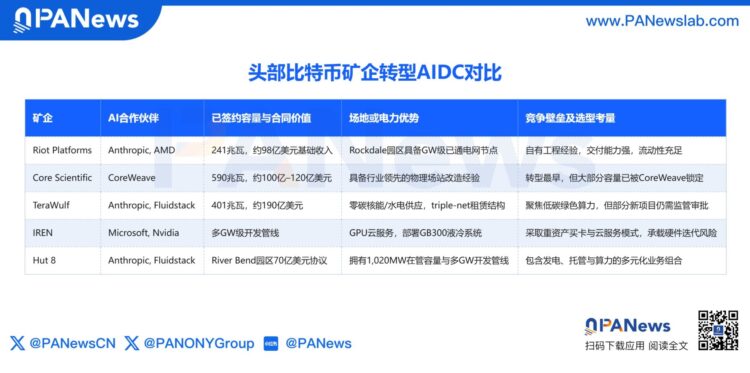
- a 20-year lease with TeraWulf covering 401 megawatts and valued at $19 billion;
- a $10 billion supply agreement with infrastructure startup Volta Infra Holdings;
- an intended compute procurement arrangement with xAI worth nearly $45 billion;
- AI data center partnerships with Hut 8 and Fluidstack.
The strategy described in the article is straightforward: secure physical compute resources for decades in advance. Compared with building an AIDC from scratch, which can take years and require heavy capital spending and operating risk, long-term leasing leaves Anthropic with more financial flexibility while pushing construction obligations to specialized infrastructure providers.
Why PANews says Riot won the mandate
Publicly traded miners in the U.S. have broadly been moving toward AIDC strategies as bitcoin halving pressure collides with a surge in AI demand. The article names Core Scientific, TeraWulf, IREN, Hut 8 and Cipher Mining as companies telling versions of the same hosting story. PANews says Anthropic’s choice of Riot comes down to three factors.
Power that is already connected
One of the biggest bottlenecks in global AIDC development is access approval for substations and high-voltage grids. Traditional data center developers often wait two to four years from application to live power.
Riot’s Rockdale site is described as one of North America’s largest single digital infrastructure campuses. It already has approval from ERCOT, the Texas grid operator, and high-voltage energized access, making it one of the few U.S. sites that can be converted directly into an AI compute center.
Competitors have less uncommitted room, according to the article. Much of Core Scientific’s capacity has already been taken by CoreWeave, while TeraWulf’s existing capacity has been allocated across customers including Fluidstack. For Anthropic, which needs capacity to come online fast, Riot’s ready-to-use power allocation was difficult to replace.
The report also notes a regulatory risk. Texas has become a favored destination for AIDC projects because of relatively low power prices, but large high-load facilities are drawing greater scrutiny. Bitcoin mining can power down flexibly to help the grid manage peaks, while AI training and inference need uninterrupted 24/7 electricity.
Execution that has already been tested
Frontier AI labs are highly sensitive to delivery timelines. Construction delays can ripple into model training, product release schedules and financing plans.
The article points to Riot’s work with Advanced Micro Devices, or AMD, as proof of execution. Riot signed an initial 50-megawatt data center lease agreement with AMD in January and completed the first 25 megawatts of IT capacity on time and on budget by the second quarter.
It also says Riot is not just acting as a landlord. The company has its own engineering manufacturing and assembly facilities in Denver and Houston, giving it end-to-end control from transformer design to customized cooling systems and site construction. That can reduce the risk of supply-chain disruption and build delays.
Even so, the article says AI infrastructure carries meaningful uncertainty over a two-year build window. Chip architectures can change, the structure of compute demand can shift, and costs can overrun.
A stronger balance sheet for heavy conversion work
Turning a bitcoin mining site into an AIDC requires substantial capital. The article puts average industry conversion spending at as much as $7.5 million per megawatt. Many smaller miners, it says, have struggled because their balance sheets cannot support that level of investment.
As of the end of the second quarter, Riot had more than $1.2 billion in liquid assets, including about $549 million in cash and 11,380 BTC in reserves. To support the Rockdale buildout, it also entered into a $573 million transitional financing agreement with Morgan Stanley.
That mix of cash, bitcoin reserves and bank financing, in the article’s view, lowers the risk that Riot runs out of money mid-project.
Still, the report warns that Riot and other miners making the same pivot remain highly exposed to a small group of AI labs and cloud companies. If commercialization or fundraising at those customers fails to keep pace with enormous capital requirements, the market may question the durability of long-dated hosting agreements.
How the deal could change the way miners are valued
The article argues that the $9.1 billion agreement is more than a business expansion for Riot. It marks a possible reset in the capital-market logic applied to bitcoin miners.
Higher revenue efficiency per megawatt
Bitcoin mining revenue has long moved with token prices and network difficulty. After the halving, margins have stayed under pressure and the business remains cyclical. By comparison, the article says compute hosting can generate close to $2.4 million in annualized revenue per megawatt, or roughly one to three times the revenue efficiency of mining.
There is also a cash-flow difference. Hosting income is tied to long-term contracts, which makes it more predictable and less dependent on swings in the crypto market.
A different valuation anchor
The report says capital markets usually assign discounted valuations to bitcoin miners, with EBITDA multiples typically around 6x to 12x. Data center infrastructure operators with long-term and stable cash flow, by contrast, often trade at EBITDA multiples of 20x to 25x.
With AMD and Anthropic agreements in place, Riot has accumulated 241 megawatts of long-term contracted capacity tied to about $9.8 billion in value, according to the article. That, it says, moves Riot away from the category of high-volatility crypto proxy and closer to an infrastructure company with utility-like characteristics.
From bitcoin reserves to hard assets
The shift also shows up in capital allocation. Riot sold 9,665 BTC in the second quarter and raised about $733 million to fund AIDC conversion and construction, according to the article.
PANews says this may become a wider pattern among miners: converting bitcoin reserves that do not generate cash flow into physical hard assets that can produce long-term contracted income.
On that view, miners are no longer only bitcoin producers. They are becoming landlords of compute resources. Delivery risk, technological change and regulatory pressure remain real constraints, but companies that already control power, land and engineering capability are entering a different valuation framework as the AI buildout accelerates.