
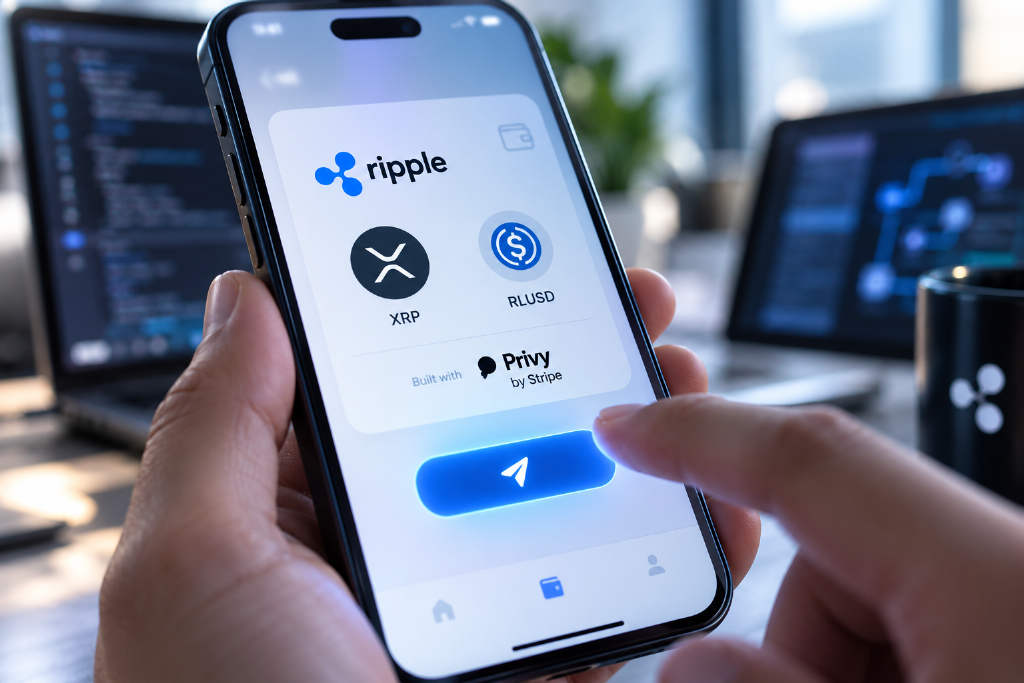
Ripple has partnered with Privy, Stripe’s wallet infrastructure unit, to bring embedded wallet technology to the XRP Ledger, allowing developers to build XRPL wallets directly into their apps instead of sending users to separate wallet software.
The integration supports transfers in XRP, Ripple’s RLUSD stablecoin, and other issued assets on the network. Privy handles the wallet infrastructure layer, reducing the amount of wallet tooling developers need to build on their own, while also supporting private key export and recovery phrases so wallets can be moved.
Built for financial apps and AI agents
The partnership is positioned around financial applications and AI agents that need to create wallets, hold crypto assets, and make payments from within an app. In practice, that means software products can embed wallet creation and payment functions directly into the user flow.
Privy’s documentation says server-operated wallets can let software hold and spend funds, including for buying data and online services through the x402 payment standard. An agent requesting paid data can receive a payment prompt, authorize the payment automatically, complete verification, and retrieve the data without a human opening a checkout page.
XRPL has processed more than 13 million x402 agentic payments
RippleX engineering lead J. Ayo Akinyele said on X that the XRP Ledger has processed more than 13 million agent payments through x402, with 166 x402 merchants on the network. He said agentic payments now account for roughly 25% of ledger activity.
He wrote: 「Just a couple of months ago, I predicted XRPL would quickly surpass 10M agentic transactions. XRPL has now hit another milestone, processing over 13M with 166 x402 merchants. Agentic payments now account for roughly 25% of activity on the ledger. 100M might actually come sooner…」
Transaction count is high, transferred value is still small
Data from XRPL AI Hub, operated by payment infrastructure developer t54, showed more than 14.3 million cumulative transactions and 169 registered merchants as of Wednesday.
But the total amount paid remains far below what the transaction count might suggest. The dashboard recorded about 6,991 XRP and 12,752 RLUSD in cumulative payments. The report said most transfers were small, matching a pattern of software paying for individual requests rather than moving large financial sums.
Ripple started offering the tools in June
Ripple began making these payment tools available to developers in June, allowing agents to create wallets, check balances, and pay with XRP or RLUSD. In September, the tooling was expanded to support a payment standard developed by Stripe and the payment blockchain Tempo, and added a way to pre-fund repeated requests with XRP so each one did not need to be settled separately.
The new Privy partnership is described as a deeper integration. Future additions are expected to include policy controls and features that help users cover network fees.
A 1 XRP reserve is still required
There is still one funding step that cannot be skipped when creating wallets inside an app. Privy’s documentation says each new XRP Ledger account must first receive the network’s minimum reserve, currently set at 1 XRP.
That means even if a customer only wants to transfer a dollar-pegged stablecoin, someone still has to provide 1 XRP to activate the account.
Usage is growing, but economic activity is still early
The report said more than 14 million agent payments sounds large, but the aggregate value remains limited. Based on the XRPL AI Hub figures of 6,991 XRP and 12,752 RLUSD, current activity still looks much closer to technical demonstrations and micro-payments than to large-scale economic use.
Ripple’s use of Privy’s embedded wallet technology is aimed at lowering friction for AI agents on XRPL. No separate wallet is needed, keys do not have to be managed in a separate workflow, and payments can be completed directly on enterprise backends. The report also noted that broader adoption of the x402 standard by data providers and API services would be needed before automated agent-to-agent payments can turn into a real commercial use case.
RLUSD is another piece of the story. Ripple is betting that RLUSD can become a core payment asset on XRPL. If agentic payments are settled mainly in stablecoins, they can avoid XRP price swings and align more closely with enterprise payment needs. For now, though, the cumulative total of 12,752 RLUSD suggests the ecosystem is still in an early stage.