
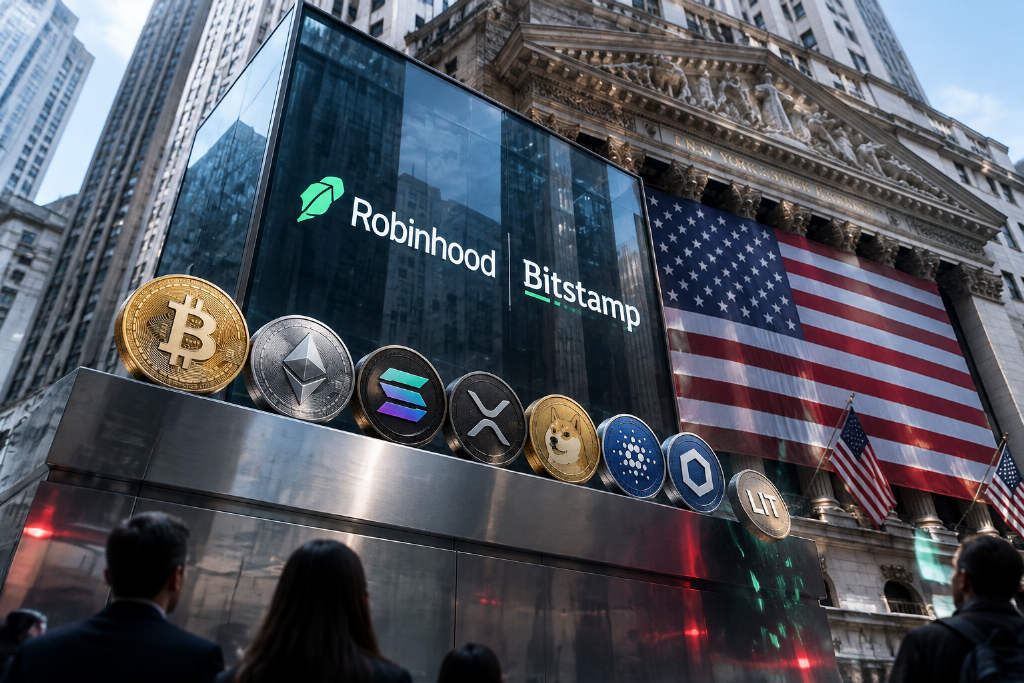
Robinhood’s new push into perpetual futures in the U.S. rattled Lighter’s token almost immediately.
At its annual presentation early on Sept. 30 Beijing time, Robinhood said it will offer perpetual futures trading to eligible U.S. users through Bitstamp, the crypto exchange it acquired for $200 million in 2025. The initial list of supported assets includes BTC, ETH, SOL, XRP, DOGE, ADA, LINK and HYPE. BTC and ETH will carry leverage of up to 10x, while the other assets will be capped at 3x.
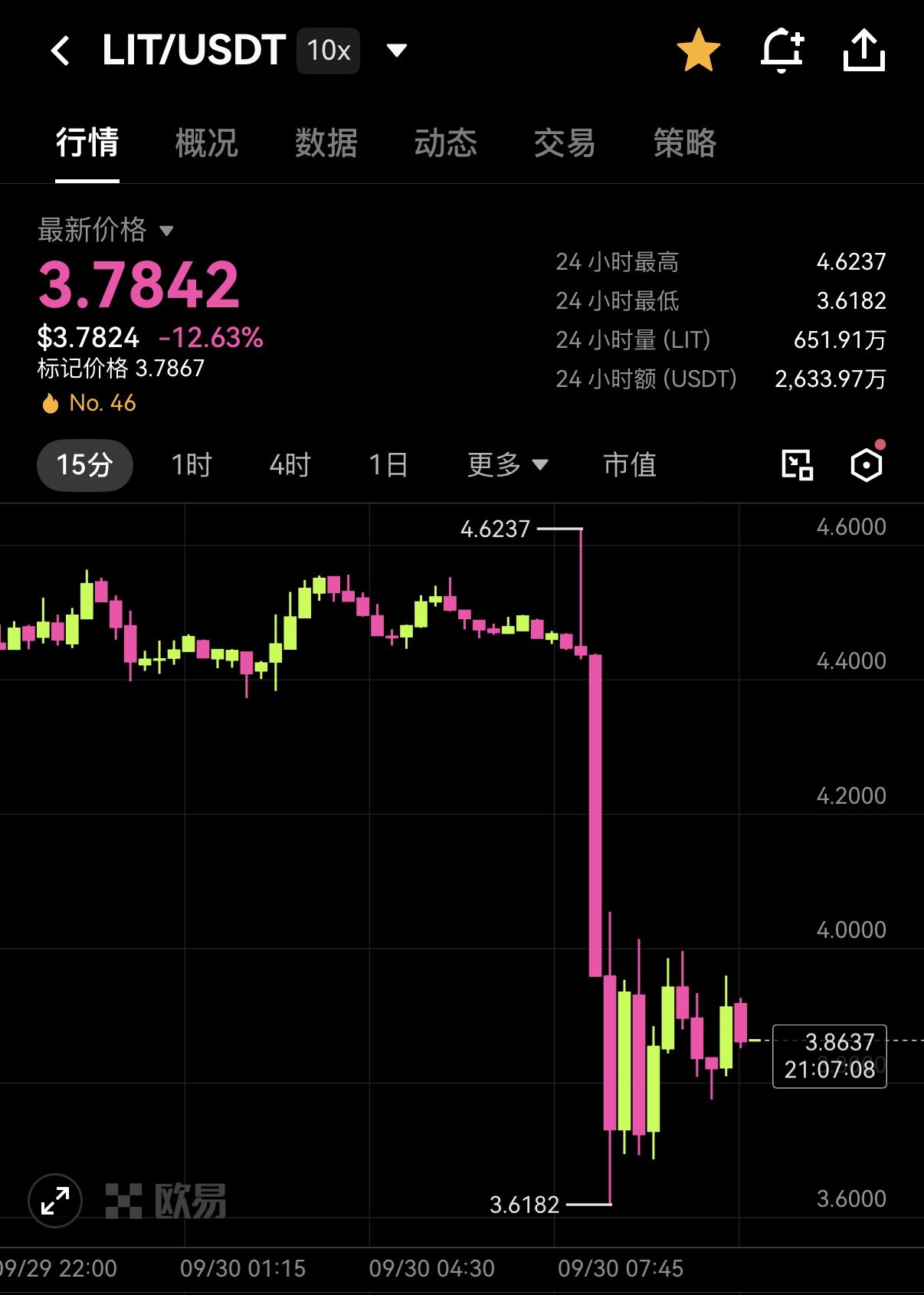
After the announcement, Lighter’s native token LIT dropped nearly 20% in short-term trading, erasing a sizable part of the gains it had built up earlier.
The move was less about Robinhood launching a new derivatives product and more about how that product is being rolled out. A major part of LIT’s market narrative had been the expectation that Lighter could use its ties to Robinhood to tap into the broker’s large retail user base. Once Robinhood confirmed that U.S. perpetuals would be delivered through Bitstamp, that expected upgrade in the relationship failed to materialize, and the market began to reassess whether Lighter could be pushed to the edge of Robinhood’s broader crypto stack.
What the market had been pricing in
Confidence in the Robinhood-Lighter connection did not come out of nowhere. The article points to the personal link between the two companies’ founders: Vladimir Novakovski and Vlad Tenev were high school classmates, both graduated from Thomas Jefferson High School for Science and Technology, and were described as the school’s only two Vlads.
In 2025, Lighter announced a $68 million Series B round, with Robinhood participating directly. Then, in mid-2026, Lighter was integrated with Robinhood Wallet, allowing wallet users to access Lighter’s products for perpetual futures and tokenized stock trading from inside the wallet.
That wallet integration gave Lighter its first direct channel to Robinhood users and opened the door to broader speculation about future business alignment. As Robinhood kept expanding its crypto business and moved deeper into on-chain assets and derivatives, Lighter, seen as one of the closest Perp DEX projects to Robinhood, drew rising expectations. Some in the market had gone a step further, betting that Robinhood might eventually bring Lighter into its main app or use its technology and liquidity to expand into more markets outside the U.S.
That is not the path Robinhood outlined this time. Instead, the company chose Bitstamp. From Robinhood’s perspective, using an exchange already inside the group to run derivatives is not a surprising decision. It comes with an existing operating base and allows the company to manage the service within a structure it already controls. For LIT holders, though, the issue is that part of the token’s valuation had already reflected hopes of a deeper partnership. Once that near-term scenario failed to show up, the repricing was swift.
Bitstamp’s role does not automatically remove Lighter
That said, a missed upgrade in expectations is not the same thing as a terminated partnership.
Viewed across Robinhood’s existing product map, Bitstamp and Lighter do not appear to be in a simple winner-takes-all relationship. The two have already existed in parallel across different business settings. Bitstamp has long offered perpetual futures in Europe, while Robinhood Wallet’s integration with Lighter has mainly served non-U.S. markets where that feature is supported. They address different market and product needs.
On that basis, Robinhood’s decision to use Bitstamp for U.S. perpetuals looks more like an extension of an existing operating model into the U.S. than a direct replacement of Lighter’s current role inside the wallet.
Publicly available information also stops short of showing a break. As of now, Robinhood Wallet documentation still lists Lighter as the underlying platform for perpetual futures trading. There is no public indication that the two sides have ended their partnership or that the integration is being removed. At the level of current business operations, the relationship appears to remain in place.
That does not mean expansion is guaranteed. Whether Robinhood will keep sending traffic to Lighter, or move toward deeper technical or commercial coordination, still depends on what comes next.
Regulatory approvals may be the real bottleneck
If the focus shifts from market narrative to operating reality, regulation may be the more important reason Lighter was not chosen for Robinhood’s U.S. perpetual futures rollout.
Robinhood’s plan to serve U.S. users through Bitstamp comes against the backdrop of strict oversight in the U.S. derivatives market. According to the article, Lighter has not yet obtained the regulatory approvals required to conduct that business in the United States. Even if Robinhood wanted to bring Lighter into its main app, the compliance hurdle would still need to be cleared first.
Bitstamp, by contrast, already has the foundation needed to support that line of business. After Robinhood brought the exchange in-house through its 2025 acquisition, Bitstamp became a ready platform for pushing perpetual futures into the U.S. market. Seen from that angle, choosing Bitstamp does not necessarily amount to a rejection of Lighter’s technology or business model. It may simply be the more workable arrangement under current regulatory conditions.
The article also notes that Lighter founder Vladimir Novakovski previously served on a Commodity Futures Trading Commission, or CFTC, advisory committee and has publicly discussed plans to pursue regulatory approvals. The market had at one point expected Lighter to be among the earlier Perp DEX projects to secure compliant access to the U.S. market.
For Lighter, progress on licensing will directly shape how much room it has to expand. If it eventually obtains Designated Contract Market, or DCM, status under the CFTC framework, it could gain a path to explore a compliant U.S. business. But there is still distance between an application, an approval, and an operating business, and the outcome remains uncertain.
What the sell-off is really repricing
LIT’s decline looks, above all, like a reset in assumptions.
If the investment case was built on the idea that Robinhood would soon route a large volume of U.S. retail derivatives flow directly into Lighter, the latest announcement clearly disrupted that timeline. If the thesis was instead based on Lighter’s standing as part of Robinhood’s on-chain ecosystem, then the current sell-off shifts attention back to a narrower set of questions: whether the existing partnership remains intact, whether regulatory progress starts to show up, and whether Robinhood takes any concrete steps beyond the wallet integration.
Based on the information in the article, two future catalysts stand out. One is substantive progress on the regulatory approvals Lighter needs. The other is whether Robinhood signals a deeper form of cooperation outside Robinhood Wallet.
For now, Robinhood’s decision to use Bitstamp for U.S. perpetual futures is enough to change how the market prices Lighter’s short-term story. It is not, on its own, enough to prove that Robinhood is walking away from Lighter.