
A weekend argument that began on Sept. 5 over Robinhood Chain’s fee model has turned into a broader clash between two ideas: ultra-low gas on one side, and infrastructure built around sustainable revenue on the other.
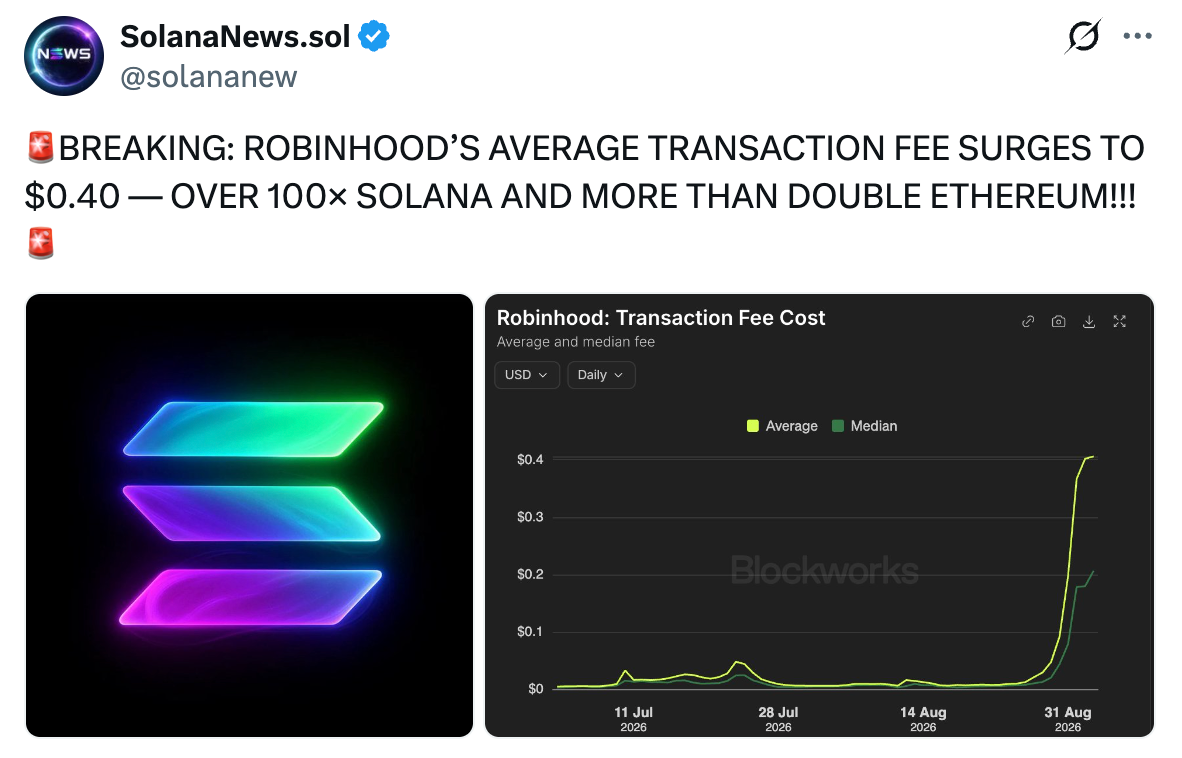
The trigger was Robinhood Chain itself. On July 1, 2026, Robinhood launched its standalone Layer 2 on Arbitrum Orbit, positioning it around tokenized U.S. stocks, perpetuals, and other financial products. Since launch, activity on the network has continued to rise, with daily fees at one point topping several million dollars.
As trading volume increased, average gas on the L2 rose to about $0.4 in early September. The article says that was more than 100 times the cost of transactions on Solana and about twice the cost of transacting on Ethereum mainnet.
Who should collect the fees?
Solana co-founder Anatoly Yakovenko amplified the discussion by pointing to Robinhood Chain’s revenue split with the Arbitrum ecosystem. Under the protocol arrangement described in the article, 10% of net protocol revenue is shared with Arbitrum, with 8% going to the DAO treasury and 2% to the developer fund. Robinhood keeps about 90%.
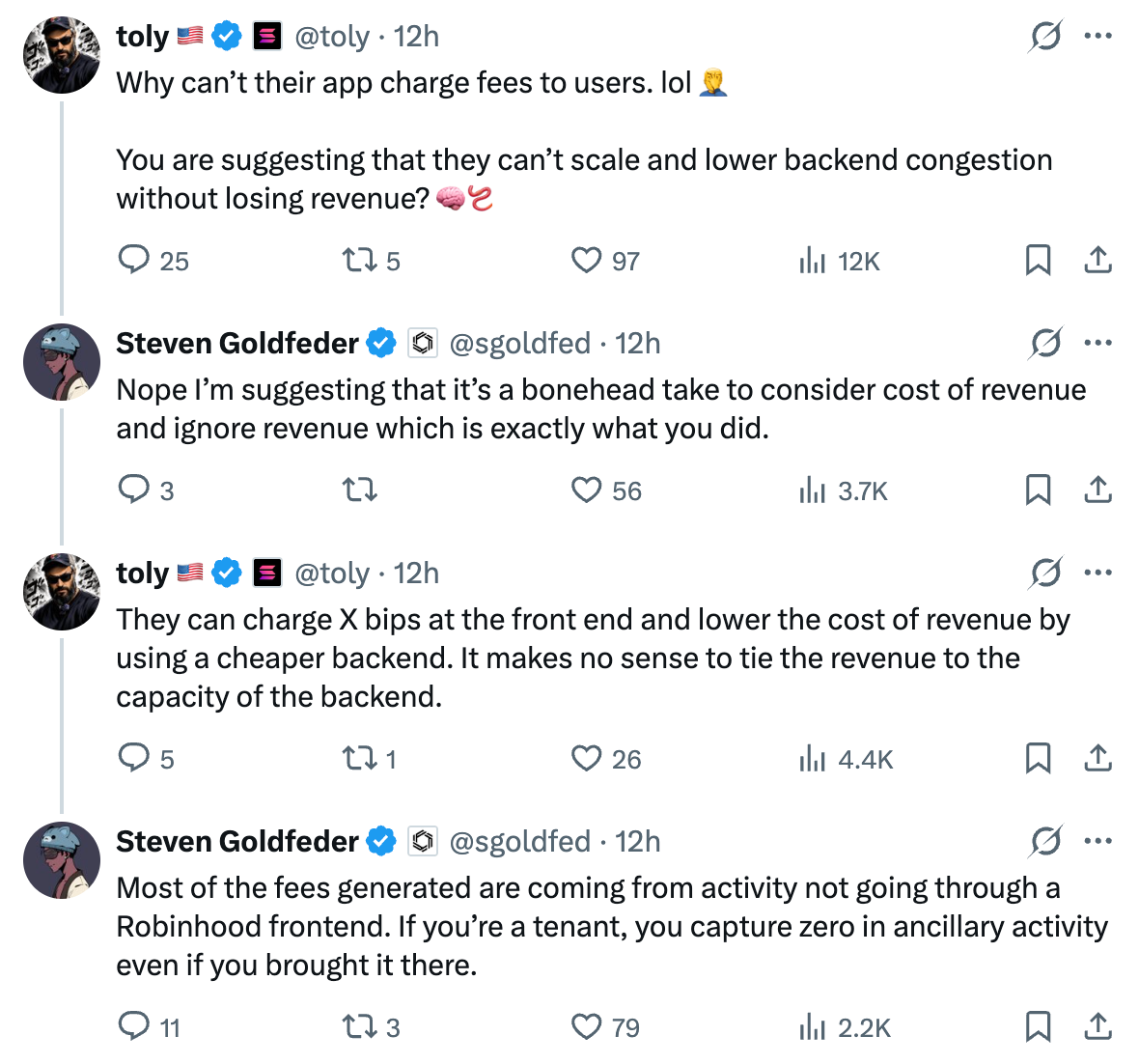
Yakovenko argued that this 10% share alone would be enough to cover four times the fees required for the same transaction volume on Solana. In his view, if Robinhood had launched on Solana, it could have delivered something close to a near-zero-gas user experience rather than passing congestion costs on to users. He criticized what he framed as a model that profits from congestion at the base layer, saying applications should charge users directly while the chain itself should aim for extremely low costs.
Offchain Labs co-founder Steven Goldfeder responded quickly. He said he respected Yakovenko but called the argument “absurd.” His point was straightforward: under Arbitrum’s structure, Robinhood gets to keep 90% of gas revenue. If the product had been deployed on Solana, the underlying fees would go to validators, not to Robinhood. If Robinhood still wanted to subsidize gas for users, it would need to pay for that itself.
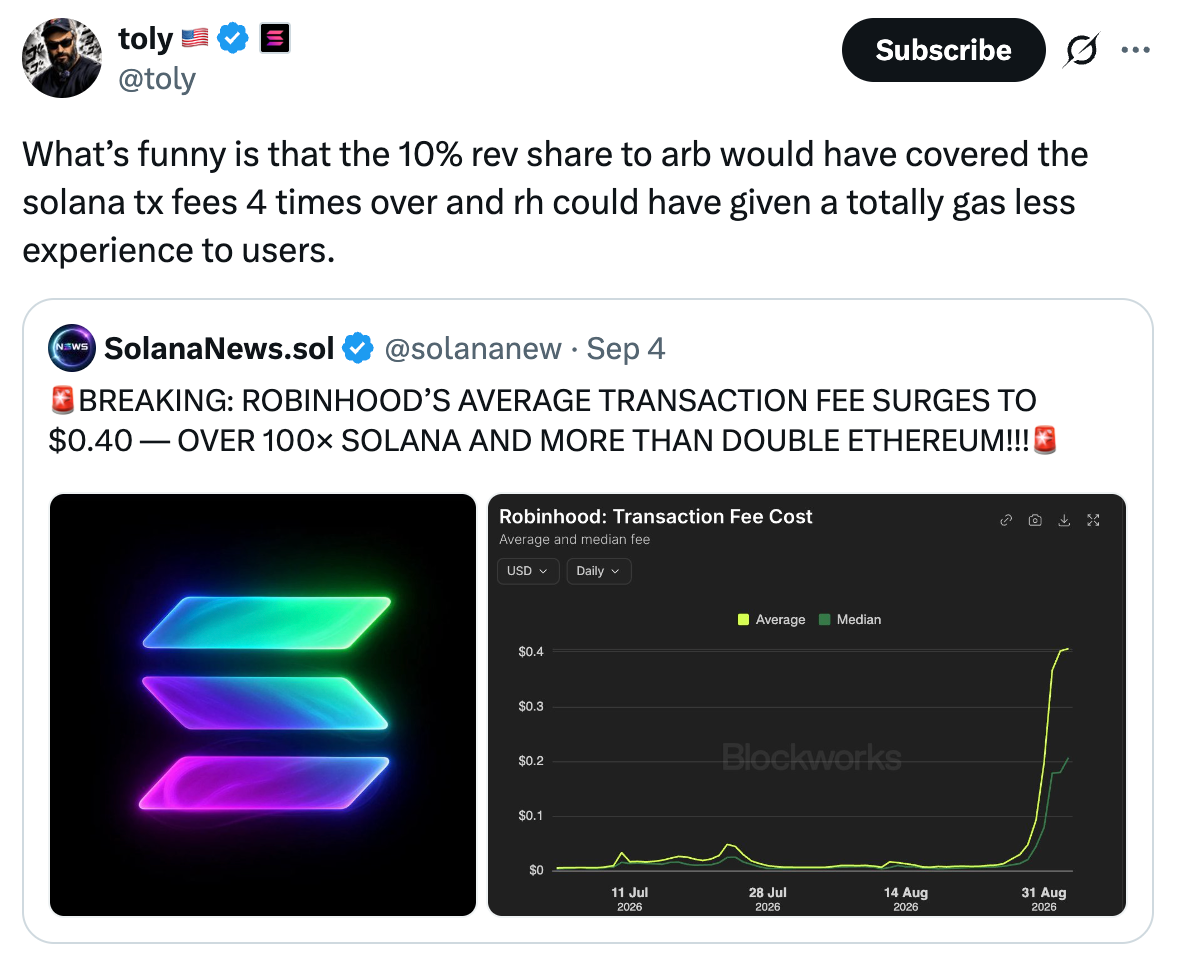
Goldfeder boiled the distinction down to ownership. Robinhood, he said, chose Arbitrum because it wanted to be a “landlord,” not a “tenant.” Running its own sequencer and controlling most of the revenue is what turns infrastructure into a durable business.
The exchange then moved past Robinhood and into a more basic question: should the chain charge for usage, or should the chain be close to free while applications monetize elsewhere?
The debate widened beyond Robinhood
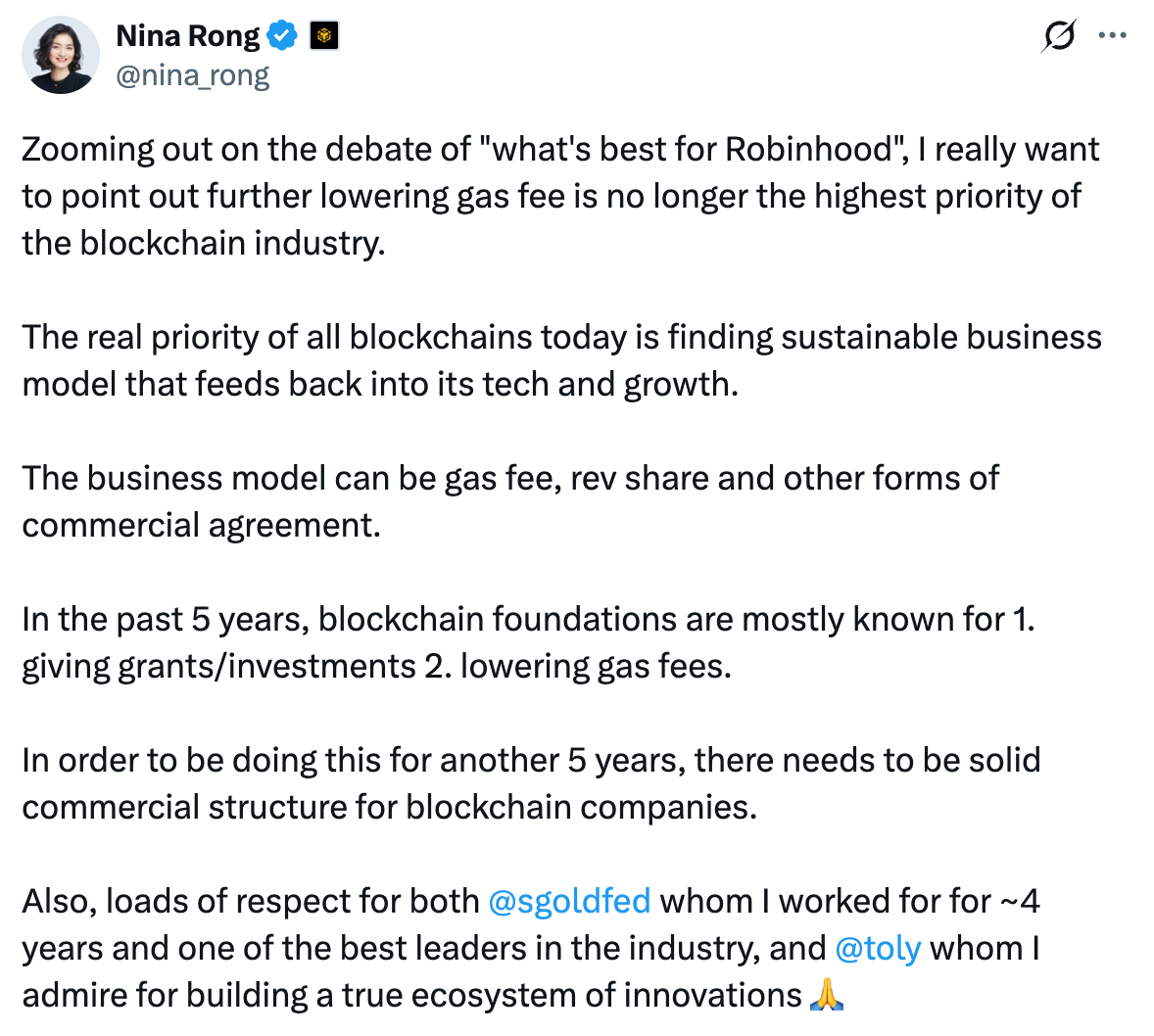
Nina Rong, growth lead at BNB Chain and a former Arbitrum executive for about four years, shifted the discussion away from which chain was better for Robinhood specifically. Her argument was that lowering gas is no longer the industry’s top priority. What matters more now is finding business models that can feed back into technology and user growth, whether those models take the form of gas fees, revenue sharing, or other commercial arrangements.
She noted that over the past five years, many blockchain foundations have been defined by grant programs and ever-lower gas costs. If the industry wants to last another five years, she said, it needs stronger commercial structures.
A Chinese-speaking user, @lanyihou, answered with a more concrete example. Trading a roughly 200U token position on Robinhood Chain, the user wrote, could cost 21U in gas and taxes, adding that talking about a business model in that environment was “more ruthless than drug dealing.”
Rong replied that fees could be lowered immediately if the goal was simply to change the number, but that would not solve the underlying problem. The harder challenge is finding a model that users can accept and that leaves the platform not just solvent, but profitable. She pointed to products such as GMGN as examples showing that users will pay for services they see as genuinely valuable.
Two ways to capture value
At the center of the argument are two different paths for value capture.
One path is built on extremely low costs and ecosystem flywheels. Solana has long leaned on high throughput and low fees to attract applications and users. The network maintains security and incentives through base fees and mechanisms such as MEV. If an application wants to offer gas-free transactions to users, it has to absorb those costs itself or monetize through frontend fees, advertising, subscriptions, or similar channels. The advantage is a better user experience. The trade-off is that applications have a harder time capturing value directly from congestion at the infrastructure layer.
The article argues that this path has already been validated. Solana’s low-cost, fast-finality setup helped it stand out during the meme coin trading waves of recent years, and periods of heavy traffic also produced products such as propAMM.
The other path is a customizable appchain model tied to revenue sharing. Arbitrum Orbit lets a project launch a dedicated chain, control its own sequencer, and keep most of the fee revenue while paying a fixed share back to the broader ecosystem. For a company such as Robinhood, that means turning its user traffic and trading activity into predictable infrastructure revenue while still relying on Ethereum security and the Arbitrum stack. The business loop is clearer, but the cost to users can end up higher.
The article adds that Arbitrum is not alone here. Similar logic has also shaped the development of Optimism, ZKsync, and even Avalanche’s earlier subnet model, which later evolved into independent Layer 1 networks.
Under that framework, relying only on foundation spending, grants, and permanently lower gas may work for a while, but it does not answer how a chain sustains itself over the long run. Whether the network is an L1 or an L2, the same question eventually appears: who pays for long-term maintenance? Users, applications, or the protocol itself through pricing that reflects the service being provided?
The article also makes a distinction that matters here: sustainability is not the same thing as high fees. What matters is whether the fee structure is transparent, whether it matches actual value, and whether it creates a positive cycle. Fees that are too high push users away. Fees that are too low can reduce infrastructure to a public-good problem with no durable funding base. Robinhood Chain’s current fee level, the article says, reflects demand after early subsidies faded, but also shows that dynamic pricing and capacity management still have room to improve.
Neither model is presented as universally right. In strong market conditions, Solana’s lower-cost setup has helped pull in attention and liquidity. In weaker markets, users may be willing to pay more if the opportunity to make money is compelling enough. The article’s framing is that Solana’s model may depend more on operational execution, while Ethereum-aligned revenue loops offer a clearer way for infrastructure providers to keep earning through leaner periods.
Ethereum secures the stack, but captures little of the upside
One of the most uncomfortable points in the debate is not about Solana or Arbitrum directly. It is about Ethereum.
Robinhood Chain settles to Ethereum, but most of the value generated on the network does not flow back to Ethereum mainnet. Based on the public data and protocol arrangement cited in the article, most user-paid gas is retained by Robinhood as the chain operator, at roughly 90%. Around 10% goes to the Arbitrum ecosystem through the DAO and developer fund. The share that actually reaches Ethereum for data availability and settlement is described as extremely small, at times only slightly above one ten-thousandth.
That leaves Ethereum providing the security foundation while collecting only a very thin toll. The article presents this as a structural feature of the current L2 ecosystem: appchains and purpose-built L2s keep most execution-layer value inside their own systems, while Ethereum mainnet acts more as the settlement and data-availability layer.
For Ethereum, that is both a success and a challenge. It is a success because transaction load is being pushed off the base layer, which eases mainnet congestion. It is also a challenge because Ethereum’s long-term security budget still depends on mainnet fees and staking returns. As more high-value activity moves to L2s and dedicated appchains, the question becomes how the mainnet continues to receive enough economic support over time.
The article notes that this issue has been debated for years, and Robinhood Chain has brought it back into view. Ethereum, it says, recognized the problem early but did not rush to force short-term value capture. Instead, it stayed focused on long-term blob demand growth. As long as L2s continue to use ETH for gas and still rely on the mainnet for final settlement, Ethereum can still make the case for long-run value accrual.
The industry is arguing about structure now, not just speed and cost
The exchange between Yakovenko and Goldfeder points to a shift in what the market is actually debating. The industry is no longer arguing only about who can make transactions cheaper. It is now arguing about which commercial structures can keep ecosystems alive.
For applications, the choice between being a “landlord” and a “tenant” depends on traffic scale and monetization power. For L1s and L2s, the design challenge is how to attract builders while also creating positive cash flow. For Ethereum, the largest provider of settlement and security in this stack, the harder question is how mainnet captures a fairer share of value while L2 activity keeps expanding.
There is no clear winner in this debate. The real issue is how to balance user experience, infrastructure profitability, and base-layer security incentives. That is a much more complicated problem than simply asking which chain has lower gas.