ChainFeeds’ Sept. 2 briefing centered on Robinhood Chain and shifting market structure
ChainFeeds used its latest daily research briefing to map out several themes now gaining traction across crypto markets: the rise of Robinhood Chain, the expansion of offshore trading tied to Korean equities, the case for selective crypto accumulation, and a new meme-coin experiment built around tokenized stocks. The briefing was presented as a curated package compiled by the ChainFeeds team together with AI.
Its news section highlighted several items, including Cognition’s reported plan to raise about $1 billion at a valuation that could reach $47 billion, PURR increasing its equity financing commitment to $2.5 billion with a low-price issuance cap, Nvidia’s reported pursuit of Hugging Face in a deal that could total $14 billion, Full Sail’s planned wind-down in the Sui DeFi ecosystem, and Pons surpassing $4.54 billion in trading volume on Robinhood Chain.
The main body then moved through five topics: LIT’s rally and Lighter’s background, a full view of Robinhood Chain’s investable asset layers, offshore trading linked to Korean stocks, the argument that crypto may be in a favorable selective-buying window, and the emergence of meme coins paired with tokenized U.S. equities.
LIT’s surge put fresh attention on Lighter and its Robinhood ties
The first section, citing BlockBeats, linked LIT’s strong move to Lighter’s market position. It said LIT had climbed nearly fivefold over five months and reached a high of $3.79. Over the past 30 days it rose 75%, and over the past seven days it gained 24%. The piece placed LIT at No. 76 by global crypto market capitalization, with a market value of $865 million.
The argument was that LIT’s move was not just a broad-market rebound. Perpetual DEXs have been a core sector over the last two years, with Hyperliquid serving as the benchmark. Lighter operates in the same segment, but the article argued that its U.S. positioning is even more direct: it is a U.S.-based project registered in Delaware, and its token is issued by a U.S. C corporation rather than through offshore structures such as Cayman or Swiss foundations.
The article said Lighter founder Vladimir immigrated to the U.S. from Russia as a child. On Aug. 20, when the U.S. Commodity Futures Trading Commission’s newly formed innovation advisory committee met for the first time to discuss what a decentralized exchange would need to look like to operate legally in the U.S., Lighter founder and CEO Vladimir was at the table offering input.
It also spent considerable time on the relationship between “big Vlad” and “small Vlad.” Big Vlad was described as leaving Harvard after two years and being recruited by Citadel founder Ken Griffin into Citadel, where he worked on quantitative research and high-frequency trading systems for foreign exchange. He later spent seven years at Graham Capital, rising to portfolio manager and director. Small Vlad first tried to build a company called Celeris in New York, then in January 2011 shifted to Chronos Research, which sold low-latency trading software to banks and hedge funds and reportedly reached several million dollars in revenue within a year.
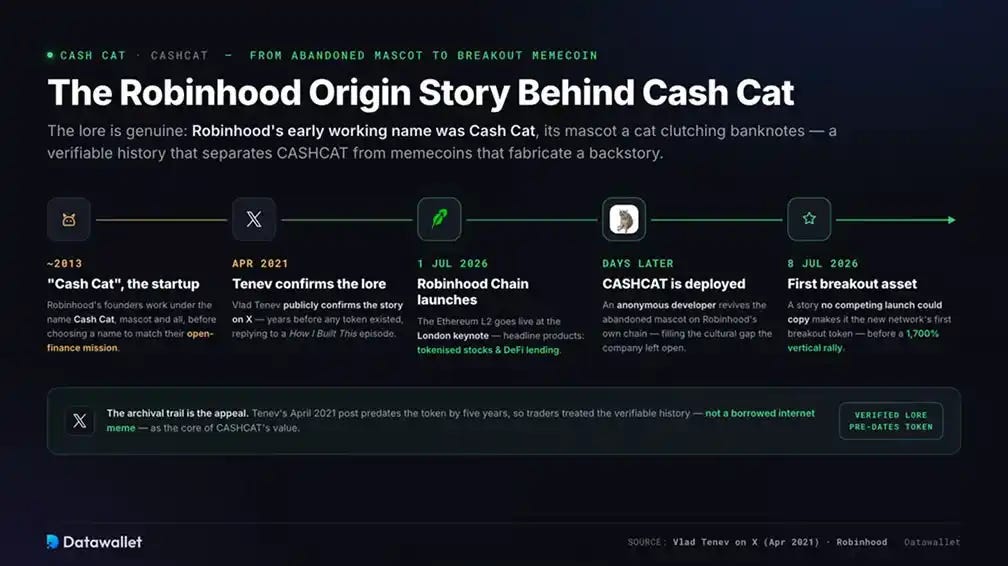
According to the article, big Vlad became an early adviser when small Vlad started a new company in 2013, and that startup eventually became Robinhood. On July 1, 2026, Robinhood Chain’s mainnet went live. The network was described as Robinhood’s own Ethereum Layer 2 built with Arbitrum technology, with 100-millisecond block times, no native token, and fees settled in ETH.
The perpetuals running inside Robinhood Chain are provided by Lighter, the piece said. Rather than routing Robinhood flow to its main venue, Lighter runs a separate order book called Lighter Domains. The two venues are independent, but because both sit on Ethereum, market makers can quote both sides using the same balance sheet and move capital between the two with very little delay.
Robinhood’s side uses USDG as collateral and as the quote asset, while Lighter’s main venue uses USDC. Revenue is split 50-50. The article said big Vlad acknowledged on a podcast that this creates friction for market makers, but explained why they still participate: a large share of the order flow coming from Robinhood consists of retail trades, and “that’s the flow they ultimately want.”
The same section noted that regulatory constraints still keep users in the U.S., the U.K., Canada, Switzerland, the UAE and Singapore from accessing the perpetuals inside the Robinhood wallet. At the same time, both Vlads sit on the same innovation committee. The article said big Vlad is seeking a decentralized perpetuals license from the CFTC that would cover both Lighter’s own front end and brokers that connect to it, including Robinhood. It quoted him as saying, “At the moment, no one has obtained this kind of license.”
Robinhood Chain has no native token, leaving value capture spread across several layers
The second section, from TechFlow, broke down what investors can actually buy if they want exposure to Robinhood Chain. Two months after launch, the chain’s total value locked had exceeded $1 billion, daily DEX volume was approaching $1 billion, and stablecoin supply was nearing $770 million, according to the article. For an L2 built by a listed brokerage, those numbers were framed as stronger than what many standalone chains manage in a year.
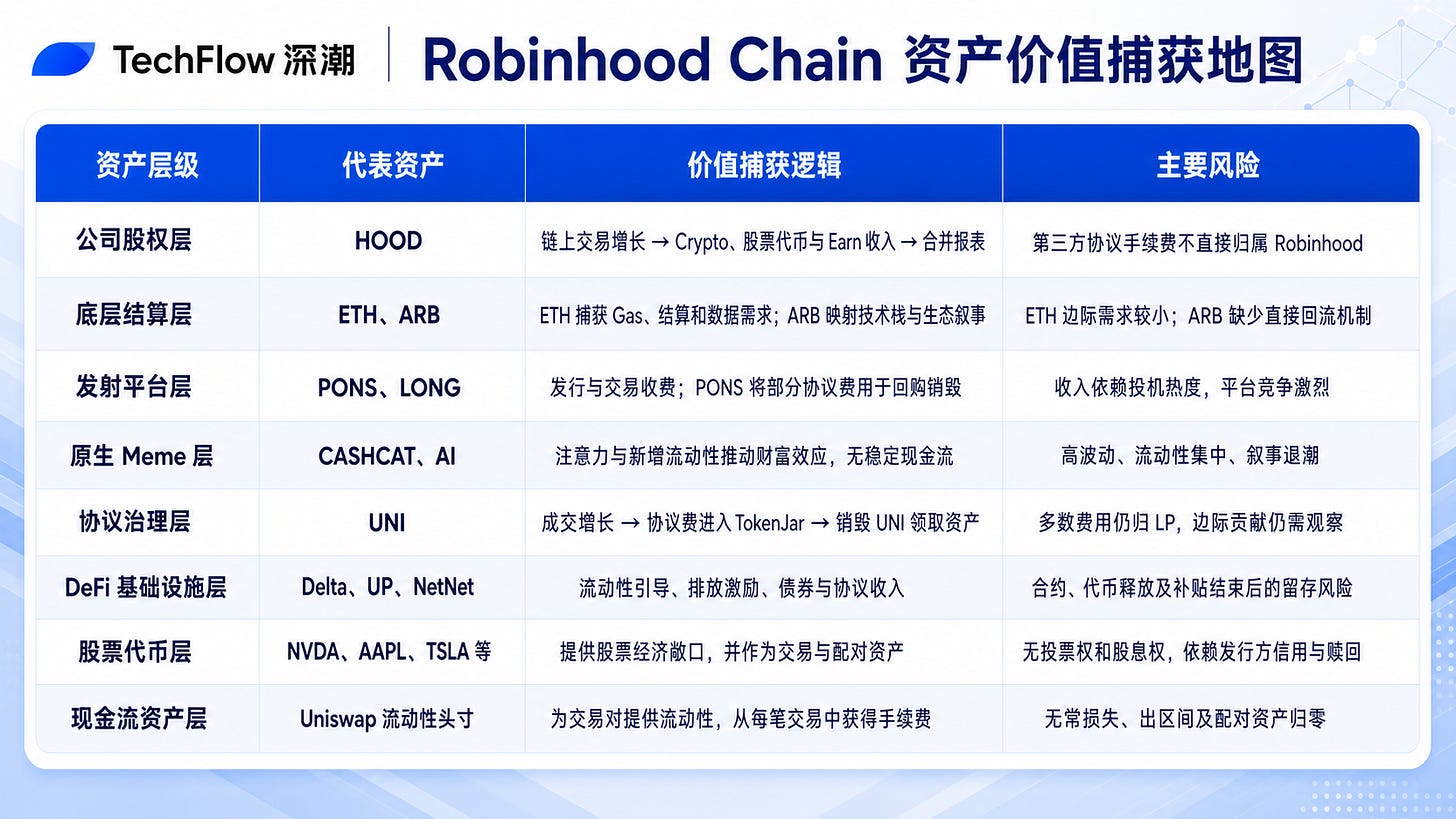
Still, the piece stressed a structural point. Robinhood Chain has no native gas token. Fees are paid in ETH. There is no straightforward “Robinhood Chain coin” to purchase. As a result, the chain’s growth does not create a single unified entry point for value capture. Instead, investors face a map of opportunities spread across eight asset layers, each with its own risk and return profile.
On the traditional equity side, HOOD on Nasdaq was described as the closest listed asset to Robinhood Chain. The article put HOOD at roughly $104 per share with a market capitalization of about $94 billion. It also cited trailing 12-month revenue of $4.93 billion, up more than 38% year over year, and second-quarter revenue of $1.31 billion with EPS of $0.62, well ahead of expectations.
But stronger onchain activity does not automatically flow through to HOOD, the piece said. The proposed transmission path is onchain trading volume to Robinhood Crypto revenue to consolidated financial statements. Even then, Robinhood Chain is a permissionless L2 built on Arbitrum, and a large share of activity takes place in third-party protocols such as Uniswap and PONS, where fees do not go directly to Robinhood the company.
Within the chain itself, PONS was presented as the clearest “sell the picks” asset and one of the most direct forms of value capture. Pons lets anyone issue a fixed-supply token. Its documentation says each project in the current version launches with 1 billion tokens that go directly into a Uniswap liquidity pool, with a base trading fee of 1%.
Under the current factory design, 70% of fees go to creators and 30% to the protocol. Of the protocol share, 80% is intended for automatic PONS buybacks and burns, while the remaining 20% goes to infrastructure and team operations. The article said about 27% of supply has already been burned. As of Aug. 30, market capitalization had briefly topped $260 million, after rising more than 10x during the month from roughly $20 million. The platform had launched more than 167,000 tokens and had over 52,000 holder addresses.
Another platform discussed in detail was LONG, at long.xyz. The article described it as a differentiated launch platform focused on pairing meme coins with stock tokens, creating one of the most talked-about asset categories inside the ecosystem.
The risk is that revenue at launch platforms is tightly linked to speculative intensity onchain. The report pointed to Uniswap Labs launching a competitor, pools.trade, on Aug. 5. On its first day, Robinhood Chain trading volume on Uniswap v4 exceeded Ethereum mainnet volume. PONS dropped 49% during the week pools.trade went live and later rebounded. The piece argued that the launchpad war is still unresolved and that first-mover status is not the same as a moat.
It split Robinhood Chain’s opportunities into two broad groups. One includes high-beta assets powered by attention and fresh capital, such as PONS, CASHCAT and AI. The other includes infrastructure assets that charge on every trade, such as HOOD, UNI and liquidity positions. The first group can generate outsized upside stories quickly. The second is more likely to matter across a full cycle.
To judge whether Robinhood Chain’s wealth effect can last, the article said investors should watch three developments: whether trading broadens from meme coins into stock tokens, lending and yield products; whether real fee capture at PONS, UNI and Robinhood continues to grow and flows through to the related assets; and whether new users keep funds onchain after the first speculative wave fades. If all three happen at once, the article said, Robinhood Chain may start to look less like a new-chain trade and more like a financial ecosystem capable of producing assets and cash flow.
KRW 307 trillion in offshore volume shows Korean equity exposure moving overseas
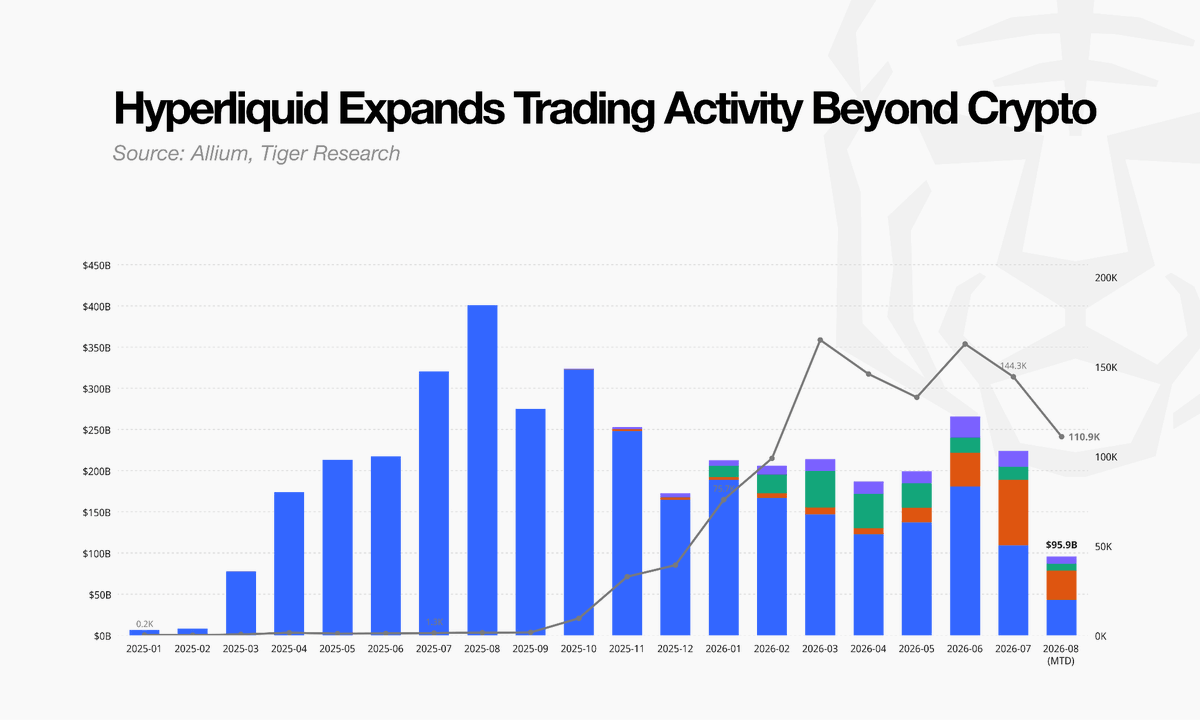
The third section drew from an English thread by Tiger Research about crypto exchanges expanding into traditional assets, with Korean equities standing near the center of that shift. Where these venues once focused on bitcoin and ether, they are now rapidly listing products linked to stocks and commodities, the piece said.
Perpetual contracts sit at the center of the trend. Because investors can gain price exposure without holding the underlying asset, and because perpetuals have no expiry or physical delivery requirement, exchanges can list instruments tied to stocks and commodities with relative ease. That has opened a practical route for crypto-native venues to push beyond digital assets and into traditional markets.
Korea was presented as a key case. Offshore crypto exchanges are actively trading perpetual products linked to major Korean stocks such as Samsung Electronics and SK Hynix. These contracts trade at night and on weekends and offer high leverage, giving Korean and global users stock exposure beyond the local market’s trading hours.
The scale has expanded quickly. From February through August 2026, cumulative volume in perpetuals tied to Korean equities reached about KRW 307 trillion, the article said. August alone accounted for KRW 166 trillion, nearly four times the roughly KRW 42 trillion traded on Korea’s five major domestic crypto exchanges over the same period. In just a few months, the offshore perpetual market tied to Korean stocks had grown larger than Korea’s main domestic crypto market by that measure.
In some cases, derivatives volume has already overtaken the underlying ETF. The article pointed to August 2026 trading in perpetuals linked to KORU, the U.S.-listed 3x leveraged Korea ETF. Those perpetuals traded about $24.1 billion, while the KORU ETF itself traded $8.9 billion, making the derivative market roughly 2.7 times larger.
If derivatives continue to outtrade the underlying market, offshore venues may play a larger role in price discovery, the article said. It added that they may also feed back into spot markets. Market makers supplying liquidity to perpetuals hedge their exposure by buying and selling the related stocks or ETFs. As derivatives volume increases, so does hedging activity. In periods of sharp price movement, that hedging demand can rise further and start to affect spot pricing.
The piece argued that this is no longer just a story about crypto infrastructure moving into traditional assets. A market is forming offshore where investors can access Korean stock exposure without using KRW, a Korean brokerage or a Korean exchange. Tokenized U.S. Treasuries can serve as collateral, and professional traders as well as investors managing large pools of capital are also entering.
It framed KRW 307 trillion not as the final size of a mature market, but as the current size of one that is still being formed. If more assets become tradable and institutional capital joins at scale, offshore liquidity could keep growing. Korea can limit domestic investor participation, the report said, but it will have a much harder time stopping offshore markets from expanding because the restrictions fall more directly on Korean investors and local institutions than on the offshore venues themselves.
The selective-buying argument focuses on assets whose fundamentals held up better than price
The fourth section summarized a long thread by Jiayi Jia Yi that made a case for a potentially attractive selective-buying window in crypto without calling for an immediate broad bull market. The author explicitly said a major bull market does not have to start right away, and a token that has fallen 90% does not automatically deserve to return to prior highs.
The framework was built around a handful of portfolio questions: how much downside remains at today’s price, how large the upside may be, how long it may take, how much volatility must be tolerated along the way, and whether the project can survive long enough to be repriced. Through that lens, the author said some high-quality crypto assets now offer some of the most attractive odds seen in recent years.
The thread noted that bitcoin had at one point fallen more than 50% from its 2025 high, while many altcoins were down 80%, 90% or more. The market has spent a long period going through deleveraging, capital outflows, valuation compression and broken confidence. Some projects deserved to fall, the author said, because they lacked real products and users and depended only on token incentives and narrative. Some are also unlikely to revisit prior peaks.
The key filter was expressed in one line: “Price collapsed. Fundamentals did not.” In other words, the author is focusing on assets where the market price broke down but the underlying business or network remained relatively intact. In that setup, much of the downside may already have been realized during the bear phase, while the upside on a repricing could still be substantial.
The thread also pointed to changing ETF flows. Crypto ETFs saw sustained outflows earlier in 2026, but more recently Bitcoin ETFs had returned to consecutive net inflows, totaling nearly $2 billion over five trading days. The conclusion was not that institutional capital had fully returned, but that it had shifted from steady retreat to early-stage re-engagement.
Four opportunity buckets were outlined. The first consists of sectors that large U.S. pools of capital and financial institutions are actually watching, using or building positions in. The second includes lower-valued No. 2 or No. 3 projects within those sectors, where valuation gaps may be wider than fundamental gaps. The third covers projects with product-market fit, real cash flow and teams that do not need to keep selling tokens to survive. The fourth includes assets with clear future repricing catalysts, potentially tied to AI, U.S. politics and policy, stablecoins, tokenization, global trading, collateralized lending or platforms that improve global capital efficiency.
The author still warned that even quality altcoins could fall another 30% to 50%. Macro conditions could worsen, policy support could be delayed, ETF flows could reverse again and project fundamentals could change. But the argument drew a line between volatility and permanent loss: if a project is strong enough to survive, if the original thesis remains intact, and if the upside can still reasonably run to several multiples, then interim volatility may be a cost worth paying.
Meme coins paired with tokenized U.S. stocks are creating a new onchain trading experiment
The final section was based on an English thread from blocmates. It opened with a callback to the January 2021 meme-stock episode in GME, when retail buying sent the stock sharply higher and put pressure on hedge funds carrying large short positions. Robinhood then drew controversy by switching GME to closing-only status and blocking new position openings.
By 2026, the report said, Robinhood had become linked to a different kind of experiment. This time, meme-coin traders are launching tokens that pair not with ETH or stablecoins, but directly with tokenized equities. The idea is to lock as many stock tokens as possible inside meme-coin liquidity pools. In theory, if that setup keeps absorbing tokenized supply and forcing more issuance of stock tokens, someone must buy the corresponding real shares in traditional markets to back the new tokens.
Robinhood Chain launched on July 1, 2026 as a Layer 2 based on Arbitrum Orbit and built around tokenized real-world assets, according to the article. Its core Stock Tokens product is issued by Robinhood Assets (Jersey) Limited in standard ERC-20 form, tracks U.S. stocks and ETFs, and supports round-the-clock trading.
On Robinhood Chain, meme coins have started shifting away from ETH or stablecoin pairs and toward direct pairings with tokenized names such as NVDA, TSLA, SPCX and HIMS. The article listed several examples: Artificial Inu paired with tokenized Nvidia stock NVDA, Gently Used Tesla paired with TSLA, Stonks paired with SPY, and BONER paired with HIMS. These pairs have mainly been launched through specialized platforms such as Long and Pons.
The mechanics are similar to ordinary meme-coin trading, but with one important change. Instead of holding meme coins and ETH, the AMM pool now holds meme coins and stock tokens. In the AI/NVDA pair, for example, buying AI effectively means selling NVDA into the pool. That means AI trading also produces NVDA volume and leaves more NVDA locked inside LP positions. The meme coin’s price becomes a ratio of how many stock tokens one meme coin represents, while profit and loss in dollar terms also depends on moves in the real-world stock tracked by the token.
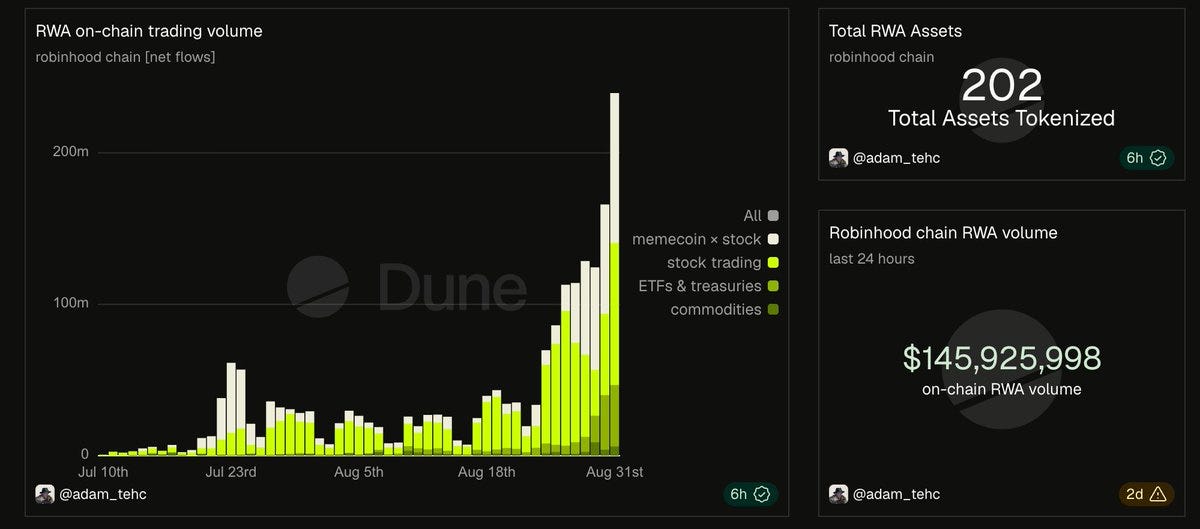
The article said pairs made up of meme coins and stock tokens already account for about 68% of total onchain volume on Robinhood Chain, and that the model has started spreading to other networks including Solana.
It argued that the truly interesting targets are not mega-cap names like Nvidia or Tesla, where liquidity is too deep for onchain capital alone to matter much. The more plausible targets are lower-volume, smaller-float penny stocks with heavy short interest. As meme-driven buying keeps hitting liquidity pools and pulling stock tokens out of available circulation, the amount of stock-token supply actively available onchain can shrink quickly.
The report also pointed to the mismatch between traditional market hours and 24/7 crypto trading. On weekends or late at night, tokenized equities can continue trading onchain while the underlying U.S. stocks are closed. In those windows, liquidity may thin out further, spreads may widen and arbitrage becomes harder. If onchain demand jumps suddenly, tokenized stocks may trade at a premium to the real shares they track.
When authorized participants are again able to mint more stock tokens, they must buy real shares to provide 1:1 backing for the new issuance, the article said. For stocks with smaller floats and high short interest, that incremental buy pressure could have a more noticeable impact, potentially setting up a loop in which a rising stock price strengthens the meme narrative and the meme narrative drives more volume.
The article also drew a limit around the idea. It said this market is still far too small to truly “squeeze Wall Street,” at least for now. Meme coins remain highly volatile, and onchain holding periods are not as long as they once were.
The briefing points to several concurrent market narratives
Read together, the five sections show how Robinhood Chain has become one of the market’s densest narrative clusters, touching infrastructure, tokenized stocks, launch platforms, fee capture and regulatory design at the same time. They also show a wider shift in focus. Offshore perpetuals tied to Korean equities are scaling fast, and some investors are no longer looking only for narrative-driven rebounds. They are spending more time on asset structure, cash-flow routes, user retention, pricing catalysts and whether a project can survive long enough for the market to rerate it.