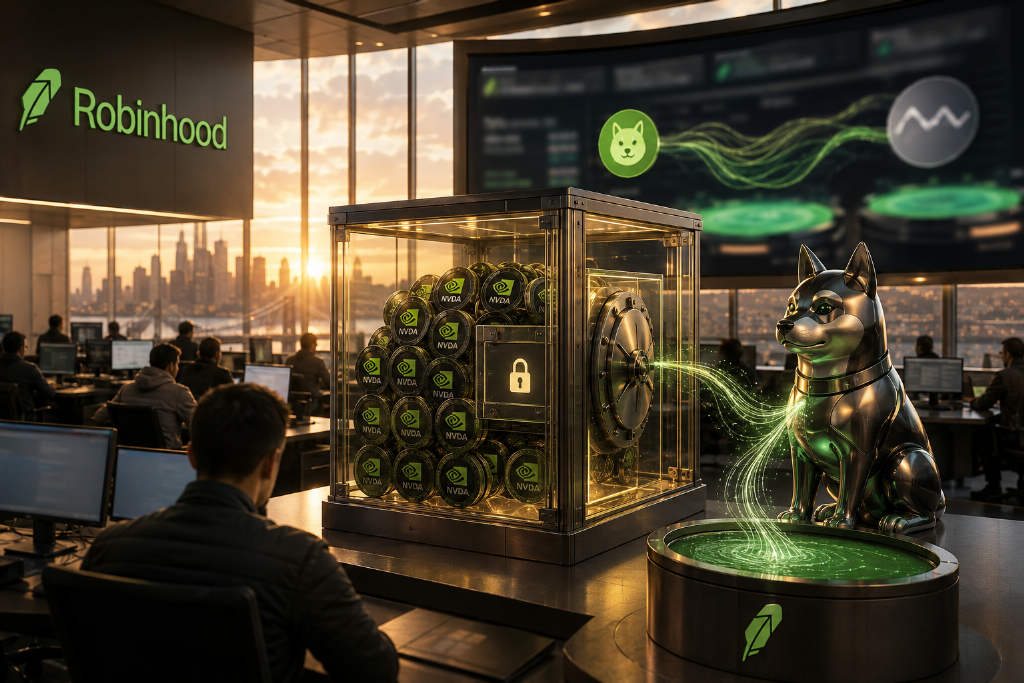
Robinhood Chain has become home to a fresh kind of speculation: meme coins tied straight to tokenized stocks. And one case is already big enough to matter. Launchpad platform LONG says 23% of the chain’s tokenized NVDA supply has been locked inside the community treasury of AI, short for Artificial Inu.
The buildup happened through a pricing setup that used to be rare. AI trades directly against tokenized Nvidia stock, NVDA, so every buy or sell in the meme coin gets routed into NVDA before liquidity is added to the pool. Most meme launches have been paired with ETH, SOL, or stablecoins. Not here. Here, the quote asset is a tokenized stock.
Stock tokens are being pulled into meme pricing
The article says this setup does not alter the asset backing behind tokenized equities. What it does change is how much supply is still floating around in the open market. Tokenized stock prices stay aligned through a mix of real-asset backing, issuance and redemption, and active secondary markets. But if large chunks of NVDA get soaked up by meme liquidity pools, fewer stock tokens are left for trading, arbitrage, and repricing.
Robinhood Chain launched with tokenized stocks, 24/7 trading, and crypto-native AI as its headline pitch. But much of the actual activity, and much of the fee growth too, has come from launchpads like bankr and LONG. Those platforms use tokenized U.S. equities, not ETH or stablecoins, as the base asset in meme pools.
More than 90 tokenized U.S. equities have already been used this way, including NVDA, Tesla’s TSLA, Apple’s AAPL, and SpaceX tokenized stock SPCX. That has produced Uniswap pairs such as AI/NVDA and BONER/HIMS. Strange combos. And new ones.
This was not something Robinhood originally planned out. CEO Vlad Tenev later said in an interview that developers had built liquidity pools the company itself had never designed, mixing meme tokens, crypto assets, and stock tokens in ways the firm did not expect. The article quotes him as saying these products were “something we had absolutely not expected to end up building before.”
The trading flow is the key part. A user may pay with ETH on the front end, but on the backend that capital is first turned into stock tokens before it enters the meme pool. So every speculative trade also creates real trading volume in the stock token. On Aug. 31 alone, volume in stock-paired meme coins hit $93.1 million, while stock-token volume increased by about $40 million on the same day. The two curves moved together. The report says the stock-token volume created by these meme pairs now makes up about one-third of Robinhood Chain’s total RWA trading volume, second only to direct stock-token trading.
Fees surge, while the clearest winners are the entities charging them
The article describes this mechanism as one of the main reasons behind Robinhood Chain’s fee spike over the past month. Network fees in the last 24 hours reached $3.75 million, topping the combined fees of Solana, Ethereum, and Base over the same stretch. Cumulative fees rose to a record $18.6 million.
Part of that came from pure meme launchpads such as Pons, which the article says brought in more than $5 million in fees in a single day. Another part came from platforms like LONG and bankr that bake stock tokens directly into the pricing structure. They are not the only reason fees are climbing. But they are the new factor in this cycle, at least in the article’s view.
The steadier money in this boom is going to fee collectors, not always to traders making bets. Launchpads take issuance fees and a cut of trading fees. Robinhood Chain collects network gas fees at the base layer. And under a partnership arrangement that returns 10% of protocol net revenue, part of that stream also flows into the Arbitrum ecosystem.
Arbitrum Foundation’s half-year report, released on Sept. 2, said Arbitrum DAO’s protocol revenue posted an overall gross margin above 97% in the first half of 2026. After Robinhood Chain’s mainnet launch in July, licensing fees alone accounted for 35% of Arbitrum DAO’s income for that month.
At the company level, the article presents this episode as an unplanned validation of Robinhood’s longer route: from launching crypto trading in 2018, to opening tokenized U.S. stocks to overseas users in 2025, to building Robinhood Chain’s mainnet this year. The issue was never just whether stock-paired memes could catch on. It was whether a chain controlled by Robinhood could turn transaction fees into a direct revenue stream. The current numbers suggest Robinhood is moving part of its business away from being just an access point for trading and toward being infrastructure that generates its own onchain fees.
Data from Token Terminal shows that as of Sept. 1, the average fee per transaction on Robinhood Chain had climbed to $0.33, more than 64 times higher than in early August and more than 100 times the level on Base during the same period. Users have started calling it an “aristocrat chain,” according to the article. The official wallet still subsidizes eligible swaps, but that support is set to end on Sept. 29.
Dune data shows that over the past 30 days, among traders on Robinhood Chain who sold at least once, the ratio of profitable to unprofitable traders was 4 to 6. The picture was even worse on FOMO App, one of the main trading gateways. Over the past 90 days, more than 94.27% of roughly 477,000 trading addresses were in loss, and only about 0.14% made more than $1,000.
At the same time, getting in has become easier. Robinhood Wallet and trading app Fomo let users buy these meme tokens with credit cards through Apple Pay or Google Pay, without identity verification. Those transactions were classified under MCC 5815 in the Visa and Mastercard systems, a merchant category usually used for ebooks and digital films rather than crypto trading. The article says that reduced payment friction for money entering meme pools.
Float gets thinner, and price correction becomes more fragile
The arbitrage framework itself has not changed. What has changed is the condition needed for that framework to keep working: enough free float in circulation.
Robinhood’s official stock tokens are issued by Robinhood Assets (Jersey) Limited, which holds the matching real shares. Only authorized participants can subscribe and redeem. In theory, when the onchain token price drifts away from the reference stock price, arbitrageurs can use issuance and redemption to push it back into line.
That process works only if enough stock tokens remain available for trading at any given moment. Stock-paired meme pools shrink that supply. Once stock tokens become the quote asset and the base liquidity for meme trading, a large share of float is no longer immediately accessible to arbitrageurs. It just sits in Uniswap pools and can only come out through selling the paired meme token.
The clearest example in the article is the 23% of NVDA locked inside AI’s treasury. AI reportedly rose close to 10x over one week, briefly reached a $100 million market capitalization, and kept pushing the lock ratio higher as volume grew. As more stock tokens settle into meme pools, short-term price gaps between tokenized stocks and their reference assets become more dependent on the liquidity still left over and on any new supply entering the market.
The FAMI incident showed a different version of the same weakness
The report says the risk showed up in real time on the night of Sept. 2 on Robinhood Chain. Messy ending.
Days earlier, meme coin BONER had benefited from a short-squeeze story that boosted sentiment. Traders then started hunting for another setup with the same kind of appeal. Crypto KOL Rune said he planned to spend about $1.8 million over the counter to buy roughly 37.4% of a Nasdaq microcap with short interest at 92.3%, then tokenize it and pair it with a meme coin to trigger a squeeze.
The community quickly figured out the target: Farmmi, a Chinese company focused on agricultural products including shiitake mushrooms and wood ear mushrooms. On the evening of Sept. 2, token FAMI and paired meme coin JINQIAN launched back to back. Within minutes, combined trading volume neared $240 million. JINQIAN’s implied market capitalization briefly reached $73 million, while FAMI went past $53 million. At the same time, Farmmi’s real share price jumped as much as 350% intraday, and FAMI’s peak onchain market capitalization reached about 10 times Farmmi’s real market value.
The reversal was fast. Community members discovered that FAMI’s 37.43 million total supply had been minted in a single creation transaction through two mints. The deployer wallet kept 38% and also installed a contract called PoolRepricer to manage pricing. There was no clear issuer, no stock redemption mechanism, and no link to real Farmmi shares.
Rune later said the earlier post about spending $1.8 million to acquire equity had been generated with AI and included fabricated and exaggerated numbers. He also said the onchain FAMI token was not issued by him. After that, both FAMI and JINQIAN dropped sharply, with their market capitalizations falling to about $4.9 million and $2.7 million, respectively.
The article draws a line between FAMI and NVDA. NVDA is backed by real holdings, and the stock-pair structure weakens its arbitrage-based price correction. FAMI was something else entirely: a liquidity lure packaged from the start as a shadow stock with no real holdings behind it. But both point to the same broader risk. If the target company has a thin float and the onchain story is strong enough, speculative activity onchain can spill into the real equity market and create linked price moves. Whether that link reflects distortion or just sentiment resonance is still unproven, the article says.
Launchpads are turning into a distribution layer for financial assets
This is not the first time Robinhood has run into controversy tied to a wealth-effect story. In 2021, the company restricted purchases of stocks such as GameStop during a retail frenzy, setting off congressional hearings and dozens of class-action lawsuits. Vlad Tenev apologized publicly at the time. Back then, the core issue was platform power: who gets to stop user trading in a euphoric market.
Now the dispute is moving toward asset authenticity. If anyone can issue a meme token around a stock ticker without permission, there is still no clear answer to whether arbitrage mechanisms can hold up once too much float gets absorbed into liquidity pools.
For Robinhood Chain, the importance of stock-paired memes goes beyond just another breakout token. The article argues that launchpads are, for the first time, moving past standardized token issuance venues and becoming a distribution layer that links speculative traffic with real financial assets. That opens a new question for other blockchains and platforms too: if stocks can be used as pair assets for meme coins, could gold or other traditional financial instruments be used the same way?
The Farmmi episode was a pretty ugly early example. A fake token with no real holdings still managed to shape the pricing story around an actual listed company. If that same pattern shows up in asset classes with thinner liquidity and looser oversight, the article leaves the ending unresolved.