
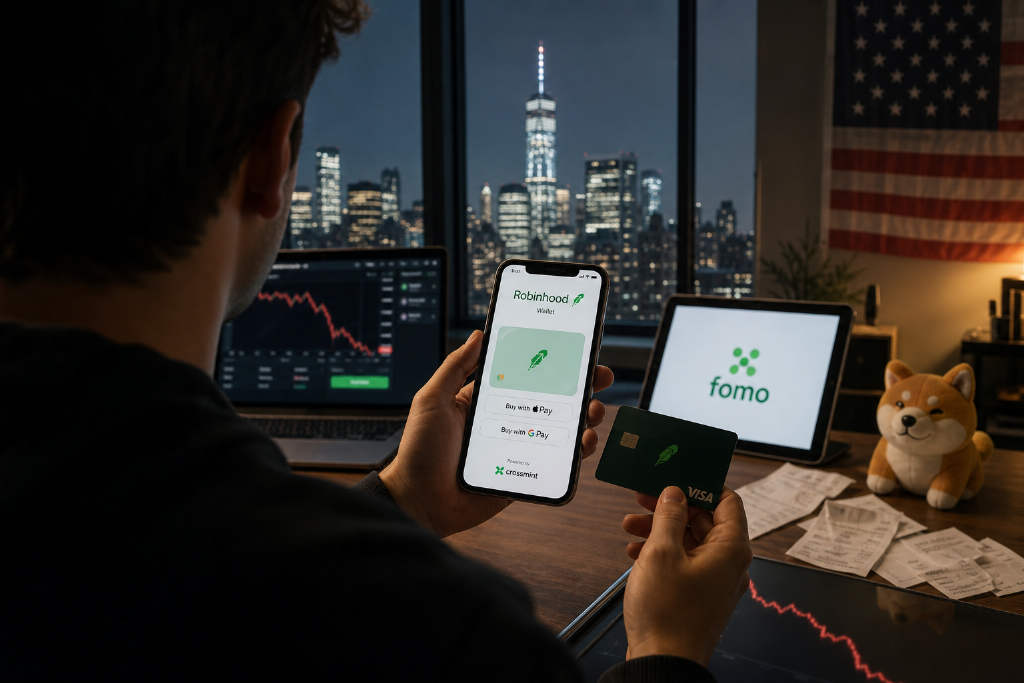
Meme-coin trading tied to the Robinhood ecosystem has picked up sharply, but the rise in volume has come with disputes over card payment classification, extreme slippage and large paper gains, putting fresh attention on self-custody wallet compliance arrangements and the risks of trading low-liquidity tokens.
Test purchase found no additional full KYC form for some meme-coin checkouts
According to The Block, a test showed that users could buy certain meme coins in Robinhood Wallet and the social trading app Fomo through checkout services provided by Crossmint, using a credit card with Apple Pay or Google Pay. The test involved tokens including WIF, and no additional full KYC identity-verification form appeared during the checkout flow. Users also received ordinary credit-card rewards on the transaction.
That does not mean users can anonymously buy any cryptocurrency across all Robinhood services. Crossmint said its system still runs anti-money-laundering and anti-fraud monitoring. It also said assets such as Bitcoin and Ether may still need to be purchased through traditional crypto on-ramp flows or other payment methods.
The report noted that Robinhood Wallet is a self-custody wallet and is distinct from Robinhood’s regulated brokerage accounts and Robinhood Crypto services. In that context, the more precise reading of the so-called no-KYC claim is that some meme-coin checkout flows did not require users to submit another full set of identity-verification materials, not that there was no identity or risk screening at all.
Card purchases were coded as digital goods, and Chase asked Visa to review
The dispute centers on the merchant category code used for the card transactions. In the test described in the report, meme-coin purchases were classified as MCC 5815, a category used for digital books, video, art images and music, rather than codes commonly tied to direct cryptocurrency purchases through financial institutions or non-financial foreign-exchange transaction channels.
Because the system did not identify the payment as a crypto or cash-like transaction, cardholders still received standard spending rewards. Chase, the JPMorgan consumer banking unit, said the transactions may have used the wrong merchant classification and has opened a case with Visa for review. The New York attorney general’s office also said it is reviewing the matter.
Crossmint argued that some meme coins with no practical utility and used mainly for collecting and trading can be treated as digital collectibles rather than standard crypto funding transactions. Even so, payments industry figures cited in the report said the way regulators describe meme coins does not automatically determine which merchant classification Visa or Mastercard should use.
So far, Visa has not publicly ruled that Crossmint or Robinhood violated card-network rules, and regulators have not determined that the arrangement amounted to illegal evasion of KYC requirements.
Robinhood Chain DEX volume briefly topped $1 billion in 24 hours
Meme-coin activity on Robinhood Chain has also heated up quickly. Market data cited in the report showed that 24-hour trading volume on decentralized exchanges on the network reached about $1.06 billion at one point, the first time it moved past the $1 billion mark. Most of the activity was concentrated in tokens including PONS, Artificial Inu and CASHCAT.
Robinhood Chain is a Layer 2 network built on Arbitrum technology and uses a permissionless environment for token issuance and trading. Third-party developers and users can deploy tokens, create liquidity pools and set up trading markets on their own.
That also means the meme coins that have recently gone viral on Robinhood Chain were not necessarily issued or endorsed by Robinhood. Trading on a network tied to the Robinhood brand does not amount to a guarantee by Robinhood on value, liquidity or safety.
Roughly $20 million Artificial Inu trade sparked slippage debate
One Artificial Inu trade drew broad discussion on X. An on-chain tracking account said one address carried out an AI token trade worth about $20 million, but because of limited liquidity and price impact, the tokens received were valued at only about $175,000 after the trade was completed, implying a paper markdown of nearly $19.8 million.
Some community accounts described the episode as a fat-finger trade or an input error, but the on-chain data currently available shows only asset transfers, token swap quantities and estimated values before and after the trade. It does not prove the trader’s actual intent. Public data also does not rule out the possibility that the transaction involved liquidity arrangements, related addresses, token migration or other strategies.
The report added that unless the holder has already sold the tokens received, the claimed $19.8 million loss is mainly based on the market price after execution and does not represent a confirmed realized loss.
Some early holders posted large unrealized returns
On the other side of the same market move, some early holders posted outsized paper gains. One investor put in only $21,200 into a meme coin paired with tokenized NVIDIA, and based on a Sept. 2 price snapshot, the position’s value briefly rose to about $8.13 million. That implied an unrealized gain of about $8.11 million, or nearly 382x on paper.
Another address realized about $566,000 in profits through CASHCAT trades and also held a batch of PONS valued at about $4.2 million at the time. The address’s total gains were at one point estimated at more than $4.7 million, though most of that amount remained unrealized.