
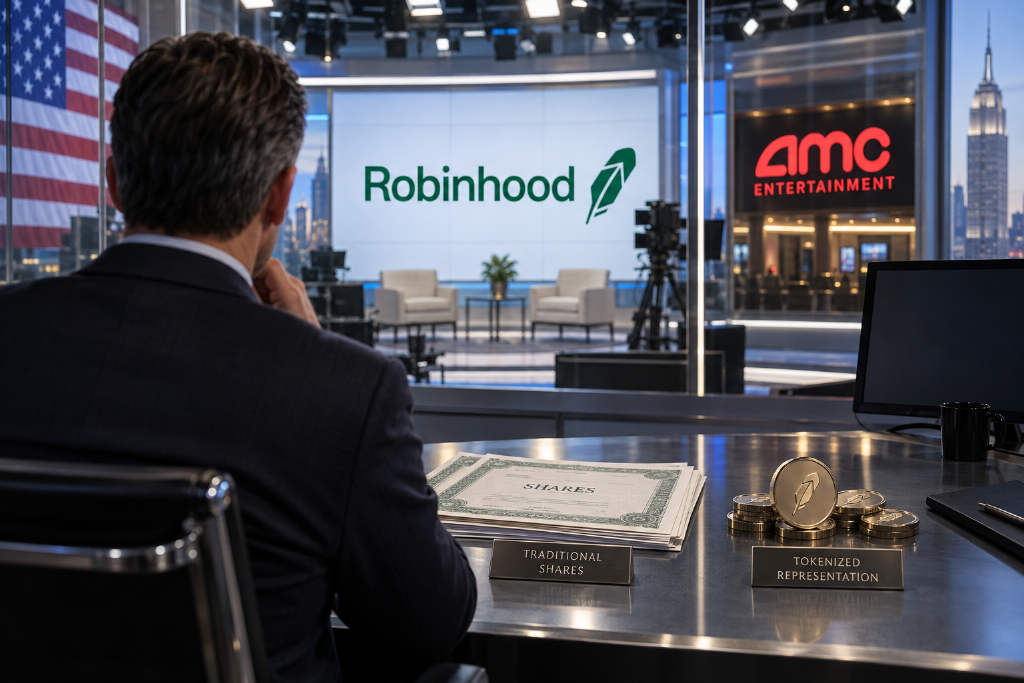
Robinhood CEO Vlad Tenev said the company’s stock tokens should not be assumed to require consent from the underlying issuer, even when the tokens reference shares of a public company. He also said token holders do not receive the voting rights attached to those shares.
The remarks came in a Sept. 9 interview on CNBC’s Squawk Box and sharpened the legal and structural distinction at the center of Robinhood’s dispute with AMC Entertainment. Robinhood is not defending an AMC share placed directly on a blockchain. It is defending a separate security tied to AMC stock.
Tenev’s argument on issuer control
Tenev said, according to the interview, 「Issuers should have control and do have control over the rights and obligations of the stock that they issue, but that doesn't mean they control everything about it.」 He added, 「In particular, they don't control other companies issuing their own securities that reference those shares.」
He also said that 「Issuer consent depends on what exactly you're doing.」 In his description, Robinhood’s stock tokens are 「tokenized securities that are issued by a separate entity that are backed by underlying shares」 and therefore 「should not automatically require issuer consent.」
No voting rights for token holders
Tenev acknowledged in the same interview that holders of the tokens do not receive the voting rights attached to the underlying shares. When asked whether Robinhood would vote those shares, he said the company 「hasn't really announced plans for the voting aspect of that.」
That leaves one governance issue open: who will direct the votes tied to the AMC shares being held in custody. Robinhood has not announced a plan for those votes.
A debt token rather than an AMC share
Robinhood’s product documents describe Stock Tokens as tokenized debt securities issued by Robinhood Assets (Jersey) Limited, or RHJ. The documents say the products give investors economic exposure to an underlying security, but no legal or beneficial rights in or against the company that issued that security.
Robinhood’s disclosures identify RHJ, not AMC, as the issuer of the debt securities. The company says each token in circulation is backed one-for-one by the corresponding stock, with the shares held by a U.S. custodian. Service-provider disclosures name Alpaca Securities LLC as the broker and custodian.
For dividends, token holders receive the economics through a mechanism that reinvests cash distributions into additional underlying shares and increases a multiplier applied to the token. Even with that arrangement, holders do not receive legal or beneficial rights in or against AMC through the token, and Tenev confirmed that voting rights are not passed through.
The dispute with AMC
The structure is the core of the clash between the two companies. Tenev’s position is that a separate entity should be able to issue a security referencing publicly traded shares without automatically getting the underlying issuer’s approval. AMC CEO Adam Aron has taken the opposite view, arguing that the product separates token demand from AMC’s capital-raising function and does not grant shareholder rights.
On Sept. 4, Aron wrote on X that Robinhood’s product 「decouples stock token ownership from a company's ability to control its own capital raising efforts.」 He added: 「Your stock token pretend to be some form of stock ownership, but disclosures to the contrary notwithstanding, they are not ownership and they deprive investors of their rights.」
Aron called on Robinhood to stop trading AMC-linked tokens and said AMC’s securities counsel would review whether the company could force a halt.
Unavailable in the U.S.
Robinhood’s documents say Stock Tokens are not available in the United States or to U.S. persons. Eligible investors receive economic exposure through debt securities issued by RHJ and do not receive legal or beneficial rights in or against the underlying issuer.
Tenev’s comments do not settle whether AMC has a legal path to stop the product. They also leave unresolved the question of who will exercise the voting rights attached to the AMC shares held in custody. Robinhood has not announced those plans.