
Two marquee names in robotics hit the market with fresh signals within a day of each other, and both pointed to the same issue: valuations are running far ahead of current business performance.
On Oct. 27, Bloomberg reported that U.S. robotics AI startup Physical Intelligence is in talks to raise at least $1 billion at a valuation of about $20 billion. The company is just over two years old and has no revenue.
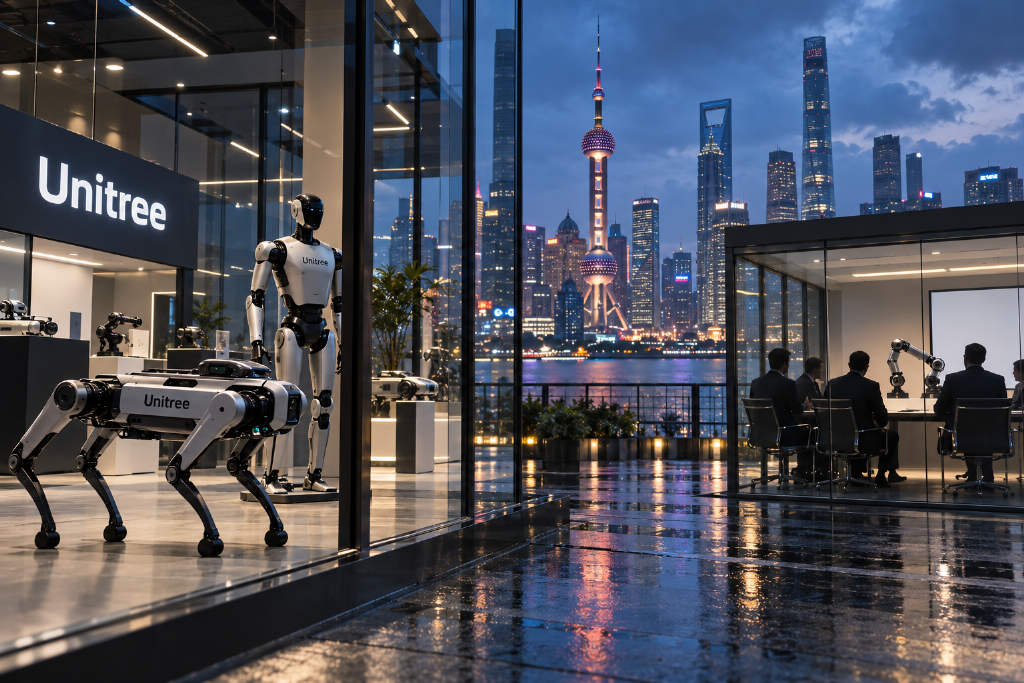
One day later, Unitree Technology, which is listed on Shanghai’s STAR Market, released its third-quarter results. Revenue for the first three quarters reached RMB 1.817 billion, up 55.71% from a year earlier, while third-quarter net profit fell 17.37% year over year.
The two companies sit on different tracks, one focused on general AI models and the other on robot hardware manufacturing. They are now confronting the same reality: current commercialization progress remains far from the valuations assigned by capital markets.
Unitree has revenue, shipments and profit, but the valuation still looks stretched
Unitree went public on the STAR Market on Aug. 19. Its opening price on the first trading day was RMB 1,100, up nearly 630% from the IPO price of RMB 150.80, and its market capitalization briefly topped RMB 440 billion.
The stock then retreated sharply. On Oct. 15, it fell to an intraday low of RMB 404.03, down more than 60% from its opening price on listing day. Just a week later, the move reversed. The shares hit the daily limit on Oct. 23 and rose another 7.69% on Oct. 26. By Oct. 29, the stock had recovered to RMB 662.39, giving the company a market value of about RMB 267.9 billion.
That left Unitree with swings worth hundreds of billions of yuan in a little over two months, even though the company’s fundamentals did not change enough over the same period to explain moves of that scale.
Unitree’s third-quarter report, released on Oct. 28, showed revenue of RMB 1.817 billion and net profit attributable to shareholders of RMB 387 million for the first three quarters. In the third quarter alone, revenue came in at RMB 665 million, up 69.93% year over year, while net profit fell 17.37% to RMB 113 million.
The headline 270.54% increase in first-three-quarter net profit was also affected by a one-off share-based payment expense in the prior-year period. Unitree had previously recognized about RMB 349 million in one-time share-based payment expenses in 2025 after a low-price capital increase to an employee shareholding platform, which lowered the profit base for that year. Excluding non-recurring items, net profit attributable to shareholders for the first three quarters actually fell 18.78% year over year, and net cash flow from operating activities dropped 54.69%.
A major source of pressure was higher research and development spending. In the third quarter, Unitree’s R&D investment reached RMB 127 million, up 249.58% from a year earlier. The money mainly went to embodied AI models, computing power and new product development.
By operating scale, Unitree is already among the leaders in humanoid robotics globally. In 2025, the company generated about RMB 1.699 billion in revenue, with humanoid robots contributing RMB 868 million and quadruped robots contributing RMB 698 million. Full-year humanoid robot shipments reached 5,511 units, with actual sales of 5,215 units.
Even so, those figures remain small relative to a valuation in the hundreds of billions of yuan. Based on the Oct. 29 market capitalization of about RMB 267.9 billion, and simply annualizing revenue for the first three quarters of 2026 to RMB 2.423 billion, Unitree’s price-to-sales ratio would still be about 111x. Based on annualized net profit attributable to shareholders over the same period, its price-to-earnings ratio would be about 520x.
Unitree itself has warned about valuation risk. In an announcement on unusual stock-price volatility released on Oct. 27, the company said that as of Oct. 26 its trailing P/E ratio had reached 465.22x, far above the 38.54x average for the general equipment manufacturing industry. It also said the humanoid robot industry remains in the early stage of commercialization and that valuation reversion is possible if large-scale adoption falls short of expectations.
Physical Intelligence is chasing a $20 billion valuation with no revenue
Unitree at least has real revenue and profit. Physical Intelligence is being valued almost entirely on expectations for what it may become.
Founded in 2024, the company’s core team comes from institutions including Google DeepMind, Stanford University and the University of California, Berkeley. Its goal is to build general AI models that can adapt across different robot hardware systems.
In November 2024, Physical Intelligence raised about $400 million at a $2 billion valuation. In November 2025, that valuation rose to $5.6 billion. Earlier this year, it increased again to $11.5 billion. The latest financing talks are now trying to push it to $20 billion. If the deal closes, the company’s valuation will have increased nearly tenfold in just two years.
What stands out even more is that the company still has no revenue. Investor enthusiasm is tied mainly to the potential commercial value of a general foundation model for robots.
Most robots today still require task-specific programming and trained control systems. Physical Intelligence wants to use vision-language-action, or VLA, models so robots can act on visual input and human instructions, then transfer learned skills across tasks and devices. In simple terms, it is trying to provide a shared “brain” for robots made by different brands.
In recent years, the company has released models including π0 and π0.5, showing capabilities such as folding clothes and organizing objects. On Oct. 13 this year, it also opened a beta version of the Pi API, allowing outside developers to upload data, fine-tune models and run them on their own robots.
Physical Intelligence has also started testing commercialization. It is already working with companies including Weave Robotics and Ultra in real-world trials covering laundromats and e-commerce order packaging.
Still, a technical demo, an actual deployment and a sustainable revenue stream are three different stages. The company has not disclosed a mature pricing framework. Its ability to adapt models across hardware, maintain long-term operating stability, manage inference costs and persuade customers to pay all remain open questions.
At a $20 billion valuation, even if the market were willing to assign a 20x price-to-sales multiple in the future, Physical Intelligence would still need to generate $1 billion in annual revenue. For a company with no revenue today, that means moving from research into product sales and then distributing model services across enough robots and enough application scenarios.
Market structure is also amplifying valuation moves
The core argument behind high robot valuations is the prospect of a very large future market. But trading mechanics in capital markets are also magnifying those valuations to some extent.
Unitree’s share structure is a clear example. According to its listing prospectus, the company had about 404 million shares outstanding after the offering, but only 30.0877 million shares were freely tradable in the early stage after listing, or 7.44% of the total.
As of Oct. 29, Unitree’s total market capitalization was about RMB 267.9 billion, but the market value represented by unrestricted tradable shares was only about RMB 19.9 billion. A limited free float made the stock more sensitive to changes in capital supply and demand, which helps explain the sharp swings in market value after listing.
Physical Intelligence operates in a different setting. As a private company, its valuation is largely negotiated among a small group of investors. Even without revenue, the valuation can keep rising across funding rounds as long as investors are willing to pay for future technical potential.
That logic helped drive robot-company valuations higher over the past two years. In the second half of 2026, though, sentiment around embodied AI started to shift in subtle ways.
Capital is still flowing in, but investors are recalculating commercialization
Globally, money is still entering the sector. According to data published by Crunchbase on Oct. 27, global robot startup funding reached $9.9 billion in the third quarter of 2026, more than double the level a year earlier. Total funding in the first three quarters rose about 185% year over year, with China and the United States remaining the two largest financing markets.
But the pace of funding and valuation growth has also brought more scrutiny. On Sept. 21, Reuters reported that Chinese regulators had adopted stricter reviews for some humanoid robot IPO applications. Beyond high valuations, people involved in regulation were said to be paying particular attention to whether revenue obtained through local government-backed data collection centers and joint ventures could really represent sustainable demand from independent customers.
One investor interviewed said valuations for some embodied AI projects in the private market had already been cut by 30% to 50%. Another source estimated that if revenue from data collection centers were excluded, valuations for some robot companies could fall by 60% to 70%. Those figures were estimates from interviewees, and the report noted that there is not enough public financial data to verify them independently.
This valuation debate is not limited to China. U.S. humanoid robot company Agility Robotics previously said it planned to go public through a SPAC deal at a valuation of about $2.5 billion. Yet filings submitted to the U.S. Securities and Exchange Commission showed the company generated only about $1.78 million in revenue in 2025 and recorded an operating loss of about $140 million. Even with robots deployed in real warehouse settings, its revenue remains far from enough to support a multibillion-dollar valuation.
Money is still pouring into robotics, but more investors are asking harder questions about business models and earnings potential, and whether future results can justify current prices. Valuations that were pushed higher by round after round of financing are now being tested against financial statements and public markets.
Leading companies such as Unitree and Physical Intelligence remain at the center of the current capital wave. Other robot startups have already started to face valuation cuts and tighter fundraising reviews.
A recent investigative report by HardKr, under 36Kr, described the shift in more detail. Some major institutions that had previously invested aggressively in embodied AI have started to tighten funding, and some financial advisers are no longer willing to take on robot fundraising mandates. Financing that may once have been completed in one month now takes three to six months.
The Securities Times reported on Oct. 29 that over the past two months, some early shareholders in embodied AI companies have started selling existing shares at discounts, with quotes at only 65% to 80% of the previous round’s valuation. The report said that even some leading companies were included.
The technology race in embodied AI is only beginning. The repricing of future profit expectations in capital markets, however, is already well underway. A split is now emerging: some investors are still willing to pay more for a distant future, while others are rechecking how much of today’s valuation can actually be realized.


