


Robotics will not have a "ChatGPT moment," according to a RoboStrategy research report translated and published by TechFlow. The team’s argument is blunt: the physical world runs on a very different set of constraints from cloud software, so embodied AI is unlikely to spread through a sudden consumer-style surge.

Instead, RoboStrategy says robotics is moving along a curve that looks much more like autonomous driving. Adoption starts with high reliability in narrow commercial settings, then widens over time. In the report’s framing, that process is already in motion.
Why RoboStrategy rejects the idea of a robotics "ChatGPT moment"
The report goes back to Nov. 30, 2022, when OpenAI released ChatGPT. Five days later, it had reached 1 million users. Two months later, it had crossed 100 million. RoboStrategy says that milestone mattered not only because of user growth, but because it reset how governments, companies, investors, founders, and ordinary users thought about AI almost all at once.
Since then, people in robotics have been asked the same question repeatedly: when will robots get their own ChatGPT moment? RoboStrategy’s answer is that they will not.
The report says robots will still be adopted at scale, just not in a matter of weeks. It compares the likely path to the spread of the internet, smartphones, and more recently autonomous vehicles. In RoboStrategy’s view, the starting gun for robotics was fired years ago, and the first wave of real-world scaled deployment began this year. The note names UPS, BMW, and Samsung as examples of large companies putting resources into robotic automation, while talent and capital continue to move into what it calls the Physical AI ecosystem.

The two barriers: idle cost and the 99.9% wall
RoboStrategy says the problem is not only that manufacturing 100 million robots would be physically difficult. The bigger issue is that the threshold for usefulness in robotics is fundamentally different from the threshold for usefulness in general-purpose AI software.
The report notes that ChatGPT was far from perfect when it launched. It hallucinated, made obvious mistakes, and often failed on simple questions. Even so, it was useful in writing, summarization, and basic research. It did not need to replace an entire workflow to create value. It only had to save users some time. Because it ran in the cloud, users did not need to buy or host GPUs themselves, and the marginal delivery cost was extremely low.
Robots face two problems that chatbots do not. The first is what the report calls "the idle-robot tax." Whether a robot is working or sitting still, the buyer keeps paying for it, either as CapEx or through leasing and Robot-as-a-Service, or RaaS, as OpEx. If a robot is used for only one hour a week, it has to create extraordinary value in that single hour, because moving it to another task and retraining it is expensive. RoboStrategy says this may change as physical AI gives general-purpose robots broader multitask ability and more human-like mobility, but for now every idle hour is a drag on returns.
The second barrier is "the 99.9% wall." The report argues that knowledge work and physical work have completely different tolerance for mistakes. A rough first draft can still save time because a person can edit it. A bad weld can ruin a metal component. A wrong medication dose can have irreversible consequences.
That difference changes the deployment threshold. In knowledge work, AI output can be corrected before it becomes the final deliverable. In physical work, recovery from an error is often far more costly than revising a paragraph. RoboStrategy says many physical tasks require not just 99% success, but 99.9% or more before customers will trust a robot in production.

The report adds that knowledge work can often create value with success rates in the 50% to 90% range, while physical operations may require reliability from 99.9% up to 99.9999%. In other words, the practical threshold is much higher.
How general AI progress is feeding robotics
RoboStrategy says robotics has made major gains in the years since ChatGPT launched, and some of that progress comes from spillover effects from general AI and video generation models. Those advances are now forming the basis of the robot "brain."
Many leading robot systems use a dual-system architecture, the report says. System 2 is the slower layer that handles scene understanding, planning, and reasoning, usually through an adapted large AI model. System 1 is the fast execution layer that turns those plans into high-frequency motor control commands, and in some cases is derived from video prediction models.
Under that setup, breakthroughs from OpenAI, Anthropic, Google DeepMind, Nvidia, Alibaba, and top university labs all feed directly or indirectly into physical intelligence. The report includes a comparison of leading robot models against early ChatGPT, based on GPT-3.5, and current general-purpose models across learning and memory, autonomous execution, and reliability.

RoboStrategy says that on several key dimensions, frontier robot models have already moved beyond the GPT-3.5 model that powered ChatGPT at launch. It names Dyna Robotics and Rhoda AI, saying their embodied models can now handle long workflows, carry out multi-step reasoning, maintain context over longer periods, and detect mistakes before retrying and correcting themselves.
From demos to real deployment
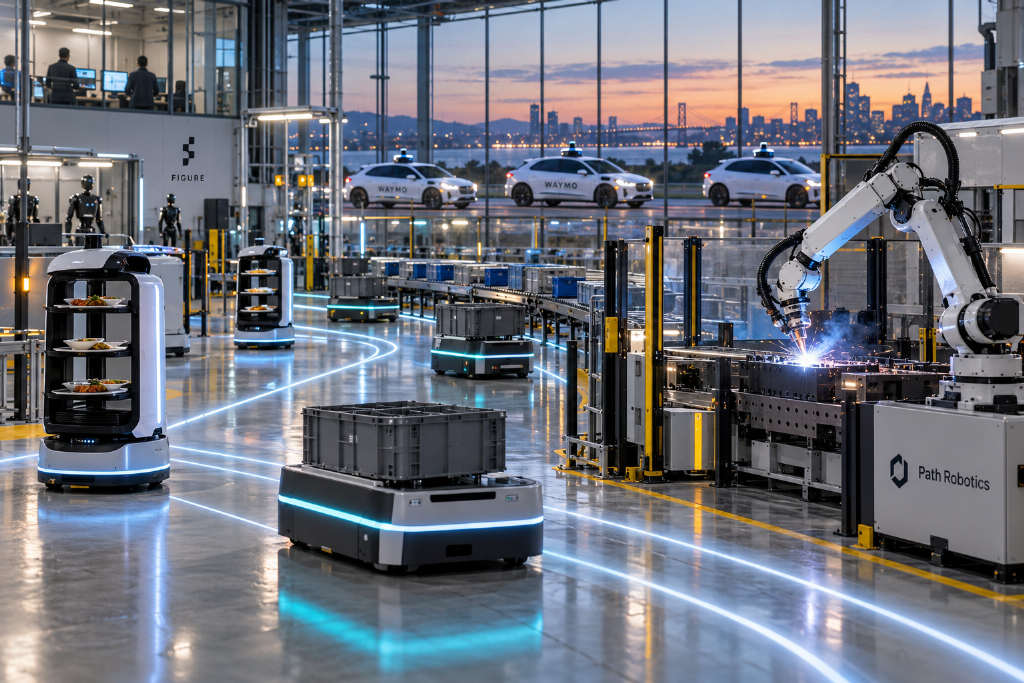
The report says the first wave of Physical AI companies has moved beyond the lab and prototype stage into scaled real-world deployment. It points to Waymo as a company that has already been following that path for years in autonomous driving.
RoboStrategy also argues that polished robot videos on the internet have long left an important question unanswered: were they selected from dozens or even hundreds of failed attempts? The report says Figure AI’s livestream of humanoid parcel sorting, which ran for more than 200 hours without interruption, was a kind of "mini ChatGPT moment" for robotics. In its telling, that was the first real-time and hard-to-dispute evidence that general-purpose machinery could perform complex physical labor with human-like consistency.
The note says Path Robotics has now deployed industrial welding robots across leading customers in energy, defense, and shipbuilding, and earlier this year announced a contract with defense giant HII worth $600 million and up to $900 million. Dyna, it says, has also rolled out automation robots across large restaurant chains, hotels, and commercial laundry networks, where they are running complex processes on an ongoing basis.
Specialized models, fine-tuning, and scaling laws
How did those deployments become possible? RoboStrategy’s answer is specialized models and targeted fine-tuning.

A model that helps Waymo vehicles navigate, or one that lets Path perform precision welding, cannot automatically handle bin picking, the report says. But those vertical markets are large enough to justify training a model around one skill and making sure it works reliably under messy real-world conditions.
Companies such as Dyna and Rhoda typically start with a general robot foundation model, collect real physical-world data around a specific workflow, and keep fine-tuning until reliability reaches an industrial standard. They begin with broad, painful, high-value tasks, then expand the data boundary as funding rounds and capital accumulation allow. RoboStrategy compares that strategy to the way general AI labs first concentrated on software engineering and coding.
The report says that in the past, getting a robot to commercial-grade reliability on a single task often took months. As foundation models improve, some leading companies are now seeing that cycle shrink to weeks. Earlier this year, several frontier teams published research that RoboStrategy says provides evidence that robot models also follow scaling laws. In that view, more data and more compute can produce a step change in generalization, while the amount of fine-tuning data needed for each new skill falls. Every drop in post-training cost reduces deployment friction and extends the list of tasks general-purpose robots can handle.
The adoption curve may look more like autonomous driving
RoboStrategy says autonomous vehicles offer the clearest reference point for what large-scale robot adoption may look like. One chart in the report tracks the number of autonomous vehicles on the road from 2021 to 2026, rising from an early base of 500,000 and projected to exceed 16 million in 2026.

The report says autonomous driving algorithms have made major leaps in recent years and that the global fleet of autonomous vehicles has already passed 10 million. At the same time, autonomous driving faces challenges that many other industrial robots do not. Reliability requirements are two to three orders of magnitude stricter because failure can cost lives. National safety rules, as well as state and city operating permits, must be cleared one by one. Robotaxi fleets such as Waymo and Cybercab also need heavy physical operations in every city, including dispatch centers, charging, cleaning, maintenance, remote safety support, and 24/7 roadside assistance.
That comparison leads RoboStrategy to a clear conclusion. Before robots break out in the consumer market, they are more likely to achieve meaningful large-scale adoption in commercial and industrial settings. The report says home service robots may one day become as common as cars are today, but in the near term the more realistic path is to reach very high reliability in structured environments such as industrial laundry, machine tending and inspection, and warehouse material handling.
RoboStrategy closes by saying that "ChatGPT moment" may have been the wrong analogy from the start. In ChatGPT’s world, distribution came before reliability. In robotics, reliability has to come first. The report says that engineering path has now been validated, and that multiple industries are standing at the beginning of an adoption curve that looks much more like autonomous driving.
The disclosure section states that RoboStrategy’s investment portfolio may include companies discussed in the report.
