
Last week, Odaily reported that Robinhood had launched its own prediction market, Rothera, to capture orders that previously had to be executed through Kalshi, thereby reducing revenue sharing. Although the market expected Rothera to avoid typical cold-start problems, its performance over the past week still exceeded expectations. It is hard to imagine a platform only two weeks old directly landing in third place in the highly competitive prediction market, behind only Kalshi and Polymarket.
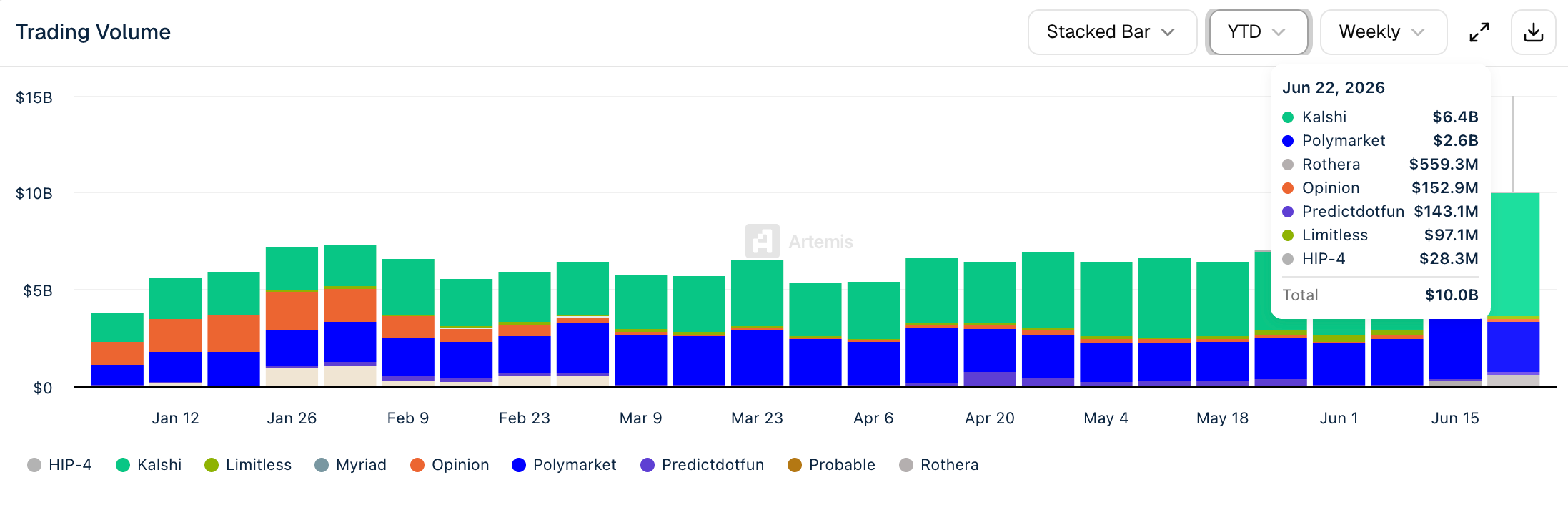
According to Artemis data, in the week ending June 8, Rothera's weekly trading volume was only $21.9 million, significantly trailing second-tier platforms like Opinion, Predict, and Limitless. But in the week ending June 15, its weekly volume jumped to third place at $276 million. In the latest week ending June 22, Rothera's weekly volume reached $559 million, nearly one-fifth of Polymarket's volume.

Stock Order Migration: Robinhood's Closed-Loop Strategy
The rise of Rothera is essentially not about creating new users (though some users entered due to the World Cup), but about migrating existing orders. For over a year, Robinhood has been one of Kalshi's most important distribution channels. Leveraging tens of millions of retail users and mature stock, options, and crypto trading interfaces, Robinhood funneled large volumes of orders to Kalshi. Piper Sandler analysts estimated that orders through Robinhood accounted for 25%-35% of Kalshi's total volume.

These orders came from Robinhood users but did not belong to Robinhood. In the partnership model, Robinhood acted as a front-end traffic gateway while Kalshi handled matching, clearing, and settlement, with revenue split between them. Rothera is Robinhood's weapon to break this model. Since early this month, Robinhood has started moving some World Cup-related event contracts to Rothera, keeping orders that would have gone to Kalshi within its own system.

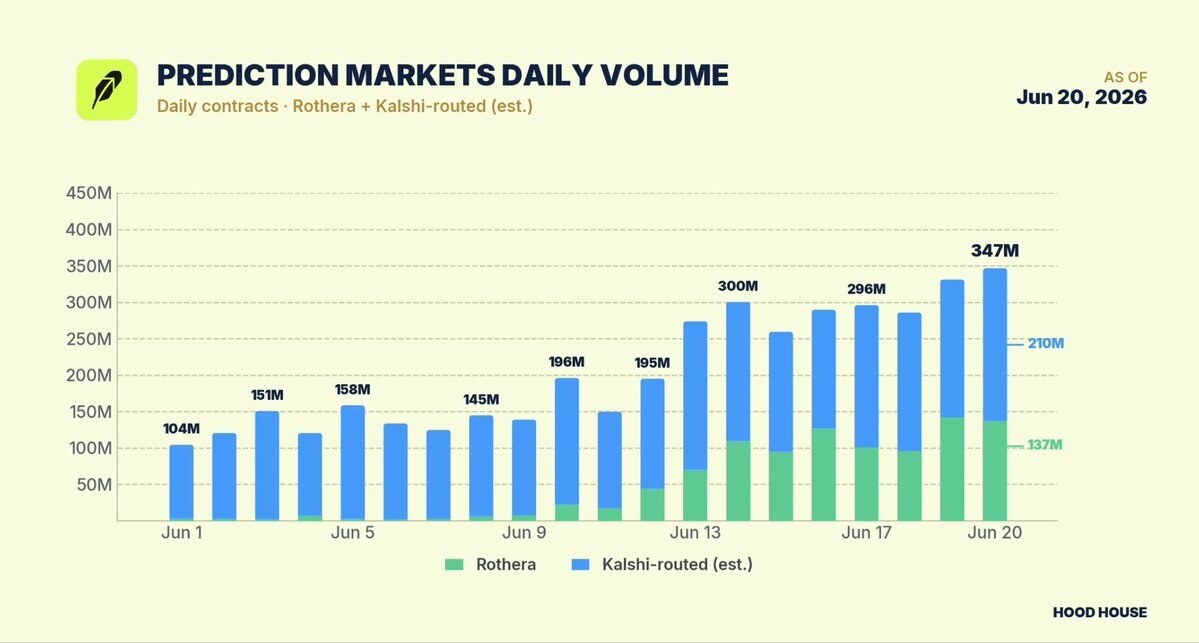
Therefore, the surge in Rothera's volume is less a threat to Polymarket, Predict, or Limitless, and more a direct "bloodletting" of Kalshi. Hood House data shows that as of June 20, Robinhood's prediction market business saw a single-day volume of 34,700 contracts, corresponding to daily revenue of about $4.9 million. Rothera (mainly World Cup markets) had a single-day volume of 137 million contracts worth $47 million; Kalshi's total volume was 1.5 billion contracts worth $416 million. Excluding World Cup markets, Kalshi's volume was about 1 billion contracts worth $260 million. Conservatively, Robinhood users still contribute 20% of Kalshi's non-World Cup volume, or 210 million contracts and $52 million in volume through Robinhood.

Hood House aggressively estimates that if this growth continues, Robinhood's prediction market business could generate $1 billion in revenue this year, exceeding Robinhood's peak crypto revenue of about $900 million in 2025. Facing Rothera's rapid rise, Kalshi has clearly seen the problem. Robinhood was both a partner and a key traffic source, but as orders move to its own platform, the two have become direct competitors. Rothera's rise proves the power of distribution. Landing in third place seemed effortless; whether it can challenge Kalshi and Polymarket in the future may no longer be a difficult question.