
SemiAnalysis said Nvidia has provided major customers with a preview of Rubin Ultra, but the chip’s specifications have been reduced again versus earlier expectations. In late June, the research firm had already said the original 4-die Rubin Ultra design would be cut in half.
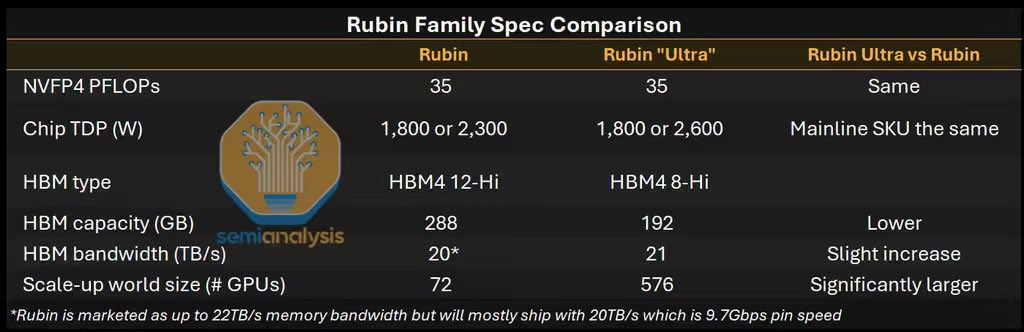
According to screenshots cited in the report, Rubin Ultra will keep the same peak theoretical compute as Rubin at 35 PFLOPs, while memory is being scaled back sharply. Its memory capacity is said to drop to 192GB using 8-Hi stacks, lower than Rubin’s 288GB with 12-Hi stacks. Memory bandwidth changes little, rising by only 1 TB/s, which SemiAnalysis said is largely negligible in high-throughput computing workloads.
Power does not improve either. The low end remains the same as Rubin at 1,800 W, while the high end rises to 2,600 W.
The main upgrade, according to the report, is scale-up connectivity. Rubin Ultra’s scale-up world size increases from 72 GPUs to 576 GPUs. That shifts the product’s selling point toward cluster networking: through NVLink, Nvidia can link as many as 576 Rubin Ultra GPUs into a much larger logical compute system, compared with a 72-GPU limit on Rubin.
HBM inflation is forcing a redesign
Rubin Ultra was introduced by Nvidia at GTC 2026 as the top-end flagship version of Rubin. It had been positioned as a part built for extreme-scale AI training and inference by combining more dies with more high-bandwidth memory. Based on SemiAnalysis’s latest disclosure, that design approach has now changed.
The report ties the shift to sharply higher HBM costs. Over the past two years, demand for AI accelerators such as Nvidia’s H100, H200 and Blackwell has pushed HBM from a relatively niche high-end memory product into one of the tightest parts of the AI infrastructure stack. SK Hynix, Samsung and Micron have all expanded HBM investment, yet the supply-demand imbalance has continued to push prices higher.
In AI systems, GPUs handle compute while HBM provides high-speed data throughput, and both shape training and inference efficiency. SemiAnalysis said HBM has now become expensive enough to affect overall system economics. Using HBM3 as an example, it said a single HBM3 stack was priced at just $180-$220 at the low point in Q2 2025, rose to $600-$700 in contract pricing in Q1 this year, and reached $700-$850 in spot pricing in Q2.
On SemiAnalysis estimates, the pure bill of materials cost for a Rubin Ultra rack had climbed from about $6.6 million to $8 million as HBM prices rose. After the design changes, that cost could fall back to about $6.4 million.

The report frames the issue in simple terms for Nvidia: if adding more HBM under the original design no longer delivers performance gains that justify the cost, the company has to look for another way to allocate resources.
More budget goes to interconnect
SemiAnalysis said the Rubin Ultra adjustment is essentially a re-optimization of AI system cost structure under constrained resources. It said spending tied to HBM falls from nearly 40% of total cost to 28%, while the share allocated to scale-up interconnect rises from 4% to 12%.
That changes the upgrade path. Rubin Ultra is now described as a product centered on system-level expansion rather than a larger memory footprint on each chip. Under the NVL576 architecture, SemiAnalysis said, Nvidia can use NVLink to connect as many as 576 GPUs into a single compute domain, using larger-scale system expansion to offset the reduced single-chip specification.
Memory stocks fall in Seoul
The report weighed on South Korean memory names after the market opened. As of 11:45 Beijing time, SK Hynix and Samsung, two major HBM suppliers, were both down about 8%, while the KOSPI was down about 5%.
The concern in the market is straightforward: if the Rubin Ultra specification change described by SemiAnalysis proves accurate — Nvidia has not publicly confirmed the details — it could signal weaker HBM demand from one of the most important buyers in AI infrastructure.
Over the last two years, rapid AI expansion has made HBM one of the scarcest components in the stack. Chipmakers including Nvidia and AMD increased HBM configurations in AI accelerators, driving sharp earnings growth at suppliers such as SK Hynix, Samsung and Micron and strengthening their pricing power across the supply chain.
Odaily’s original report said Nvidia’s latest move may show that AI chip companies are exploring hardware designs that reduce dependence on very high-capacity HBM per chip. If that approach works, the room for continued HBM price increases could narrow.