
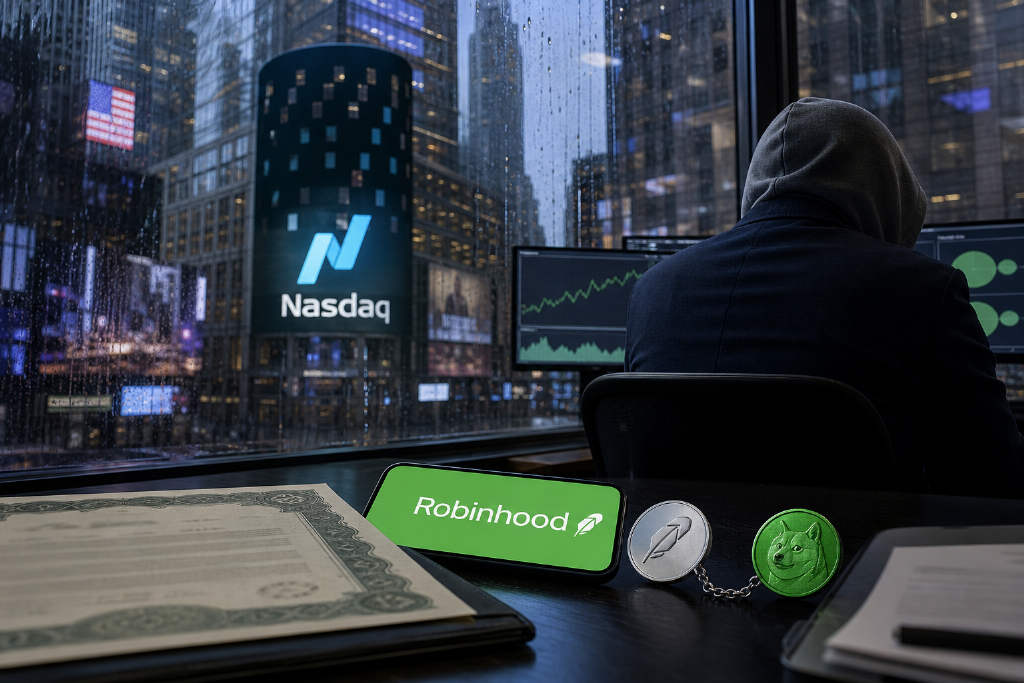
On Aug. 31, crypto trader Rune (@RuneCrypto_) posted on X that he had spent $1.8 million in an over-the-counter transaction to acquire a 37.4% stake in a Nasdaq-listed company.
He said the company has a $4.8 million market capitalization, a $0.12 share price, $380,000 in annual recurring revenue, and $6.2 million in debt. In his telling, the market had largely written the business off.
His next step, according to the post, is to tokenize the company’s stock on Robinhood Chain and launch a meme coin paired against that stock token.
The flywheel Rune is trying to build
Rune described the mechanism in sequence: meme coin traders buy the token, funds flow into a stock-token/meme-coin liquidity pool, demand for the stock token rises, and the issuer then buys the equivalent amount of U.S. shares to maintain 1:1 backing. That, in turn, would create real buying pressure in the underlying Nasdaq stock. Rune argued that this could hit a company with 92.3% short interest, trigger a squeeze, lift the share price, and then strengthen the meme coin narrative on the way back.
He called it 「the biggest crossover event in financial history, Meme coin × Nasdaq」.
The claim sounds extreme, but the structure he laid out is not detached from recent market behavior. It combines two routes that have already appeared in capital markets over the past two years.
A reversed version of the Strategy model
Over the past two years, Strategy, formerly MicroStrategy, established a clear loop: a public company sells stock or issues convertible debt, uses the proceeds to buy BTC, benefits as BTC appreciation lifts the company’s valuation, and then uses that higher valuation to raise more capital.
Under the HOOD theme, the idea of a “BTC treasury company” has already become an established track in U.S. equities. From Strategy to Metaplanet, the basic logic has been similar.
Rune is trying to invert that model. Strategy starts with a listed company and ends with a crypto asset. Rune starts with a crypto community and aims at a listed company. Strategy uses Wall Street capital to buy BTC. Rune wants meme coin traders’ money to buy U.S. stocks. Strategy’s loop depends on institutional demand for BTC exposure. Rune’s version depends on speculative appetite from on-chain retail traders.
If stock-token-paired meme coins on Robinhood Chain, similar to the AI/NVDA setup, have already shown that meme coin trading volume can drive demand for stock tokens, then Rune’s thesis is internally consistent at a conceptual level. Replace Nvidia with a shell company worth $4.8 million, and the same buying pressure would carry a much larger effect.
Three major assumptions still need proof
There is a wide gap between a self-consistent concept and an executable structure.
First, the acquisition itself has not been verified
As of publication, X Community Notes had flagged that no Nasdaq-listed stock appears to match all three parameters Rune cited at the same time: a $4.8 million market cap, a $0.12 share price, and 92.3% short interest. Rune has not disclosed the company’s name or an SEC filing number, which leaves the transaction impossible to verify independently for now.
Second, the 1:1 backing mechanism is unresolved
Issuing a stock token requires a custodian to hold the same amount of real shares. Within the Robinhood Chain ecosystem, stock tokens are backed by Robinhood as issuer and custodian. For Rune to apply the same structure to a $4.8 million penny stock, he would need a compliant institution willing to provide custody services and a reserve system that can be audited.
Liquidity is also a problem on its own. A stock like this may trade only tens of thousands of dollars a day.
Third, regulation is an obvious pressure point
Openly saying the goal is to create buying pressure in a U.S. stock through meme coin trading and trigger a short squeeze reads like a textbook example of what the U.S. Securities and Exchange Commission could examine as market manipulation. Since the 2021 GameStop episode, the SEC has kept a close watch on coordinated buying, short-squeeze setups, and social-media-driven trading campaigns.
Rune’s response in the post was: 「Acquiring a public company and converting it into a blockchain business is not manipulation, it’s an acquisition. Companies do this every day.」
Rune is not the only one linking meme coins and public companies
His plan does not stand alone. Over the past few months, the overlap between meme coins and listed companies has picked up.
- On Aug. 19, ZeroStack (NASDAQ: ZSTK) acquired 926 million MemeCore tokens at an implied valuation of about $1 billion and added them to its digital-asset treasury.
- DeFi Development Corp (NASDAQ: DFDV) issued DisclaimerCoin (DONT), described as the first meme coin created by a public company.
- Several Nasdaq-listed microcap companies are also adding crypto tokens to their balance sheets.
The common thread in those cases is that public companies are embracing meme culture and trying to trade community attention for an equity premium. Rune’s version goes one step farther: the crypto community would move first and try to gain direct control of a listed company.
The real test is how liquidity transfers through the structure
Setting aside the questions around verification and compliance, the key variable in this flywheel is how efficiently liquidity moves from on-chain trading into the underlying stock.
On Robinhood Chain, Artificial Inu (AI), a meme coin paired with tokenized NVDA, rose from a $1.5 million market cap to $135 million during August. Its NVDA pool held about $3.3 million in tokenized Nvidia.
But Nvidia is a $5.25 trillion company. A $3.3 million position has no real effect on its stock price.
Swap that underlying asset for a shell company worth $4.8 million, and the math changes. Rune said that if on-chain trading volume could generate $500,000 in real buying of the U.S. stock, that would amount to a shock of more than 10% for a company of that size. If the buying reached $2 million, it could directly alter the ownership structure.
The downside loop is just as clear
The problem is that the reverse path would also work.
If on-chain liquidity fades, the meme coin falls, demand for the stock token disappears, the U.S. stock loses that source of buying support, the share price drops, and the meme narrative breaks down. A 92.3% short-interest ratio cuts both ways. It can serve as fuel for a squeeze, but it can also reflect how short sellers are pricing the company’s fundamentals.
Until a Schedule 13D, company disclosures, and the stock-token contract actually appear, this remains a capital-markets experiment with high visibility and low confirmation.
Still, if on-chain demand can in fact be converted into buying of the underlying stock through token minting and collateral backing, Robinhood Chain may end up producing more than another batch of meme coins. It could point to a new capital machine linking crypto attention with Nasdaq microcaps.