
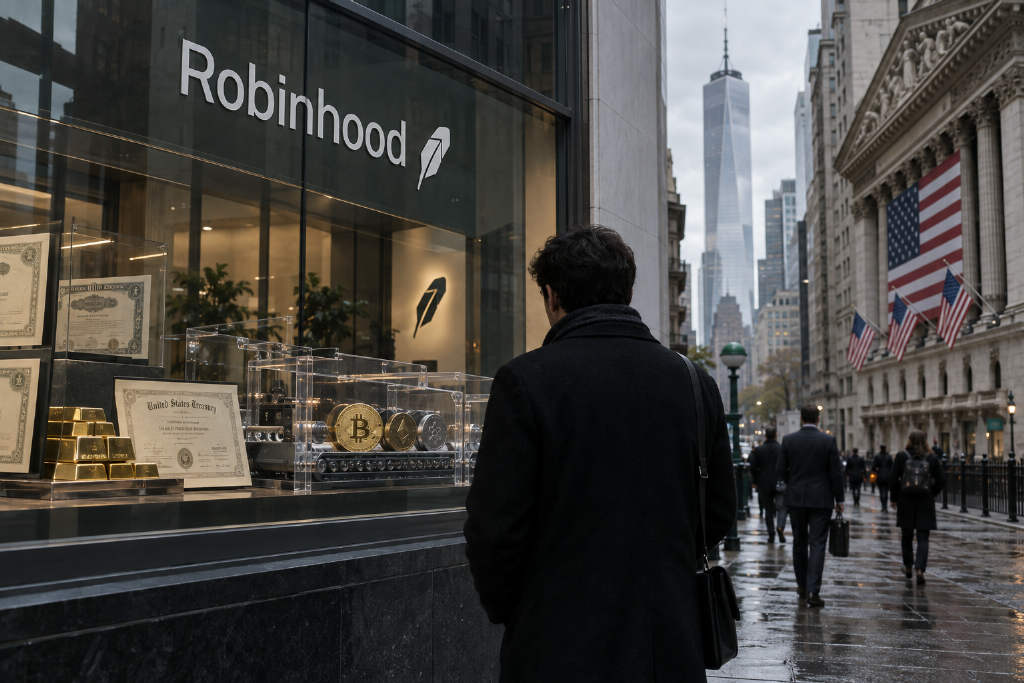
In a session hosted by Zhengming School, HB laid out a detailed case for why real-world assets, or RWA, deserve close attention and why Robinhood Chain has become part of that discussion. He framed the topic around two questions: what the next breakout asset class will be, and where that new asset will trade. Over the past two to three months, he said, Robinhood Chain has emerged quickly and helped trigger a fresh meme wave. Quoting an earlier line from a previous write-up, HB said a meme is often a marketing campaign for the chain it lives on, and that the real subject is the chain behind it. From an investment angle, that means looking at the chain behind the meme.
HB said the primary market is consolidating and the line between primary and secondary markets is fading. Capital and projects are concentrating at the top end, with rounds reaching $2 billion and $3 billion. One fund he recently studied had put 40% of its capital into a single project. Robinhood Ventures, he added, is already in its second phase and has turned 20 to 30 primary-market projects into an index.
He described RWA as a paradigm shift at the base layer of the financial system, potentially the biggest change in finance in 30 to 40 years, though one that will move much more slowly than AI. AI is a productivity tool that reaches consumers first and businesses later. RWA is a redesign of financial infrastructure. Bitcoin was born in 2008 and is now close to 20 years old, but moving assets from offchain systems onto chains at scale could take 50 years. In his view, the core idea is to let financial information move peer to peer as freely as messages do. He used a simple example: one day, an annual school event could send stock to the best student as directly as sending a QQ message.
What RWA is and what it is trying to solve
The same logic as Q Coin
HB explained RWA through the logic of Q Coin, stablecoins, and tokenized stocks. With Q Coin, a user gives Tencent $1 and Tencent mints Q Coin on a 1:1 basis. With stablecoins, a user gives $1 to Circle or Tether and receives USDC or USDT. Tokenized equities follow the same structure: an Apple share is handed to an issuer such as Ondo, with a token form like AAPLon, or to Robinhood, and a token is minted 1:1 against it.
The holder, he said, does not actually receive the asset itself. What the holder receives is the issuer’s promise. Q Coin is not something the user truly owns in the underlying sense; it is Tencent’s promise. Tokenized stocks work the same way.
Distribution, 24/7 trading, and programmable composition
HB broke RWA’s role into three parts.
- Distribution. He called this the central pain point. Users in Latin America and Africa often cannot access dollars directly, while USDT can distribute dollar exposure to them. The same applies to stocks. Users in mainland China and across Asia, Africa, and Latin America may not be able to buy US equities directly, but they can do so onchain. In that sense, chain-based rails become a global distribution channel for dollar-denominated assets. HB said the end state could be direct stock issuance and direct trading onchain, bypassing Nasdaq and erasing the line between primary and secondary markets.
- 24/7 trading. He also noted that this point is already being addressed offchain, as US financial infrastructure continues to upgrade.
- One ledger and programmable composition. He gave an example of using Zhipu as collateral to borrow Apple stock. That kind of structure is difficult today because of regulation and jurisdictional separation between China and the US, but onchain systems make such combinations possible.
The problem with stock RWA: two settlement systems running in parallel
HB argued that stock RWA has not actually solved the efficiency problem. In his breakdown, a stock trade in today’s financial system has four steps: order intake, execution, clearing, and settlement. Onchain markets also have those four steps. For native tokens such as BTC, ETH, and UNI, the full loop from order intake and matching to clearing and settlement can happen onchain.
Tokenized stocks are different. Even after onchain clearing and settlement, an offchain delivery process still has to take place because legal rights and dividend entitlements remain offchain. That leaves two systems running in parallel, and overall efficiency is determined by the slowest part. In that sense, RWA has not fixed the efficiency issue.
He said this is also why stablecoins have been the most successful RWA-like product. It is not because they are the most standardized, but because the dollar in that structure does not require another round of offchain settlement. The entire clearing and settlement loop can close onchain.
RWA 1.0, 2.0, and 3.0
HB divided the evolution of RWA into three stages.
RWA 1.0 began in 2023, when asset managers including BlackRock, WisdomTree, UBS, and Hashnote put Treasuries and ETFs onchain through offshore SPVs. HB’s view was that this phase served the supply side rather than the demand side and lacked user thinking.
RWA 2.0 was placed in early 2026, with volume starting to build around March. The representative products were perpetual contracts on Hyperliquid tied to the Nasdaq 100, Nvidia, and commodity futures, followed by Binance, Bitget, and OKX. HB said the previous cycle had already seen products such as US stock contracts on FTX, but deposit and withdrawal friction suppressed demand. This cycle, he said, has shown that demand is real.
RWA 3.0 referred to Binance integrating a broker into its offchain app and selling spot stocks directly rather than using token mapping. HB’s judgment was that onchain operation itself may become a source of friction. In that setup, crypto is not necessarily the advantage; offshore access is.
There is money in crypto, but not enough assets
HB tied the timing of RWA to what he sees as a decline in the crypto-native asset universe. He pointed to falling historical fundraising by CryptoVCs, a lower listing frequency on Coinbase, and a decline in the total market capitalization of altcoins outside the top 10, though he noted that a recent two-day surge meant one chart needed updating. Chinese crypto Twitter, he said, has been full of complaints that there is no bid left for altcoins.
At the same time, total stablecoin market capitalization has been flat since the bear market began in October 2025. His reading is that money is still inside the system, but there are not enough investable assets. Exchanges pushing RWA are acting out of that pressure as well, because exchanges earn fees rather than asset appreciation, which means they can promote almost any asset class.
HB also said BTC and QQQ were highly correlated from 2021 to 2025, with BTC behaving roughly like a leveraged QQQ. That changed in June and July this year, when QQQ surged and BTC fell sharply, while RWA activity exploded at the same time. He raised two open questions: whether RWA products are pulling capital away from native crypto assets, or whether the weakening of native crypto is accelerating RWA; and what this means over the long run for crypto-native markets, including whether the total size of the native market in this cycle may never exceed the last one.
Discussion on divergence, taxes, contracts, and settlement
Why BTC and QQQ diverged, and whether the native market is shrinking
Kacey said the divergence began after October 1 last year and was mainly driven by a high-rate macro environment, around 3.5%, where capital simply rotates between US equities and BTC. She is not optimistic about spot stock products on centralized exchanges, but she sees contracts as a major crypto advantage over traditional finance because institutions often use 1x contracts as spot substitutes. She said Jane Street’s basis trading volume on Binance may be larger than in traditional markets. She also said the US Securities and Exchange Commission has allowed fundraising below $5 million to be issued directly through onchain stock structures, and that new listings will gradually move onchain. In her view, altcoins and new assets will still appear, and A-shares and Hong Kong stocks are also ways of creating new market inventory.
Tron said the core issue is still distribution. If the asset is high quality, users will adopt it quickly. He argued that crypto assets are becoming more stock-like. After Hyperliquid, more projects have started using revenue for buybacks and burns, which he described as the equivalent of an onchain IPO. Those are the assets he thinks can become blue chips. Exchange listings, he added, are no longer focused on VC coins because the real problem is a shortage of assets.
TW said that if the question is asset quality, stocks clearly rank above tokens. Centralized exchanges used to combine issuance and trading in one place. As the number of new asset categories shrinks, the issuance function will weaken sharply.
YJ disagreed that the divergence has much to do with RWA. In his view, onchain RWA perpetual volume is still too small to move BTC. He said the divergence is mainly about AI and semiconductor stocks, plus the pull from upcoming listings such as OpenAI, Anthropic, and SpaceX.
Fees and taxes
On fees, the discussion said Binance spot stock trading costs roughly 0.05% to 0.1%, meaning a $10,000 trade costs around $7 to $8, or about two to three times Interactive Brokers. IB was described as the cheapest venue with the best liquidity and fewer regulatory concerns, assuming the user can open an account.
TW said non-KYC use cases serve demand in non-compliant regions, and one of those demands is tax avoidance. US capital gains taxes are heavy, he said, which is why Americans are reluctant to sell stock. He used Kevin as an example of someone unwilling to sell holdings.
YJ pushed back on that point. He said making money from US stock trading on an exchange and not reporting it is clearly illegal in the US. The Internal Revenue Service, he said, made it clear four or five years ago that onchain transactions, including NFTs and tokens, must be reported. The reason enforcement has been limited is that the market is still small and the IRS has not committed the resources. BN is not open to US residents, he added, and if Hyperliquid enters the US, it will connect to tax authorities. He also said combined short-term and long-term capital gains taxes in the US can exceed 50%, while Europe is around 15% to 20%, and Singapore and Hong Kong are much lower. In his view, tax avoidance is only an early-stage, small-scale regulatory arbitrage and not a core long-term demand driver.
Why buy RWA stock products if you can already buy stocks
The discussion reduced the answer to two points. One is new gameplay, such as 100x leverage. The other is access to assets that are otherwise unavailable, such as pre-listing exposure to DeepSeek.
Contracts, the speakers said, do not require issuer or shareholder approval and do not need 1:1 mapping. A platform can simply create a ticker and start trading, which makes product launch fast. Pre-IPO contracts tied to names such as Kimi are already live. The speakers described them as similar to pre-market trading, more a bet than a conventional asset, a “new asset” only in quotation marks. HB added a blunt line: if something cannot be sold offchain, it will not sell onchain either.
On depegging and default risk, the discussion said onchain prices are set by pool liquidity rather than directly by the real stock market. Price convergence depends on whether the mint and redemption channel works smoothly enough to attract arbitrage. USDT and USDC have both depegged before, and the real concern is always the reserve backing. Users therefore need to trust that the project operator is not acting in bad faith. If the underlying assets have actually been purchased, the risk is much lower. Weekend price gaps between onchain and traditional markets were described as arbitrage space for market makers.
Settlement speed and the ledger view of blockchains
HB said onchain trading is trade-and-settle in one step, a real delivery process. With stocks, by contrast, the asset may appear in the account immediately, but it does not truly belong to the buyer until T+1.
He used ledgers to explain the first principle of blockchains. Transfers inside the same ledger can settle instantly, such as internal Alipay transfers or Binance UID transfers. Cross-system transfers require coordination, such as moving value from Alipay to WeChat. In the traditional world, every institution maintains its own isolated ledger. Onchain systems create a shared ledger.
RWA as capital efficiency
HB said the more important question is not whether a structure is fully compliant today, but what kind of return and product design it can create. He gave one example of a derivatives firm that moved an options delta strategy originally used for BTC and ETH onto Hyperliquid and applied it to stocks nearing IPO, such as ChangXin Memory Technologies, then packaged the result into a discounted purchase product for clients. He said that kind of structure is not something an offchain centralized exchange can offer.
For HB, the essence of putting RWA onchain is capital efficiency, meaning programmability and financial Lego, not distribution. Distribution can be replaced. He pointed to Kraken integrating Hyperliquid HIP-3, Hyperliquid preparing an Android app, and Robinhood Wallet already allowing direct onchain stock purchases. Over the medium to long term, he said, access points are not the main concern.
Robinhood Chain: traffic, externalities, and constraints
Robinhood is using chain to solve for traffic, not ARPU
HB said crypto-native exchanges such as Binance, Hyperliquid, OKX, and Bybit are using RWA to solve an ARPU problem: if users no longer want to buy tokens, exchanges can keep collecting fees by offering another asset class. Robinhood, by contrast, is using chain to solve for globalization and traffic. In his telling, Robinhood has not truly broken through in China or Europe, and chain infrastructure offers a way to avoid taking licenses region by region and negotiating regulation market by market.
He also described an externality-driven investment angle. Robinhood may spend resources and subsidies, but the biggest beneficiaries may not be Robinhood itself. Smaller protocols such as Uniswap, Fluid, Pulse, and Lighter could benefit more. He said Lighter and Uniswap had both risen about 5x recently. He compared this to large technology companies spending on capex: the large company may rise 20 points, while the infrastructure chain around it may rise 10x to 20x.
In terms of product design, Robinhood Chain is centered on stock-token pairings, using stocks to buy memes through AMM-based structures, along with various launchpads. HB said that has taken some meme market share away from SOL and helped trigger a meme season. He added that Vlad has strong conviction and wants chain to become a business line that can be discussed on earnings calls rather than a marginal innovation project. Robinhood’s quarterly presentations, he said, will continue to talk about onchain derivatives.
Based on the onchain snapshot cited in the session, Robinhood’s trading activity already sits between Base and Solana. HB said activity in this cycle could enter the top tier and reach SOL-like levels, while TVL could be benchmarked against Base.
What Robinhood has, and what it lacks
HB listed three advantages: determination, strong product execution, and Robinhood’s own financial backing; and a third, US retail mindshare.
He also listed clear constraints. Robinhood Chain lacks a core native application ecosystem. Solana has Jupiter, Pump.fun, and Raydium, while Hood Chain’s main applications are still EVM-based DeFi names such as Uniswap and Morpho. Robinhood is also a listed company under SEC oversight, which means expanding through onchain US equities could trigger compliance disputes. The materials also mentioned AMM exemptions and the company’s political and public affairs capabilities as factors that need continued observation.
HB’s conclusion was direct: meme is the method, RWA is the goal. In his words, Robinhood Chain flipping Base is the base case, and possibly even the bear case.
More views on Robinhood Chain
YJ split onchain US equities into two layers. The first is onchain clearing and settlement, which he said will happen eventually. Vlad has long pushed the market from T+2 to T+1 and then to T+0, and Robinhood, Coinbase, Nasdaq, and DTCC are all pushing in that direction from the top down, though the eventual scale is uncertain. He described it as a faster matching and settlement SaaS layer. The second layer is onchain access, meaning distribution, and he said that part does not necessarily need to happen onchain.
YJ gave three reasons for Robinhood to build a chain: T+0 settlement, global distribution of US equities, and Vlad’s stated goal to “democratize finance for all,” including giving retail users access to pre-IPO assets that have historically been dominated by VC and PE. The discussion noted that Robinhood had worked with Baidu to enter China and had also tried Singapore and the UK, but ran into regulatory barriers.
He said Robinhood Chain’s north-star metric is TVL, the onchain equivalent of offchain AUM and a core earnings-call metric, followed by trading volume and MAU. His estimate was that it would take two to three years for TVL to catch up with Base, roughly in line with the current cycle.
On meme activity, YJ said this cycle is unlikely to reach the previous peak. He cited Trump’s token launch as having set an upper bound, industrialized supply and AI making token issuance extremely fast, and weakening demand-side conviction creating a negative loop. Even so, he still expects meme projects in the $500 million to $1 billion range. In his view, Vlad is only using Solana’s momentum for a cold start and does not intend to turn the chain into a meme chain.
YJ added that Robinhood’s next step is to connect with regulators and bring more US equities onchain, targeting non-US users. The US user base is around 23 million and growth has stalled, he said, because the addressable users have largely already been reached. Crypto contributes about 20% to 25% of Robinhood’s revenue. From an employee perspective, however, chain is not the company’s top internal priority. Robinhood is running multiple business lines in parallel, including credit cards, Trump account, retirement accounts, and earlier prediction-market efforts, and allocates more staff to whichever line performs best. Vlad has clearly labeled chain a priority externally, but employees are less convinced.
On why international expansion has struggled, YJ said Robinhood came close to entering the UK in 2021, only to be blocked in the final days because the local market did not allow the PFOF model. After the GameStop episode, the company shifted attention to infrastructure. It restarted international efforts in 2024 and 2025, and crypto products have already been rolled out in Europe. The contradiction, he said, is that US users do not need chain, while the regions that do need chain, such as Europe, are places where the Robinhood brand is weaker. Only if that problem is solved can chain generate meaningful revenue.
WY approached the issue from the perspective of revenue and margins. Spot stock fees, he said, are not attractive enough, and traditional brokers also rely on 0DTE options to lift margins. Issuance and trading alone are not enough to support a team. RWA meme may not be the best answer, but it does create a way to break out of the crypto niche by increasing volatility on top of underlying equities, which lifts both fee rates and trading frequency. He said a number of traditional brokerage executives had contacted him after this wave.
For retail users onchain, WY sees demand in pre-IPO exposure and high leverage, such as access to ChangXin or SpaceX before listing, or products like 10x Hynix and 5x QQQ. He also said Futu’s prediction-market volumes have grown quickly, especially in 15-minute contracts. If he were running Robinhood, his north-star metric would be margin, and prediction markets would rank above chain because events such as the World Cup can drive volume quickly, while chain products struggle to create a catalyst of the same scale. As for meme, he said the ceiling is set by the ceiling of the sponsor behind it, citing Telegram-related projects at around $2 billion. In the end, it all has to be translated into marketing budget and revenue. The logic of lifting margins by lifting volatility has a high ceiling, but the right answer has not yet emerged.
Tron said Robinhood Chain has strong externalities, but onchain address data suggests most users migrated from other chains and that genuinely new users are limited. On BSC, he said, stock purchase volume mainly comes from Alpha point farming and arbitrage, while meme-driven stock buying is small. People who truly want to buy stocks can simply open a US brokerage account. The real benefit of stock meme campaigns, in his view, is that they accelerate ecosystem integration by quickly connecting launchpads, app stores, lending, and other partners. Robinhood’s edge is that small-cap US equities can move onchain directly, but Ethereum’s DeFi protocols and liquidity are still hard to displace and do not yet pose a major threat to BSC. For him, the meaning of a chain still comes down to permissionless access.
Robinhood as a company and the valuation framework
A broker is traffic times conversion
At the company level, HB reduced the brokerage model to a simple formula: broker = traffic × conversion rate. Traffic is measured by DAU and funded accounts. Conversion is measured by ARPU. Where a company chooses to invest tells you what it is trying to optimize. Issuing credit cards is about lifting ARPU. Building a chain is about capturing traffic.
He said that within consumer sectors, the team feels most comfortable with food and beverage and with brokerage. Their research path has moved from altcoins to chains, then to the token-chain-exchange stack, and finally to finance. A few years from now, he said, the term blockchain may disappear and the sector may simply be called fintech. For new brokers, the team uses seven Chinese characters as a framework: liquidity, traffic, and compliance. That is also how they study Futu and Robinhood.
Thinking about Robinhood through Charles Schwab
The session said Robinhood’s MAU has never exceeded its 2021 level, suggesting that its US young-user base has already been largely saturated. Revenue can be split into two parts. Trading revenue is highly cyclical. It surged in 2021 on crypto and options, then fell 60% to 70% in 2022 and 2023. From December 2025, crypto revenue began to shrink again, and prediction markets became the main support. Asset revenue, by contrast, including net interest income and asset management, has a compounding quality rooted in dollar expansion and long-term asset appreciation.
HB used Charles Schwab as a reference point. From 1993 to 2000, Schwab’s trading revenue accounted for roughly 70% to 80% of total revenue. Robinhood is now around 60%. Over the long run, he said, trading revenue always has a ceiling, and the biggest beta is assets. Schwab captured the baby boomer generation and internet traffic. Robinhood captured millennials and mobile internet traffic. His shorthand was that traffic comes first and liquidity closes the loop. Seen through asset revenue, Robinhood is a growth stock. Seen through trading revenue, it is a cyclical stock.
He added that Schwab’s real period of outperformance versus the S&P came from 1994 to 2000, when user growth and trading revenue were both expanding quickly. Later, even as asset revenue improved, the company did not produce the same kind of excess return.
Investment view and valuation assumptions
YJ’s investment view was that Robinhood will become the only “super finance app for all” in the US over the next 10 to 20 years, but that the stock still trades with the broader US equity market. For that reason, he does not see the current level as an attractive entry point and would wait for a major US equity drawdown and weaker trading volume before buying.
The valuation page in the session listed several key figures. Funded accounts are currently 13.5 million, with a projection of about 32 million to 33 million over the next two years, measured by accounts rather than users. ARPU is about $187 now and could rise to around $300, while Schwab’s ceiling is around $1,000. Revenue is close to $5 billion in 2025 and could reach about $10 billion in two years, or at most within three years. The current market-cap ceiling cited in the discussion is $107.2 billion, while the most extreme brokerage valuations have reached around $300 billion after adjusting for inflation.
HB said that if international expansion is blocked, the main driver becomes ARPU expansion, and issuing bank cards is essentially a way to wash the existing user base. Going forward, he said, every earnings report should be judged on four numbers: user count, ARPU, revenue, and the market value implied by those figures.
Portfolio views from the session
The final part of the discussion compared platforms across traffic, liquidity, and team execution, while using compliance as the main dividing line. The speakers said that if Democrats return to power after the midterm elections, non-compliant exchanges could face pressure, creating a black swan risk. Non-compliant venues such as Hyperliquid and Binance can still add sharpness to a portfolio because they scale quickly, operate efficiently, and may offer short-term alpha.
The reason the discussion focused on four platforms is that, in the speakers’ view, RWA is fundamentally about old assets and homogeneous assets. The assets themselves are not highly differentiated, so compliance, brand, and liquidity at the platform level are likely to keep concentrating at the top.
- HB: BTC + Circle. His reasoning was that at the deepest layer, blockchain only has two businesses, BTC and stablecoins. In crypto, timing matters more than stock picking, and one cycle only requires a few trades.
- YJ: BTC + Circle + HOOD. He said HOOD is a pre-IPO style original holding for him and taxes are too high to sell. New positions should wait for a major US equity decline. Onchain names such as ETH, UNI, Lighter, and Pulse are all worth owning in some size, with limited differences in alpha.
- Kacey: Ethereum + Circle. She said Robinhood’s incremental growth lies in international expansion and onchain rails, and that new liquidity will enter through Ethereum and USDC. Hood Chain uses Arbitrum architecture and has no native token, which she said may create incremental upside.
- Vision: “All in on Ethereum.” His argument was that infrastructure built from 2022 to 2024, including sequencers, OP Stack, and Arbitrum Orbit, will finally monetize through RWA. The technology has advanced, he said, but valuations have not followed. He also highlighted the Glamsterdam upgrade. The materials further noted that Robinhood pays about 10% in fees to Arbitrum.
The session returned repeatedly to one central line of thought: under a rising RWA narrative, onchain assets, trading venues, and brokerage entry points are being recombined. HB’s view was that meme is mainly a traffic tool, while RWA is the actual destination. Whether Robinhood Chain can turn that narrative into a durable business will depend on the same variables that shaped the whole discussion: assets, traffic, compliance, and capital efficiency.