
This edition covers the period from Aug. 7, 2026 to Aug. 14, 2026. During the week, on-chain real-world assets, or RWA, rose to a total market capitalization of $38.29 billion, while the number of holders jumped to 1.7935 million. The stablecoin market, by contrast, stayed in a quieter pattern: market value held broadly steady, transfer volume shrank, and active addresses moved lower. On the policy front, the People’s Bank of China said in its 15th Five-Year reform and development plan that it will steadily develop the digital yuan. The European Union decided to revise the Markets in Crypto-Assets framework, or MiCA, and the U.K. moved its digital pound lab into a second phase while regulators also began work on a framework for tokenized gold. At the project level, Anchorpoint, backed by Standard Chartered, HKT and Animoca Brands, started the first phase of issuance for its Hong Kong dollar stablecoin HKDAP, and OSL rolled out a stablecoin payment infrastructure product for AI agents.
RWA market data
According to the latest figures from RWA.xyz cited in the report, the total on-chain RWA market capitalization stood at $38.29 billion as of Aug. 14, 2026, up 1.82% from the same point a month earlier. The total number of asset holders rose to 1.7935 million, a 58.69% increase from a month earlier.
The combination of a modest increase in aggregate size and a much sharper rise in holder count points to broader participation in the RWA segment during the period covered by the weekly report.
Stablecoin market data
Total stablecoin market capitalization edged down to $297.91 billion, a 0.41% decline from the same period a month earlier. Monthly transfer volume fell to $5 trillion, down 16.58% month over month, while the total number of monthly active addresses slipped to 53.35 million, down 1.89%.
At the same time, the total number of holders climbed to 284 million, up 3.65% from a month earlier. PANews described this as a divergence between a largely stable market cap and a rising user base, while transfer activity and active addresses both moved lower during the month.
The leading stablecoins remained USDT, USDC and USDS. USDT market capitalization rose 0.06% from a month earlier, USDC fell 1.59%, and USDS recovered by 0.13%.
Policy and regulation
PBOC includes digital yuan in its 15th Five-Year plan
The People’s Bank of China said in its reform and development plan for the 15th Five-Year period that it will optimize financial infrastructure and the central bank service system, improve payment, treasury and cash services, and steadily develop the digital yuan. The plan also said the central bank will support high-quality development of the credit reporting industry and strengthen anti-money laundering supervision to support the building of a strong financial system and high-quality economic development.
The document also called for strengthening the governance foundation for the central bank’s duties and advancing the construction of a law-based central bank and a digital central bank.
EU to revise MiCA with focus on access for non-EU stablecoin issuers
According to Bitcoin.com News, the European Union has decided to revise MiCA to address the issue that non-EU stablecoin issuers such as Tether have been shut out of the EU market. The report said the U.S. GENIUS Act and the Trump administration’s supportive push for stablecoins accelerated that decision.
Patrick Hansen, Circle’s head of EU policy, had previously warned that the current MiCA regime contains a major regulatory gap, leaving European users “either unprotected or cut off.” The EU is also considering bringing emerging technologies including tokenized payments and deposits into the scope of the revision.
An EU diplomat said that “reopening discussion of the document at this stage has become unavoidable,” adding that MiCA was approved in May 2023 and that many provisions no longer fit the pace of industry development.
Bank of England advances digital pound lab and U.K. regulators discuss tokenized gold
CoinDesk reported that the Bank of England has moved its digital pound lab into phase two, with a focus on testing interoperability between stablecoins and central bank digital currencies, or CBDCs, in trade finance use cases. Polygon is providing the settlement infrastructure. Information on the Bank of England website shows that NOBO Finance will participate in the second phase alongside Dun & Bradstreet and Polygon.
The project is being run in a simulated environment to evaluate possible use cases and business models for a digital pound. The Bank of England has not yet decided whether to issue a digital pound formally.
Separately, Cailian Press reported that U.K. regulators are working on a regulatory framework for tokenized gold as part of broader efforts to digitize financial markets and preserve London’s role as a global gold trading hub. The Financial Conduct Authority has discussed regulatory approaches with industry institutions, including several large banks. Regulators are expected to announce plans related to standards in this area in the coming months.
Hong Kong: regulated stablecoin rollout gains traction
Anchorpoint starts first-phase issuance of HKDAP; HashKey and OSL join distribution
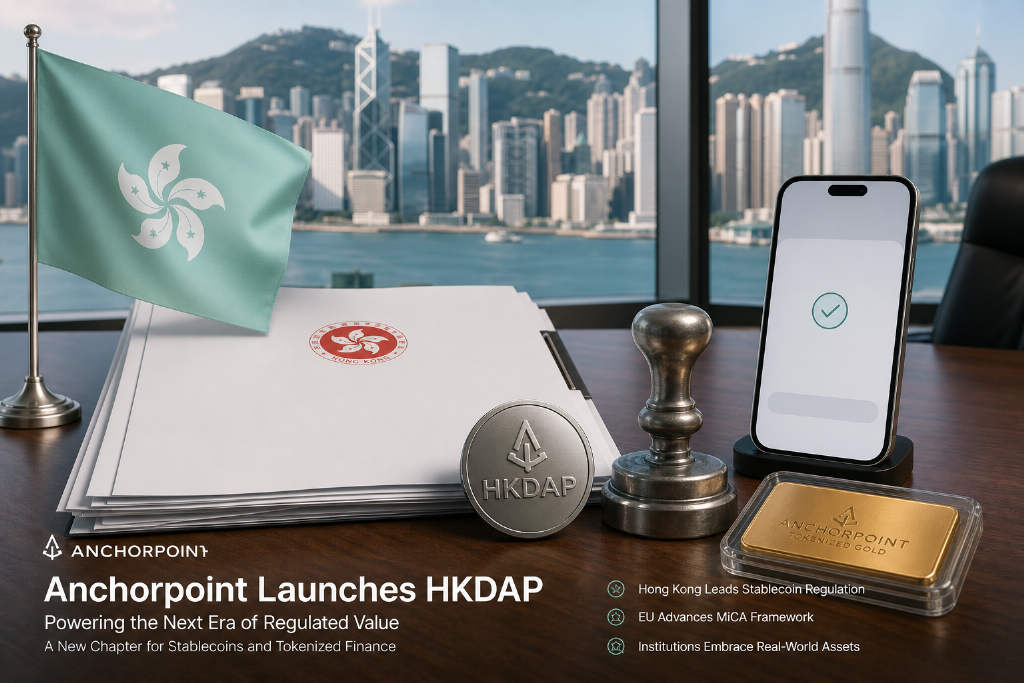
PANews reported on Aug. 14 that Anchorpoint, the Hong Kong licensed stablecoin issuer jointly established by Standard Chartered Bank, HKT and Animoca Brands, has launched the first phase of issuance and institutional application for its regulated Hong Kong dollar stablecoin HKDAP.
Licensed digital asset exchange HashKey Exchange and OSL Group have joined as major recognized distributors in the first institutional phase, providing distribution, liquidity and related support services. Under the arrangement, qualified institutions and professional investors can subscribe, redeem, exchange and settle between fiat currencies and HKDAP through HashKey and OSL.
In this first phase, HKDAP will focus on cross-border payments, settlement and distribution for tokenized real-world assets and tokenized funds, and trade finance. Anchorpoint said it will continue working with partners to expand the use of regulated stablecoins in Hong Kong and the broader regional market.
OSL launches AgentPay for AI agents
OSL Group also formally launched OSL AgentPay, a stablecoin payment infrastructure product built for AI agents. The company said the product is designed to support automated end-to-end autonomous payments and to meet the needs of high-frequency, low-value transactions between agents. Developers can connect through an API starting immediately.
OSL AgentPay combines protocol-compatible gateways with OSL’s global settlement capabilities. It is positioned as a backend settlement layer for developers rather than a consumer-facing payment tool. The product’s listed core functions include execution interfaces, multi-asset route selection, multi-stablecoin abstraction, micropayments, no on-chain gas fees, multi-protocol compatibility, multi-wallet compatibility and global fiat on- and off-ramps.
Project developments
NYSE is developing an on-chain settlement platform for tokenized securities
Digital Asset reported that New York Stock Exchange President Lynn Martin said the exchange is developing an on-chain payments platform for tokenized securities. She also said NYSE participated in the Depository Trust & Clearing Corporation, or DTC, tokenization pilot in July.
Itaú Unibanco tests tokenized bonds and funds with OpenAssets
CoinDesk reported that Itaú Unibanco, Brazil’s largest bank, is working with tokenization company OpenAssets in a pilot led by the Brazilian Financial and Capital Markets Association, or ANBIMA, to test the issuance, trading and settlement of fixed-income securities and investment funds.
The bank has more than $562 billion in assets and is the largest bank in Latin America. Itaú had previously taken part in the Central Bank of Brazil’s Drex pilot. OpenAssets raised $10 million last year in a round led by Valor Capital Group, with Tether and members of Itaú’s founding family participating.
Coinbase receives Abu Dhabi license for an international securities tokenization hub
Coinbase said it has received a Financial Services Permission, or FSP, from the Financial Services Regulatory Authority, or FSRA, of Abu Dhabi Global Market, or ADGM. The company plans to establish an international securities tokenization hub in ADGM that can conduct investment matching and custody and issue security tokens fully backed by underlying stocks. Addresses that hold the tokens will have rights to shareholder dividends and voting.
According to the company, investors will not need a brokerage account or corresponding banking relationship and can participate with a wallet. All transfers will undergo sanctions screening, and the platform will be able to freeze or seize assets at the wallet level. Coinbase said the hub will serve as its core on-chain capital markets and securities tokenization infrastructure in Abu Dhabi, alongside its global derivatives business in Dubai, forming its two overseas business centers in the UAE.
Bitwise partners with Superstate on tokenized fund holdings
PRNewswire reported that Bitwise Asset Management has entered into a partnership with fintech company Superstate to develop tokenized holding functionality for certain Bitwise funds. Superstate works with issuers and asset managers to put securities on blockchain-based record systems.
Under the framework being developed by the two firms, tokenization changes only the method for recording ownership of shares. Investors can still buy the same fund shares through existing channels and keep the same rights. Shareholders may choose to hold shares through traditional book-entry records or in tokenized form on blockchain records maintained through Superstate’s transfer agent infrastructure. Shares held in tokenized form carry the same rights as book-entry shares, but they cannot be freely transferred outside the record system. Bitwise expects the Bitwise Solana Staking ETF, trading on the NYSE under ticker BSOL, to become its first fund to offer a tokenized share option.
WLFI delays token sale tied to Maldives resort project
Bloomberg reported that a digital token project linked to a Trump-branded resort has been delayed, marking the latest obstacle in World Liberty Financial’s push to bring real-world assets on-chain.
World Liberty Financial and its partners have postponed the planned sale of digital tokens linked to a Trump-branded Maldives resort. The token had originally been scheduled for launch this spring. Investors would have received rights to part of the revenue tied to loans financing the resort project.
People familiar with the matter said the launch was delayed because the Iran war affected travel activity in the Middle East and nearby regions. Because the delay had not been made public, those people asked not to be identified.
LG CNS plans a September blockchain service for the stablecoin ecosystem
Digital Asset reported that LG CNS, the IT services arm of South Korea’s LG Group, plans to launch a new blockchain service for the stablecoin ecosystem in September. The service will cover digital wallets, transaction processing, fee sponsorship and on-chain data management.
Lee Jung-hwa, head of the company’s blockchain division, said wallets are the most important infrastructure in the stablecoin ecosystem and that control of wallets and fiat entry and exit channels will be strategically important. The company said it had already accumulated CBDC- and deposit-token-related technology through participation in the Bank of Korea’s Project Hangang and had tested multiple on-chain settlement models in that work.
Miden plans privacy stablecoin USDCx
CoinDesk reported that privacy blockchain project Miden plans to launch a privacy stablecoin called USDCx. The stablecoin will be issued natively on the Miden network using Circle’s xReserve infrastructure and will maintain a 1:1 peg with USDC.
Users holding and transferring USDCx will not publicly expose balances, counterparties or transaction histories, though the system will support selective disclosure for compliance needs. The stablecoin is expected to go live alongside the Miden mainnet, which is targeted for launch later this month. Miden said it sees USDCx as the foundation of its “PriFi” direction, with use cases including institutional trading, B2B payments, payroll management and cross-border payments.
MSX adds five spot and derivatives assets
U.S. stock token trading platform MSX has listed spot products for Neocloud ETF $NCLD.M, photonics and optics ETF $LYTE.M, and $PLUG.M, described as the world’s largest supplier of hydrogen fuel cells and green hydrogen solutions. It also added contract trading for Robinhood Chain community meme coin $CASHCAT.M and domestic DRAM company $CXMT.M.
Funding and M&A
Dow Protocol raises $10.5 million in seed funding
RWA e-commerce financing platform Dow Protocol said it completed a $10.5 million seed round with participation from MH Ventures, Mapleblock, Animoca Brands, Arcane Group, HSKChain, Essentia Partners and Quartet Group.
According to the company, Dow Protocol builds a PayFi RWA structure for e-commerce working capital and is designed to address merchants’ operating capital needs. Through asset service providers, the protocol advances funds based on merchants’ accounts receivable and credit risk data, allowing merchants to obtain funding in seconds. Repayment and risk systems are integrated directly into e-commerce platforms, with funds automatically deducted from merchant platform balances.
Rain acquires brand stored-value payments platform Ansa
Stablecoin payments company Rain announced the acquisition of payments platform Ansa, which is built for brand stored-value balances and closed-loop payments.
After the combination, and using Rain’s status as a principal Mastercard member and a Visa card issuer, partners will be able to extend stored-value balances beyond a single merchant and spend them at merchants across the Visa and Mastercard networks. Rain also said it is pushing into agent payments and has already provided AI agents with scoped cards that include budget limits.
Selected observations from the weekly roundup
a16z on crypto payment cards
PANews summarized a16z’s view by saying crypto payment cards are quickly taking stablecoins into everyday spending. Users can pay by card without a traditional bank account, while crypto assets are converted into fiat in the background and merchants do not need to handle crypto directly.
In July 2026, the segment’s monthly transaction value exceeded $759 million, up about 2.5 times year over year, with nearly 9 million transactions. The underlying chain mix also shifted. What had been led by Gnosis became more diversified, with Optimism at 29% and Solana and Base each at 19%. On the settlement side, euro stablecoins gave way to dollar-denominated stablecoins, with USDC and USDT together accounting for 84% of the total.
PANews said the segment is still smaller than traditional card networks, but growth remains strong with support from established payment rails such as Visa and from relevant legislation.
Stablecoins are moving beyond crypto-native use
PANews also summarized the argument that stablecoins are changing from a trading medium inside the crypto market into a layer of global financial infrastructure. In that framing, their role is shifting from “crypto dollars” to “on-chain dollars.”
The report said stablecoins support 24/7 instant settlement and remove frictions in traditional cross-border payments, making them a common monetary layer for cross-border transfers, corporate treasury operations and tokenized real-world assets. It also noted that Visa and Mastercard have already brought stablecoins into their settlement systems.
As regulatory frameworks improve, PANews said competition is moving away from pure issuance size and toward payment networks and compliance coverage.
Tokenized funds are competing on more than scale
PANews summarized a broader shift in tokenized money market funds, saying the market is moving from experimentation to scale and had reached roughly $10 billion globally as of May 2026.
The report described different regional paths. In the United States, tokenized funds are being linked more closely with stablecoin reserves and public blockchains. Europe and the U.K. are focusing on regulatory integration and rulemaking. Singapore is moving fund shares toward use as digital collateral for credit and crypto settlement. Hong Kong has taken an early step by allowing tokenized funds to trade on a 24/7 secondary market and by launching multi-currency products.
In PANews’ summary, this points to tokenized funds evolving from investment products into a core liquidity gateway within digital financial infrastructure, with the competitive focus shifting from issuance size to liquidity and settlement networks.