
The week from July 24 to July 31 brought a familiar split in tokenized finance: RWA market value and investor participation continued to rise, while stablecoin payment activity stayed soft.

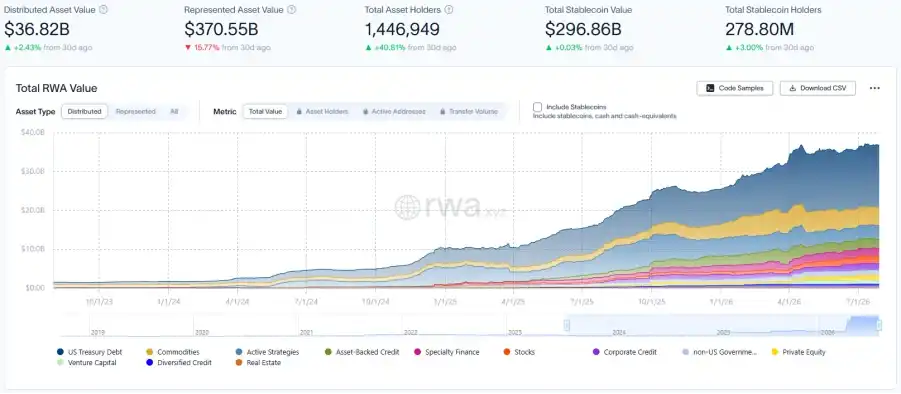
According to the latest data cited from RWA.xyz, total on-chain RWA market capitalization reached $36.82 billion as of July 31, up 2.43% from the same point a month earlier. Total holders climbed to 1.4469 million, a 40.81% increase month over month and the largest monthly net gain on record, with more than 420,000 added in a single month.
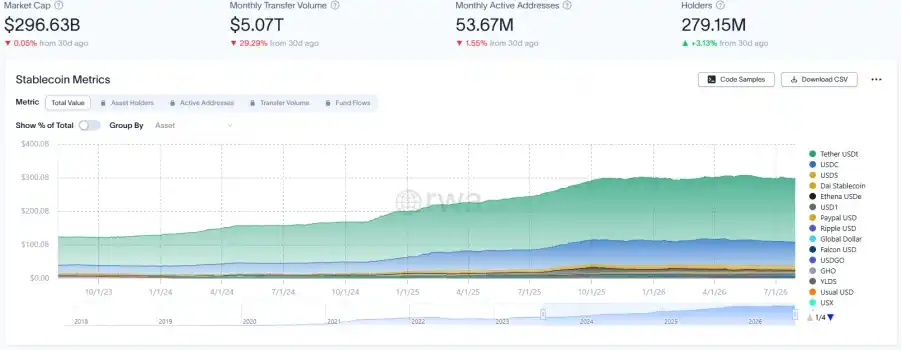
Stablecoins told a different story. Total market capitalization stood at $296.63 billion, down just 0.05% from a month earlier, but monthly transfer volume fell to $5.07 trillion, a 29.29% decline. Monthly active addresses slipped 1.55% to 53.67 million, while total holders rose 3.13% to 279 million, pointing to rising ownership alongside weaker on-chain transactional use.
RWA growth continued as stablecoin usage weakened
The weekly roundup described the broader market as one where capital continued to accumulate on-chain but settlement demand remained subdued. Among the largest stablecoins, USDT market capitalization rose 1.27% from a month earlier, USDC slipped 0.28%, and USDS fell 14.56%.
The data points to a market where asset ownership is still expanding, but transaction intensity is not keeping pace.
South Korea moves on stablecoin rules and a crypto tax repeal proposal
According to Cointelegraph, South Korea’s Financial Services Commission, or FSC, plans to work with the ruling party on a comprehensive Digital Asset Basic Act. The bill would cover stablecoin issuance and circulation, business rules for digital asset firms, exchange entry standards, disclosures, internal controls, and system resilience.
There are currently 10 separate digital asset and stablecoin bills pending in the National Assembly. Issues under debate include whether issuers of won-pegged stablecoins should be bank-controlled and whether major crypto exchanges should face shareholding caps.
At the same time, the National Assembly’s planning and finance committee is set to review an opposition-backed bill to abolish crypto taxation. The proposal was introduced in March by People Power Party lawmaker Song Eon-seok and would remove provisions taxing income from digital asset transfers or lending. Under the current plan, the tax was due to take effect on Jan. 1, 2027, applying a 20% rate plus a 2% local income tax to annual crypto income above 2.5 million won, or about $1,700.
Zimbabwe approves seven firms for sandbox testing
According to Bitcoin.com News, the Securities and Exchange Commission of Zimbabwe, or SECZ, approved seven fintech companies to enter its regulatory sandbox framework.

The approved participants include blockchain financing platform Zimbabwe Entrepreneur Exchange, asset tokenization platform Ndarama Standard, synthetic trading platform Questview Brokers, crowdfunding platform Crowdaxe Capital, and Procode Platforms, Financial Securities Exchange, and Colmin Resources Zimbabwe, three firms focused on asset, infrastructure, or securities tokenization.
SECZ said the sandbox is meant to support responsible innovation, improve financial inclusion, and help develop capital markets. Participants will operate under strict regulatory oversight, and the regulator reserved the right to issue more guidance or operational requirements.
Kenya cuts stablecoin issuer capital requirement by 40%
According to Bitcoin.com News, Kenya’s Treasury published revised rules that reduce the minimum paid-up capital requirement for stablecoin issuers by 40%, lowering it from nearly $3.9 million in the draft framework to about $2.32 million, or 300 million Kenyan shillings.
The revised rules still keep tight guardrails in place. The Central Bank of Kenya would exercise broad oversight over stablecoin issuers and other virtual asset service providers. Stablecoins must be backed 1:1 by eligible reserve assets, and users must be able to redeem at par within two business days.
At least 30% of customer funds must be placed in segregated trust accounts at Kenyan commercial banks, with the rest invested in qualified local assets. Fiat-referenced stablecoins must also be backed by reserves denominated in the same currency as the peg.
Project Agorá completes live $1 million cross-border payment test
According to The Block, the Bank for International Settlements-led Project Agorá completed a live cross-border payment test involving five central banks and 28 commercial banks, including JPMorgan, Citi, UBS, Deutsche Bank, and Standard Chartered.
The test used tokenized central bank reserves and commercial bank deposits to complete about $1 million in real transactions across six currencies: the U.S. dollar, euro, British pound, Japanese yen, Swiss franc, and South Korean won. Average settlement time was about 80 seconds.
The setup used a shared ledger so banks could transact against a single record, and it also tested synchronized foreign-exchange settlement to reduce counterparty risk. Project Agorá is one of a number of wholesale tokenization efforts aimed at testing how digital systems can modernize global financial market infrastructure.
Ten European financial institutions form RL1 cooperative
According to Cointelegraph, 10 European financial institutions have launched the Regulated Layer One, or RL1, blockchain cooperative to build infrastructure for regulated financial markets and tokenized assets.
Founding members include ING, Spain’s Cecabank, France’s Crédit Mutuel Alliance Fédérale, Germany’s DekaBank, DZ BANK, and LBBW, France’s Natixis CIB, Standard Chartered’s SC Ventures, and Seturion.
RL1 is structured as a European cooperative registered in Luxembourg, with equal governance rights for each member. The private permissioned chain is based on infrastructure developed by German fintech firm SWIAT, which has transferred ownership of the network to the cooperative.
The network is intended to support institutional use cases including digital money, tokenized bonds, collateral, and blockchain-based settlement, with the stated goal of reducing fragmentation caused by each institution running its own distributed ledger system. Former SWIAT managing director Henning Vollbehr will lead RL1. KfW and L-Bank will continue supporting the project, and RL1 is in talks with institutions including NatWest about joining.
Aviva Investors launches tokenized U.S. dollar liquidity fund shares on XRP Ledger
According to Cointelegraph, London-based asset manager Aviva Investors launched tokenized shares of its U.S. dollar liquidity fund on the XRP Ledger after receiving approval from the Central Bank of Ireland.
Eligible investors can access the product through digital wallets. The underlying assets remain held by custodian BNY Mellon, Komainu provides digital asset custody, and Licuido supplies the tokenization infrastructure. The fund invests in highly rated short-term U.S. dollar debt securities and money market instruments, and the tokenized shares carry the same investment objective and liquidity profile as the traditional fund.
POSCO International and LG CNS tokenize trade invoices on Injective
According to CoinDesk, South Korea’s largest trading company, POSCO International, is working with LG Group technology affiliate LG CNS to tokenize real commercial invoices on the Injective network.
POSCO International is using invoices generated from actual trade among its global subsidiaries rather than simulated data. The stated goal is to speed up cross-border payments. A shared blockchain ledger creates a single transferable record with compliance rules embedded, cutting reconciliation time among buyers, sellers, and banks and improving capital turnover.
Brazilian farmers use tokenized dairy cows to access financing
According to CoinDesk, farmers in Paraná, Brazil, obtained nearly $20,000 in credit by tokenizing 10 dairy cows as RWAs through stock exchange B3, as local banks tightened lending to small agricultural businesses.
The project is led by Brazilian agtech company Cowmed. Each cow is fitted with an AI-powered Smarty Collar that tracks health, behavior, and location in real time. The raw data is encrypted, turned into a digital identity, and written into the credit agreement linked to B3.
Continuous monitoring is designed to stop the same cow from being pledged more than once, and it allows a dead animal to be replaced with another living cow. Cowmed said it currently monitors about 100,000 cattle with total asset value above $395 million. It estimates that as much as 20% of its network could adopt this financing model, potentially unlocking about $77.6 million in agricultural credit.
BNY moves transfer agent recordkeeping onto blockchain
According to CoinDesk, BNY is shifting its core transfer agent recordkeeping work onto blockchain, building a single on-chain holder register covering about $8.6 trillion in assets and 7.6 million accounts to reduce intermediaries and reconciliation costs.
Initial clients include Baillie Gifford, BlackRock, and BNY’s Dreyfus. Baillie Gifford is set to launch what the report described as the first fully native tokenized fund regulated in the U.K., while BlackRock and Dreyfus plan to issue more tokenized products on the system.
BNY will keep its traditional transfer agent system in place as well, with legacy and on-chain architecture expected to run side by side for an extended period. The bank also said cybersecurity risks, including smart contract vulnerabilities, still need to be addressed.
Securitize secures SEC investment adviser registration
According to The Block, Securitize subsidiary Securitize Capital has formally obtained registered investment adviser status from the U.S. Securities and Exchange Commission.
Chief executive Carlos Domingo said the move marks another step in the platform’s expansion. The registration allows Securitize to work more closely with asset managers and institutional investors on tokenized investment strategies.
The company’s U.S. platform now combines four regulated business lines: an SEC-registered investment adviser, an SEC-registered broker-dealer operating an alternative trading system, an SEC-registered transfer agent, and fund administration services. Securitize went public through a SPAC merger on July 2.
Ondo launches Ondo Network and drops the parallel Ondo Chain path
According to The Block, Ondo Finance introduced Ondo Network, a new execution layer it described as an evolution of Ondo Chain. The company said Ondo Network will not run in parallel with Ondo Chain.
Ondo said that while building perpetual exchange Ondo Perps, it found that trading bottlenecks were concentrated in execution rather than settlement. Its new architecture separates execution from settlement and validation. Secure hardware enclaves handle high-speed and private-by-default trade execution, while a decentralized attestor network verifies the code running inside them. Asset transfers currently settle on Ethereum, with support for more public chains planned later and periodic state commitments to be posted on-chain.
Ondo Network is positioned as a general-purpose execution layer. Beyond perpetuals, it is intended to support spot trading, lending, structured products, and other applications that need fast, private, and verifiable execution. ONDO keeps its role as the project’s core governance and incentive token.
Open USD to launch on Ethereum, while USA₮ goes live on Celo
Ethereum Institutional, a nonprofit group in the Ethereum ecosystem, said on X that Open USD will be deployed on Ethereum on its first day of launch. The stablecoin project has backing from more than 140 institutions, including Visa, Mastercard, Stripe, BlackRock, and BNY Mellon. All reserve income will be directed to partners contributing to its growth.
Separately, The Block reported that Tether’s compliant stablecoin USA₮, or USAT, has officially launched on Celo mainnet, marking its second mainnet deployment after Ethereum. The token is issued by Anchorage Digital Bank and can be natively minted and redeemed on Celo. It can also be used to pay gas directly through Celo’s fee abstraction model. USAT launched in January and currently has a market capitalization of about $185 million.
MSX lists one U.S. stock contract token
U.S. stock token trading platform MSX has listed contract trading for $AMKR.M, described as a leading company in advanced packaging and testing.
Three market reads: utilization, Augustus, and OUSD versus USDC
The roundup also included three PANews summaries.
The first argued that while on-chain RWA issuance has surpassed $32 billion, roughly 90% of those assets remain dormant and DeFi utilization is still limited. It cited clear divergence among platforms: issuers such as Securitize and Ondo have DeFi utilization below 3%, while credit protocols such as Maple reach 62% because they already have stronger use cases. The reasons listed were that Treasury-style products are mainly held for yield, KYC whitelists restrict permissionless circulation, and market-making and secondary-market infrastructure remain underdeveloped. PANews said the next phase of competition is shifting from issuance toward applications and distribution, with gateways such as Robinhood becoming more important.
The second focused on Augustus, a European payments company formerly known as Ivy. PANews said the company, led by 25-year-old founder Ferdinand Dabitz, recently raised $180 million at a $1 billion valuation and received conditional approval for a U.S. OCC national bank charter. The company is moving from an open-banking merchant checkout API toward a model centered on tokenized deposits and digital asset wallets, described in the summary as a “stablecoin wholesale bank.” The same summary said the founding team lacks experience managing a regulated bank balance sheet and that questions remain around cost reduction and conversion into actual business volume.
The third looked at competition between OUSD and USDC. PANews said the Open Standard alliance, which includes more than 140 institutions such as Visa and Stripe, launched OUSD in late June 2026. The model breaks from the traditional approach used by issuers such as Circle by redistributing Treasury yield to partners, putting pressure on Circle’s distribution channels and margins. PANews also said OUSD still faces a long licensing process of 18 to 24 months, coordination inefficiencies across the alliance, and high infrastructure costs. USDC, by contrast, still has network effects in open DeFi and benefits from Circle’s Cross-Chain Transfer Protocol, or CCTP, with future competition likely to center on enterprise settlement and B2B payments.