
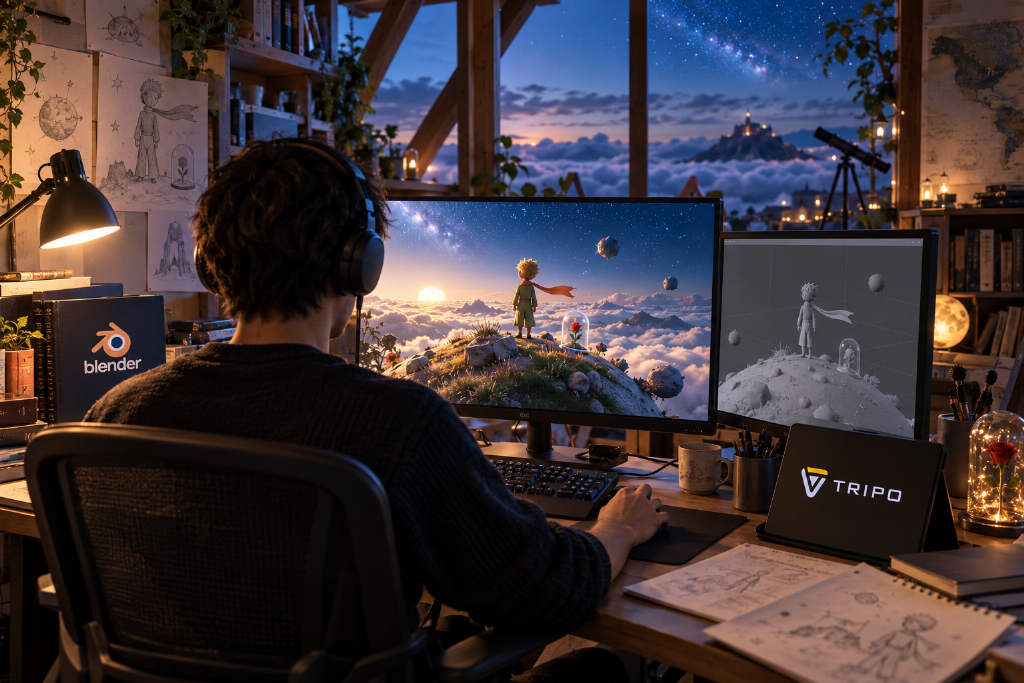
Developer Sac said he used 16 days to turn The Little Prince into a playable 3D narrative game, and unveiled the project on X on Oct. 13.
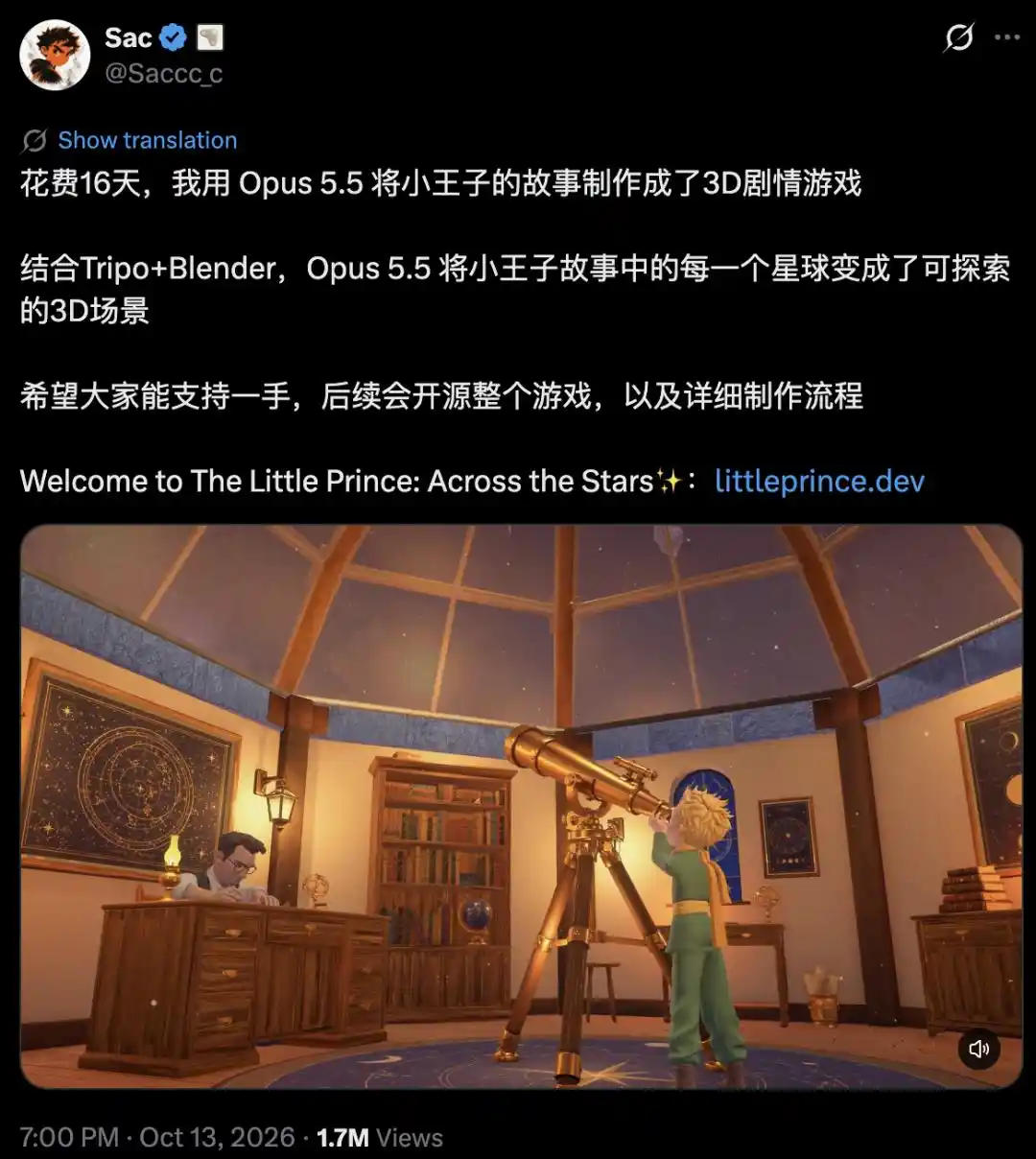
According to Sac, the game was built with Opus 5.5, the 3D model generation tool Tripo, and the 3D production software Blender. He said each planet from the story was recreated as an explorable 3D environment. The project is titled The Little Prince: Across the Stars and already has its own standalone website.
From the page to explorable 3D worlds
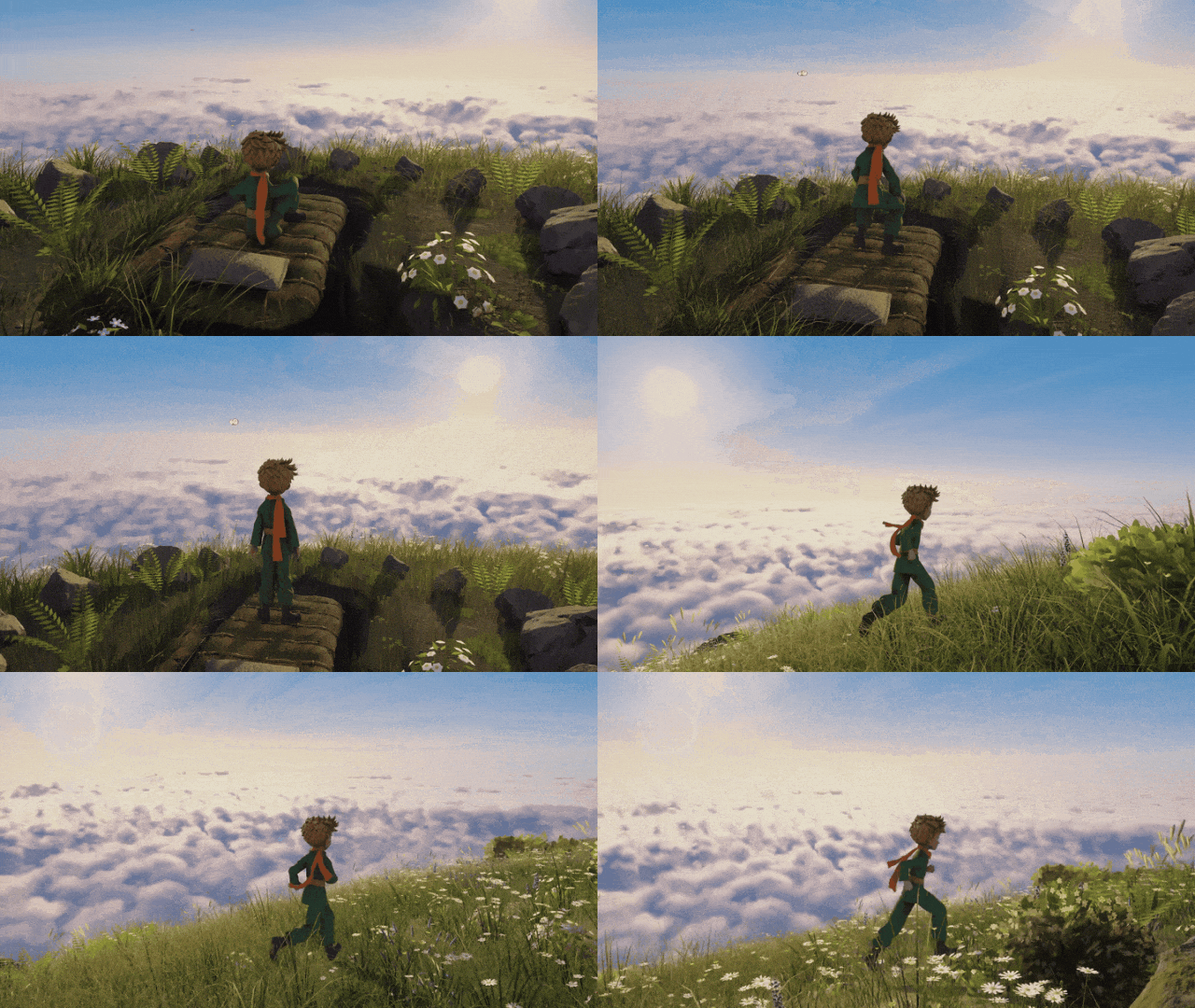
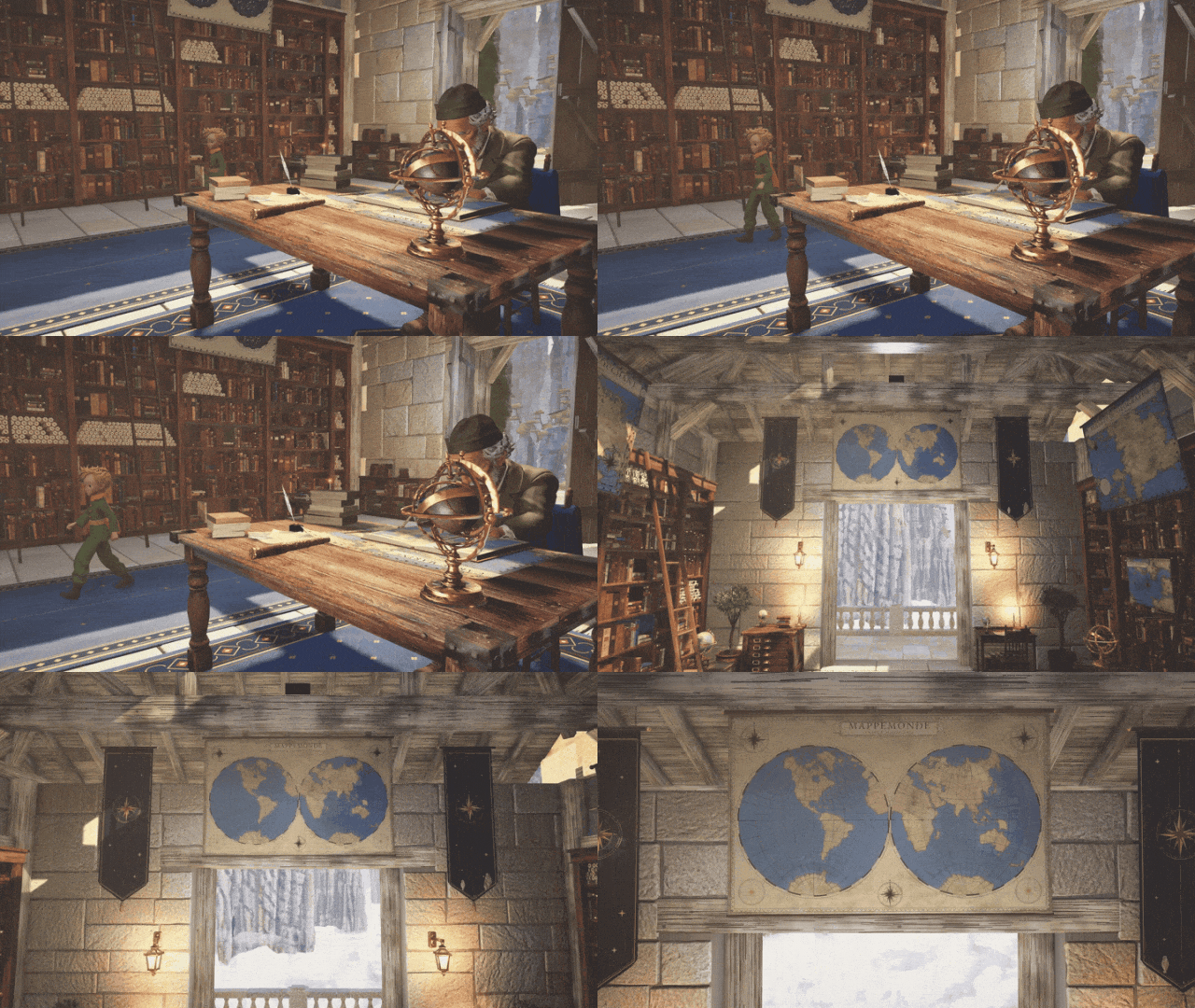
Footage shared by Sac shows the blond Little Prince standing among plants and rocks with a sea of clouds stretching into the distance. In another interior shot, a wooden ceiling appears above a room lined with bookshelves, with a map hanging on the wall. A separate sequence shows the Little Prince running across sand, with his shadow shifting along with his steps.
Cloudscapes, rooms and desert scenes give the book’s people and settings visible shape, lighting and spatial depth. For readers familiar with the novel, the adaptation raises a simple question: what does that remembered fairy-tale world look like once it becomes a game?
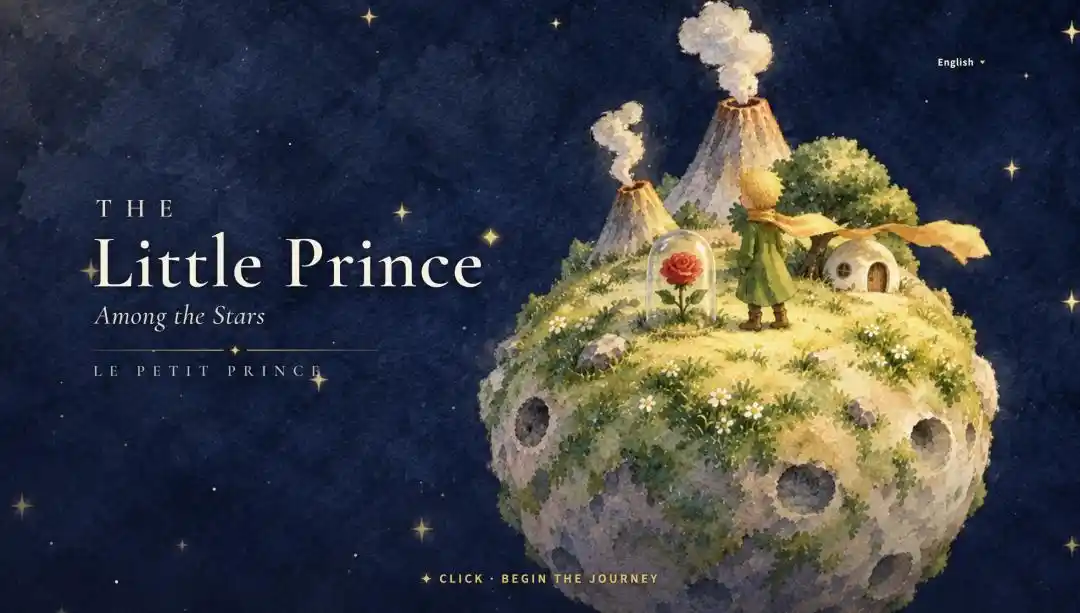
Reading the book leaves the world inside the reader’s imagination. In the game, players can step into the role of the Little Prince and move through the 3D environments themselves. Where to walk, where to stop, and which corner to inspect first are no longer fixed by the page. The story becomes something the player can enter and navigate.
Once the environments exist, the harder problem is turning memorable scenes from the book into interactive moments that still land with players. A movement, an encounter, or even the choice to linger in one location can affect how the story is delivered inside the game.
The official site currently lists eight language options, including Chinese, English and Japanese, giving readers in different languages a way into the project.
A one-person project built with several tools
One of the main points of interest around the game is how Sac finished it in 16 days.
Building a story-driven 3D game takes more than placing characters and backgrounds on screen. Characters need to move. The camera has to follow them. Story triggers need to fire when the player reaches a specific location. When a task is completed, the game has to respond.
Sac named Opus 5.5, Tripo and Blender as the core toolset behind the project. Tripo can generate 3D models from text or images, helping creators turn ideas for characters and objects into assets. Blender can then be used for modeling, materials, animation and rendering, as well as for later adjustments after the models are generated.
By combining Opus 5.5 with those tools, Sac built a game that is now publicly accessible.
There is also a less visible part of game production: once characters, scenes, animations and story beats are all built, they still have to work together smoothly. A character may look polished on its own but feel mismatched in size or style after being placed in a scene. An animation may look natural by itself and still feel awkward once paired with a tracking camera.
Those issues usually appear only after the project is running, and they have to be identified and adjusted one by one. The finished game takes shape through that process of repeated fixes.
The case also shows what individual creators can do with large models and 3D tools. A scene can be built first, then a moving character can be added, and then more scenes and story segments can be connected. Splitting a large production task into smaller milestones, while testing and revising along the way, gives the project a path to completion.
Players are already finding bugs, and WebGPU is required
Feedback started coming in soon after the game went live. X user @0xLuo said after trying it that it was hard to imagine a 3D game with that level of completion being made in only 16 days.
That user also reported a bug: after completing the flower-watering task, the forward and backward directions on the W and S keys, along with the left and right directions on the A and D keys, were reversed. He said he was still not sure what exactly triggered it.
Once players begin exploring, issues that did not surface during development can show up quickly. Different exploration routes, input patterns and task orders can expose new bugs. Visuals may get people to click in, but control feel and story pacing still have to hold them there.
The official site also states that the current version requires a browser that supports WebGPU. Anyone who wants to try the game needs to confirm that their browser environment meets that requirement. After release, supporting more devices and browsers so that more people can run it smoothly becomes part of the work still left to do.
Sac says the full project will be open-sourced
In the original post, Sac said he plans to open-source the entire game and publish a detailed production breakdown.

For people who also want to make 3D games, those materials may offer practical reference points: how to build the planets, adjust character models, connect animation with story progression, and debug the project.
If the later release also explains which parts required repeated trial and error, which details still needed human judgment, and how much time and money each stage took, it would give other creators a clearer way to estimate the resources they would need.
What makes the project stand out is that one person used AI and 3D tools to turn a familiar fairy tale into a world other people can walk into and experience. If the open-source plan moves ahead smoothly, the lessons from those 16 days may help more creators get started.