
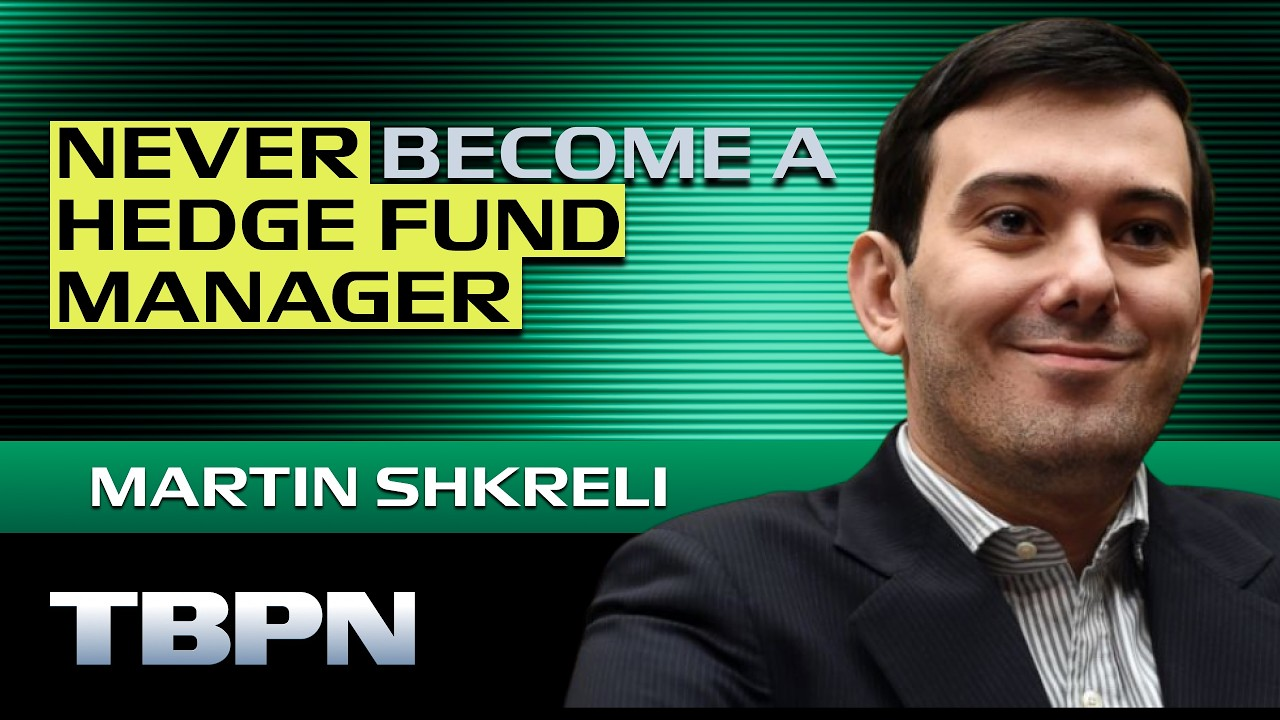
Martin Shkreli used a July 30 episode of TBPN Podcast, titled “Martin Shkreli Breaks Down the Collapse of Situational Awareness,” to walk through the liquidity crisis at Situational Awareness Fund, or SALP. He placed the episode in the same broad category as past liquidity-driven hedge fund failures such as Long-Term Capital Management and Amaranth.
The show was hosted by John Coogan and Jordi Hays. The program notes said Shkreli previously worked at a hedge fund under Jim Cramer, later founded Elea Capital and MSMB Capital, and also built biotech companies including Retrophin and Turing Pharmaceuticals. The notes also disclosed that he is currently an active personal investor, holds some AI-related stocks including Kosha in Japan, and operates DrugDash as well as a paid subscription business.
He called it one of the wildest stretches he has seen in markets
Shkreli said the prior 24 hours had been among the craziest periods of his investing life. He added that he and people around him had been hearing rumors since the middle of the previous week that Situational Awareness was in trouble, with the picture becoming clearer by Thursday night and Friday morning.
He said the fund appeared to have done a fairly good job keeping details contained. That did not stop the market from picking up the scent. In his telling, some large counterparties may have begun positioning as early as Monday or Tuesday.
He borrowed a phrase associated with Cramer and described the process as “shooting against a fund.” Once the market believes a fund must liquidate, other participants sell overlapping holdings and begin shorting what the target fund owns. Shkreli said on the show, “Once the market knows a fund has to liquidate, the most profitable thing for everyone else to do is sell what overlaps with that fund and start shorting everything it owns. It’s brutal, it’s Darwinian, but it’s very common on Wall Street.”
His main explanation was leverage, not war, oil or AI narrative shifts
The hosts tested a list of macro explanations: war involving Iran, oil prices, open-source AI anxiety and the idea that hyperscaler cloud capital spending had peaked. Shkreli dismissed them one by one.
His view was blunt: “Those are not the core issue. What matters is the buying and selling propensity of buyers and sellers.”
He described a familiar bubble sequence. Smart money buys first. As prices rise, that same capital often keeps buying. Later participants see returns of 400% and chase performance because they do not want to miss out. The weakest hands often buy near the top and are the first to panic on the way down. He joked that he himself tends to be one of the people buying near the top, adding that he liked memory and “bottleneck trades.”
For Shkreli, the critical point is that prices at moments like this are set by the marginal 5% of traders, not by every holder in the market. And that 5% is often levered. In SALP’s case, he referred to market talk that the fund was running at roughly 4x leverage. In his words, a 25% drawdown is enough to knock you out.
How the math breaks: from roughly $45 billion of capital to near wipeout territory
Shkreli used simplified numbers to show how little room a portfolio has when leverage is that high. He assumed the fund had about $35 billion in equity capital, plus around $10 billion of private Anthropic stock, putting book equity at roughly $45 billion.
At 4x leverage, that translates into a gross portfolio of about $120 billion. If the book falls 25%, from $120 billion to around $90 billion, equity can collapse from roughly $35 billion to about $5 billion or lower, in his framework. That is the point where prime brokers take over.
He specifically mentioned firms such as Goldman Sachs and Bank of America. Their job in that situation, he said, is not to rescue the client. It is to seize the assets and move them out quickly. As he put it, their boards would rather lock in a $1 billion loss than risk a $5 billion loss.
Shkreli also referred to market talk that Leopold spent the weekend calling around 10 institutions in an effort to sell Anthropic shares and raise liquidity, using an Anthropic valuation of about $1.1 trillion. In the end, the public-market book went to the prime brokers for disposal, while Citadel took the portfolio at a discount.
Once the street smells blood, liquidation turns into a race in front of the seller
Shkreli spent time on the mechanics of exiting a huge portfolio. You cannot unload $100 billion of stock the way a retail trader hits a sell button on Robinhood. That was his basic point.
The normal process is to call a dealer such as Goldman Sachs and have the dealer line up buyers. But the intermediary has to advertise the order to the market in order to move it. That means signaling inventory through market-making identifiers such as GSCO and letting people know what is for sale. Once that starts, Wall Street quickly figures out there is a major seller in the market.
Smaller funds may then short the same names in front of the liquidation. Potential buyers can hesitate as well, because the larger the sale really is, the more careful they have to be about stepping in. Shkreli said the holder list is only so long. If you call Fidelity or index funds and they say they are not the seller, the field narrows quickly.
He described the reaction in even harsher terms. Once the market confirms that someone has to dump $100 billion, he said, there can be $1 trillion lined up in front of that seller. He also argued this was not just Leopold’s $100 billion problem. Across the market, capital in the same trade could be five to 10 times that amount. His expectation was that the most violent phase of liquidation may already have passed, but more funds could still emerge over the next few weeks with losses of 30% to 40%.
Jane Street, Millennium and Citadel were the main bidders, and Citadel won
On the bidding process, Shkreli said three firms were brought into the closed circle: Jane Street, Millennium and Citadel.
He said he had heard Millennium did submit a bid, but Citadel offered better terms and came out ahead. In his reading, Ken Griffin wants Citadel to be the firm people call when things break. Shkreli said, “Ken wants to be that guy everyone goes to when there’s a problem. Buffett is older and doesn’t want this kind of work. But Citadel did this during the Amaranth blowup.”
He framed that role as an expensive form of brand investment that may only matter once a decade, but can pay off massively in one shot. For the SALP portfolio specifically, he said Citadel could be sitting on an immediate paper gain of $3 billion to $4 billion if it can absorb and manage the positions smoothly.
He also noted that Citadel was slightly positive for the month and said that may reflect pre-existing hedges. Another part of the advantage, in his telling, is structural. As a major prime brokerage client, Citadel sees enormous amounts of market flow and has a natural edge in information and execution speed.
Prime brokers like leverage until their risk teams take over
Shkreli also broke down the prime broker business model. They make money on financing spreads. If a client borrows at 4x leverage, the prime broker may collect what he described as 400 to 800 basis points of “free income.” That is why they like leverage business in the first place.
But the risk department inside the same institution is looking at concentration, short exposure and hard-to-value assets. Private equity stakes are especially awkward. In Shkreli’s view, when a hedge fund starts wearing a venture capital hat, the outcome is usually poor.
He argued that East Coast hedge funds trying to do private deals are usually at a disadvantage against West Coast firms built specifically for venture investing. Leopold’s case, as he described it, was especially difficult because Anthropic was private and illiquid. Demand may have surged, but when cash is needed, there is no sell button to press.
Shkreli also said Leopold was unusually close to the company, noting that Leopold’s fiancée is chief of staff to Anthropic CEO Dario Amodei. He added that Anthropic demand had jumped 100x over the past six months, but that did not solve the immediate liquidity problem.
He referred to market talk that by Monday or Tuesday someone may already have tapped Leopold on the shoulder and told him his margin looked thin, asking whether he could add several billion dollars. In Shkreli’s account, the situation moved too fast for that kind of rescue to work.
His view of Leopold: talented, inexperienced and trapped by structure
The episode also went into Leopold’s background. Shkreli said Leopold had previously worked at FTX until the day before the exchange collapsed. In his view, that experience should have left a strong lesson in risk management, yet the return to the market came with higher leverage and a more concentrated book.
He said Leopold also broke with the usual hedge fund rule against loading up on private equity positions, particularly names such as Anthropic that are difficult to monetize in a hurry. Shkreli’s summary was stark: Leopold may not have “done anything wrong” in a narrow sense, but the leverage level had already determined the ending. Once there was even a small disturbance, liquidation became unavoidable.
He also shared an anecdote from fundraising. A large New York fund-of-funds had passed on Leopold because he lacked experience and, in its words, was not investable. After Leopold went on to produce 20x returns, that decision looked embarrassing. Following this blowup, Shkreli said, the original rejection was in some sense proved right again.
Another point he raised was the delayed filing of Leopold’s 13F. That delay had fueled speculation that some confidentiality arrangement was in place, but Shkreli said it sounded more like the filing was simply not handled in time. To him, that hinted at operational and communications weakness inside a young fund.
He thinks Leopold can come back, though not without humiliation
When asked whether Leopold can rebuild his career, Shkreli said yes. He brought up Peter Thiel as an example. Thiel’s macro hedge fund Clarium Capital struggled later in its life, but Thiel then went on to Founders Fund, became one of the most successful venture investors, and later returned with Thiel Macro.
Shkreli’s conclusion was that Leopold could spend several years rebuilding and learning from the collapse. He said no one denies Leopold is a genius. At the same time, he stressed how humiliating the process would be: going from the biggest hedge fund in the world two months ago to a forced liquidation two months later is a severe blow.
He added that modern hedge fund contracts can make the aftermath worse. Many investors now push for clawback provisions that require managers to return the 2% management fee and 20% performance allocation after a severe drawdown.
Kelly Criterion was his final lesson: edge is not enough if position sizing is wrong
At the end of the show, Shkreli turned to position sizing and said he had built his own simulator based on the Kelly Criterion.
He said that if a trader has a 55% edge, the optimal position size is about 10% of capital. In real markets, though, many traders bet at two to 10 times the optimal size. His simulation result was straightforward: even with a 60/40 edge, overbetting still drives you to zero.
To illustrate the contrast, Shkreli recalled meeting a low-profile manager who had spent years at SAC Capital, now Point72. That manager ran $300 million to $400 million, almost entirely his own money, kept 80% to 90% in cash most of the time, traded small, had no losing quarter over more than 20 years and generated annual returns of 20% to 30%.
Shkreli then contrasted that with his own experience: “The first thing I did when I got capital was put on 8x leverage. Dumbest thing in the world.”
His closing reflection was that hedge funds are glamorous, painful and frightening at the same time. The illusion is control. The reality, in his words, can be waking up at 3 a.m. to check Korean stocks and waking again at 6 a.m. to see what changed around the world, when in fact “you’re basically doing nothing except playing a very high-risk insane poker game.”