


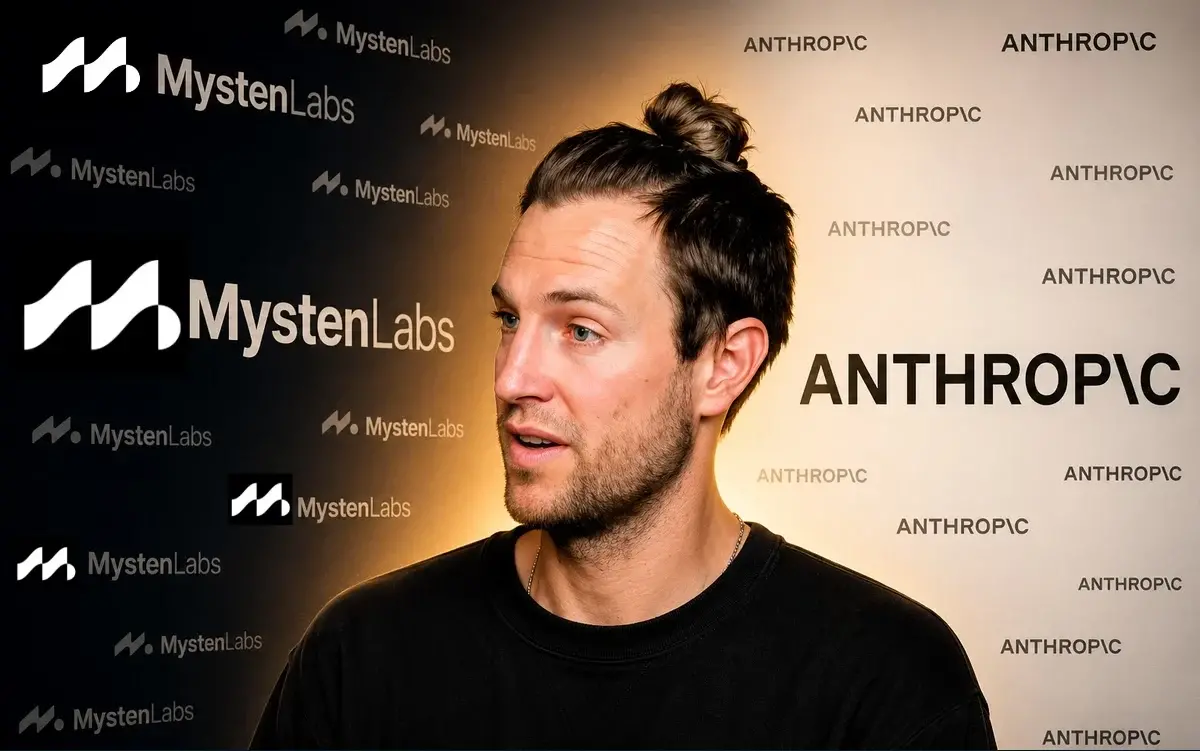
Sam Blackshear said on X on Aug. 5 that he is leaving Mysten Labs and joining Anthropic to work on defensive security research related to AI.
Many users may not recognize the name right away. The technology is easier to place: Blackshear created Move, the programming language that underpins Sui.
From Libra to Sui, more than eight years spent on Move
Back around 2018, Blackshear was still at Meta. Mark Zuckerberg was pushing the Libra stablecoin project at the time, and Blackshear was part of the core technical team. His job included designing a new programming language for that effort, which became Move.
Libra was later renamed Diem, and the stablecoin initiative was eventually stopped by regulators. Move survived.
In September 2021, Blackshear and four former Meta colleagues launched Mysten Labs, taking Move out of Meta’s failed effort and using it to build a new public blockchain, Sui. The article says he spent more than eight years on the language from its early conception to his exit now.
To explain the weight of that departure, the source draws a rough comparison: Blackshear’s place in Sui and Move can be viewed in the same broad way that Vitalik Buterin relates to Ethereum and Solidity. People like that are hard to measure by title alone. They may design the language, decide how a protocol evolves, or influence where resources and funding go.
The article describes them as the “gatekeepers” of crypto projects, the people who set security boundaries and define how high an ecosystem can grow.
A moment that showed AI’s pull
The piece says there was a clear sign before Blackshear left.
During a project security roundtable in April, he described an experience that, in the author’s view, captured why AI has become so attractive to senior technical figures in crypto. Blackshear said he had once written an analysis tool during his Facebook years and later wanted to port it to Move so it could scan Move code for potential vulnerabilities. In the past, that sort of migration had to be done manually and, in his own words, would take “a very, very long time.”
He then handed the job to Claude. According to the article, Claude completed the migration automatically and flagged a batch of potential vulnerabilities. Blackshear’s reaction was quoted as: “whoa, we’re in a new world.”
That detail matters because it moves the AI discussion away from broad marketing claims and into a developer’s daily work. The article’s point is simple: people are often not persuaded by hearing that AI is powerful in the abstract; they are persuaded when it starts solving familiar, specialized tasks in ways they did not expect, sometimes better than they could do themselves.
Under that reading, moving from crypto to AI is not only a career decision. It also reflects direct conviction that the technology can do meaningful work.
More crypto operators are making the same move
The article says similar shifts can be seen elsewhere.
In February, Ethereum Foundation co-executive director Tomasz Stańczak announced his resignation after less than a year in the role. Stańczak previously founded Nethermind, one of the most important clients in the Ethereum ecosystem, and was also a core participant in the evolution of Ethereum’s protocol layer.
When he left, he wrote on his blog: “I now know that Agentic systems and AI-assisted discovery are reshaping the world.” The source treats him as another gatekeeper, one focused not on language security but on the direction of Ethereum protocol upgrades.
It also points to earlier examples. OpenSea co-founder Alex Atallah stepped down as CTO in 2022, at the height of the NFT boom, and later built AI model aggregation platform OpenRouter, which the article says is now valued at $500 million.
Leopold Aschenbrenner left FTX’s Future Fund, wrote the 165-page Situational Awareness, and now runs a multibillion-dollar AI investment fund. The article notes that the fund has recently taken serious losses, though he continues to develop in a different arena.
His former colleague Avital Balwit also left the FTX orbit and is now chief of staff to Anthropic CEO Dario Amodei.
These departures span different projects, jobs and periods. The common thread, according to the source, is that the work these people were doing overlaps with what the AI sector now needs most. Rather than “escaping” crypto, the article says, they look more like pieces being pulled from a slower-growth system and inserted into one moving faster.
Developer activity is down, and capital is rotating too
The article then shifts from people to data.
Citing Artemis data from March, it says weekly code commits across crypto projects on GitHub fell from about 850,000 at the start of 2025 to roughly 210,000, a 75% drop.
Over the same stretch, weekly active developers fell from about 8,700 to 4,600, cutting the total by more than half. Within that, Ethereum developers were down 34% in three months, Solana developers fell 40%, and BNB Chain saw code commits drop 85%.
The source says this is not a problem isolated to one chain. Nearly every ecosystem is losing blood.
GitHub overall, however, kept growing. In 2025, about 36 million new developers joined the platform, and total commits across GitHub rose 25% year over year. The GitHub Octoverse report, as cited in the article, says much of the increase went to AI projects: AI-related repositories topped 4.3 million, and imports of large language model SDKs jumped 178% in a year.
Dragonfly investor Omar offered three reasons for the divergence, according to the article: attention has shifted toward AI, falling token prices have weakened economic incentives for developers, and some teams have moved from open source to closed-source development, meaning the code may still exist even if it is no longer visible on GitHub.
That leads to a narrower conclusion. The article says crypto is not “dead”; it is shrinking. The outer edge is thinning out, while core teams are tightening up. The problem is that the people leaving are not only on the periphery. Some of the departures are from the core.
Ethereum departures and a broader funding shift
The source says the Ethereum Foundation has seen at least nine senior researchers and leaders leave this year, with five of them departing in May alone. It describes the protocol research team as having been nearly hollowed out. In that setting, Vitalik is presented, in a certain sense, as Ethereum’s last gatekeeper, still holding the central line on project direction.
The reasons for those exits differ. The article mentions governance disputes, compensation issues and dissatisfaction with the L2 path. Whatever the reason, it says, the seats are now vacant.
Money is moving in parallel.
Bloomberg reported in July that Paradigm closed a $1.2 billion fund and, for the first time, expanded its investment mandate to AI and robotics. Managing partner Palmedo was quoted as saying: “There’s too much happening out there to pretend not to see it.”
The article also includes a financing marker for crypto itself: total crypto funding reached $12.8 billion in the second quarter of this year.
Paradigm is not alone. Framework Ventures raised $400 million last month for AI and robotics. Haun Ventures raised $1 billion in May and included AI for the first time. Citing Crunchbase, the article says global venture investment totaled $510 billion in the first half of 2026, and OpenAI plus Anthropic accounted for more than 40% of that figure. During the same period, funding across the whole crypto sector was less than 5% of that total.
The message is blunt. The people writing code are leaving, and the money that used to pay them is changing direction as well.
Coldcard exploit sharpens the security question
The article ends with security, where it says the pressure is becoming harder to ignore.
Crypto has never been a safe industry in absolute terms, but the recent pace of incidents has been especially dense, in the author’s view. On July 30, hardware wallet maker Coldcard was hit by a firmware vulnerability. The article says 1,196 wallets were drained in 41 minutes, with losses of more than 1,082 BTC, or about $70 million. The bug had reportedly been sitting in the code for more than five years without detection.
Afterward, a Reddit developer fed Coldcard’s open-source code into Claude Code and entered a simple prompt asking it to check for vulnerabilities. Eight minutes later, Claude identified the issue, the article says.
Dragonfly managing partner Haseeb Qureshi then wrote on social media that about “$2 of AI compute” could have prevented the attack.
Put together, these facts lead the article to an awkward position for crypto. Security threats are getting more severe. AI-driven attack methods are becoming more complex. At the same time, the people who define security boundaries and review base-layer code are being pulled one by one into AI.
Those who remain may end up relying on AI more heavily to review code and build projects. The article treats that as a setup that can look efficient on the surface while still feeling fragile if experienced system builders are no longer there to supervise it. Its final question is not when the next bull market arrives, but what method will be left to stop the next black swan if the gatekeepers keep leaving.