
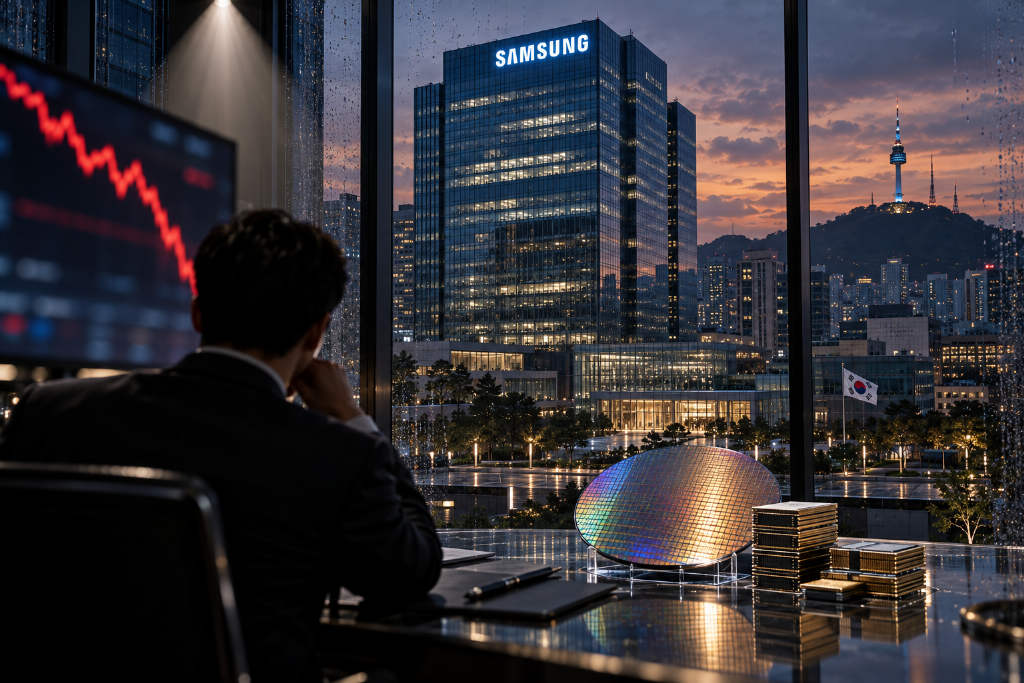
Samsung Electronics reported 2026 third-quarter consolidated revenue of 195.3 trillion won, or about $124 billion, and operating profit of 107.4 trillion won on Oct. 29. It was the first time the company’s quarterly operating profit had topped 100 trillion won, and Samsung said it had now posted record revenue and profit for a fourth straight quarter.
Revenue and operating profit both hit new highs
According to Samsung’s filing, third-quarter consolidated revenue rose 14% from the previous quarter and about 126.88% from a year earlier. Operating profit increased 20% quarter over quarter and about 126.88% year over year.
The results were broadly in line with market expectations. LSEG SmartEstimates had forecast revenue of 195.79 trillion won and operating profit of 107.66 trillion won.
On shareholder returns, Samsung declared a third-quarter cash dividend of 4,601 won per common share and 4,601 won per preferred share, for a total of about 30 trillion won. Capital expenditure reached 29 trillion won in the quarter, up 12.2 trillion won from the prior quarter and 19.8 trillion won from a year earlier. The spending was mainly directed to new fabs, infrastructure and line upgrades in the Device Solutions, or DS, division.
Semiconductors generated nearly all of group profit
Samsung’s earnings were driven overwhelmingly by chips. The DS division posted revenue of 147.1 trillion won, up 15% from the previous quarter, and operating profit of 106.5 trillion won, equal to 99% of the group’s operating profit. Memory revenue came in at about 140.7 trillion won.
Samsung said its memory business adjusted its product mix toward AI demand while operating under capacity constraints. Strong server demand pushed prices higher across application markets. The company also sharply expanded HBM4 sales and moved to meet rising demand for server solid-state drives, or SSDs.
In foundry, Samsung said revenue and profit improved clearly, helped by higher sales of HBM base dies and broader sales of advanced-node products. The company also said it continued to win high-performance computing, or HPC, orders centered on 2-nanometer processes, with customers including major cloud providers. In System LSI, revenue increased as new smartphone models entered mass production with system-on-chip, or SoC, and image sensor components, while the custom SoC business established partnerships with new customers.
Consumer electronics and mobile operations remained under pressure
Samsung’s consumer electronics and mobile businesses continued to face cost pressure. The DX division posted an 8% quarter-over-quarter increase in revenue, but recorded an operating loss of 0.8 trillion won.
The loss mainly came from the MX and Networks businesses. Revenue was supported by new flagship and foldable phone launches, but profit fell from a year earlier because of cost pressure.
Samsung sees memory tightness lasting through 2028
Looking to the fourth quarter, Samsung said AI-led industry competition would keep driving infrastructure investment. Memory demand growth is expected to center on products tied to next-generation CPU and GPU platforms, while demand for QLC SSDs is linked to the expansion of personal AI agent services.
The company plans to increase sales of HBM, server DRAM and SSDs, while raising supply of high-speed server DDR5 and QLC SSD products. Samsung said memory supply tightness is expected to continue through 2028.
For 2027, Samsung said AI infrastructure capital spending is likely to reach historic levels and that AI demand will far exceed industry supply. It plans to build a stable sales base through multi-year contracts. Based on current contract negotiations, Samsung expects 60% to 70% of total capacity to be locked into long-term supply agreements by 2030.
On pricing, the report said Samsung’s asking price in 2027 HBM4 negotiations was more than three times the current HBM3E level.
Shares fell despite the record quarter
After the earnings release, Samsung shares weakened on Oct. 29. At the time of writing, the stock was down 5.17% intraday at 229,500 won.
According to Korean media reports cited in the source article, there were two main reasons. First, much of the good news had already been priced in, and some investors appeared to be taking profits. The market had already expected Samsung’s operating profit to break 100 trillion won, and the final revenue and operating profit figures were within 0.5% of LSEG estimates. The KOSPI had also risen nearly 10% over two days, which may have added to profit-taking pressure.
Second, details of the broader shareholder return plan were pushed back to next January. Samsung only provided a total annual shareholder return range of 90 trillion won to 110 trillion won, while the specific execution plan for the remaining 55 trillion won to 75 trillion won will not be finalized until a board meeting at the end of January 2027.
The quarter was strong on profit, but the stock reaction suggested the market had already reflected much of that performance. Attention now turns to the details of shareholder returns and to fourth-quarter shipments of HBM and server memory products.



