
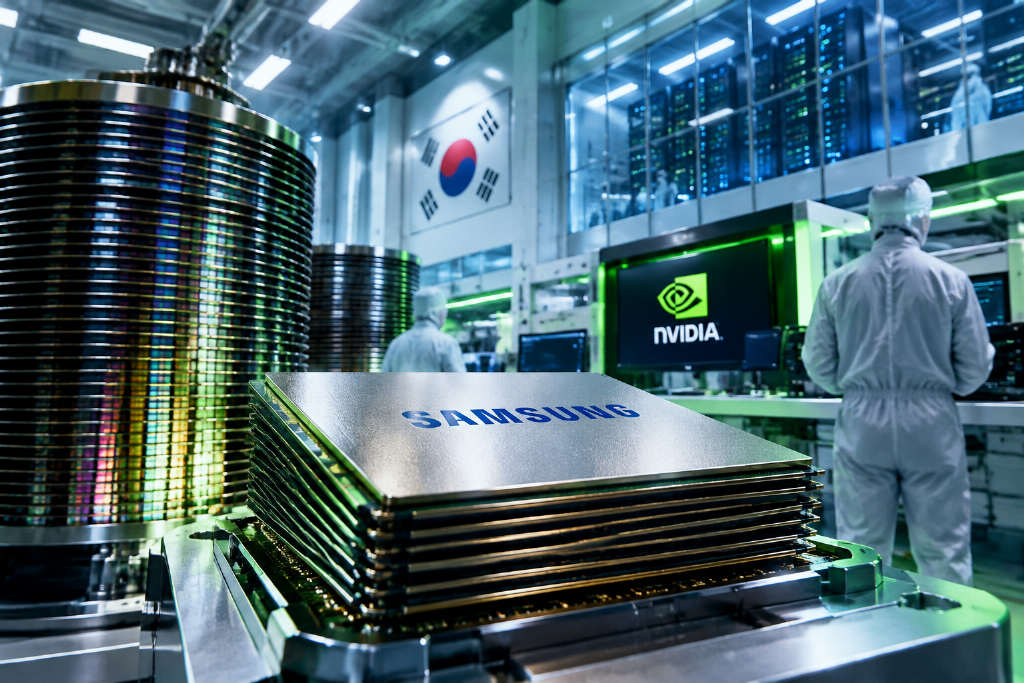
Samsung Electronics’ memory division passed qualification testing in late September for its 12-layer HBM4E product with NVIDIA and several hyperscale data center operators, according to an Oct. 7 exclusive report by The Korea Economic Daily.
The report said the result may give Samsung an early lead in the next-generation HBM supply race against SK hynix and Micron.
Qualification cleared, but orders are still unconfirmed
The report said Samsung’s 12-layer HBM4E completed inspection procedures with multiple customers, including NVIDIA. Those procedures test product quality and stability against customer specifications and are a required step before HBM products can move toward orders.
Even so, the report was explicit on one point: qualification approval is not the same as winning supply contracts. Shipment volume, contract size, and the schedule for mass-production deliveries have not yet been confirmed for any of the customers involved.
On the timeline, Samsung announced in February that it had begun mass production and shipments of HBM4. In May, it said it had supplied samples of the 12-layer HBM4E to global customers. Samsung did not name those customers at the time, though the industry had widely pointed to NVIDIA and major hyperscalers.
NVIDIA’s NVHBM path and Samsung’s 8-layer variant
Separately, NVIDIA is pushing an NVHBM project that places a custom memory controller into the base die at the bottom of the HBM stack.
Samsung is also developing an 8-layer HBM4E product for that demand. The target speed is 17Gbps to 18Gbps per pin, and the chip is expected to be introduced as early as Rubin Ultra.
What Samsung had already disclosed for the 12-layer HBM4E
HBM4E is an upgraded version built on the core HBM4 architecture, with higher operating speed, more bandwidth, and better power efficiency. Based on Samsung’s earlier disclosures, the 12-layer product carries the following specifications:
- 48GB capacity
- Up to 16Gbps per pin, more than 20% faster than the previous HBM4 generation
- Energy efficiency improved by 16% through low-power design and package structure optimization
- Built with 1c DRAM, described as sixth-generation 10nm-class DRAM, and paired with a 4nm logic die from Samsung Foundry, the same process combination used for the HBM4 already in mass production
When sample shipments were announced, Samsung said HBM4E would move into mass production in line with customer schedules. The report added that these specifications came from Samsung’s prior releases and were not newly disclosed as part of the qualification result.
Why the market is watching: pricing and share shifts
The qualification news is drawing attention as HBM prices and market share continue to move.
ChainCatcher previously reported that Samsung had quoted HBM4 for 2027 in the mid-to-high $4 per Gb range, more than triple the roughly $1.5 per Gb level of the currently dominant HBM3E. Micron said on an earnings call that most 2027 HBM supply had already been booked by customers and that pricing was well above 2026 levels. TrendForce estimated that average HBM selling prices in 2027 would rise about 121% year over year and said HBM4E is expected to ramp in the second half of next year.
Counterpoint Research data showed Samsung’s global HBM market share by revenue rose from 21% in the first quarter to 33% in the second quarter. Over the same period, SK hynix fell from 58% to 50%, while Micron slipped from 21% to 18%. SK hynix remained in the top position, but Samsung’s gain was notable.
The industry is now watching whether Samsung can convert HBM4E qualification into actual orders, when HBM4E will enter full-scale production, and how far SK hynix and Micron have progressed in qualification for the same generation.