
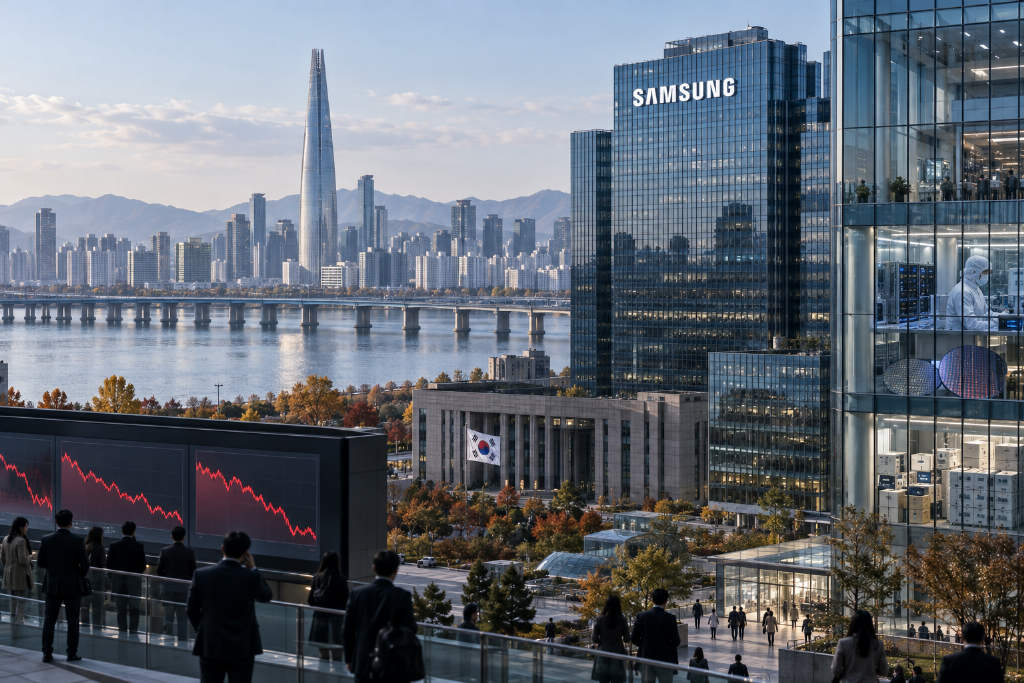
Samsung Electronics delivered a record-setting quarter, but the market reaction pointed in the opposite direction. The company’s preliminary results for the third quarter of 2026 showed consolidated revenue of about KRW 195 trillion, up 126.6% from a year earlier, and consolidated operating profit of about KRW 107.4 trillion, up 782.5% year over year. It was the first time a South Korean company had posted more than KRW 100 trillion in quarterly operating profit.
Yet the stock fell on the day the earnings preview was released. Samsung closed at KRW 262,000 on Oct. 8, down 2.42% for the session. Over the first three trading days of October, the shares fell 5.07%, and they were about 30% below the intraday high of KRW 374,500 reached on June 18.
A single quarter produced about 2.5 times Samsung’s 2025 full-year operating profit
On the profit line alone, the quarter was extraordinary. Samsung’s full-year operating profit for 2025 was KRW 43.6 trillion. Against that base, the KRW 107.4 trillion posted for the third quarter of 2026 was about 2.5 times the company’s operating profit for all of 2025.
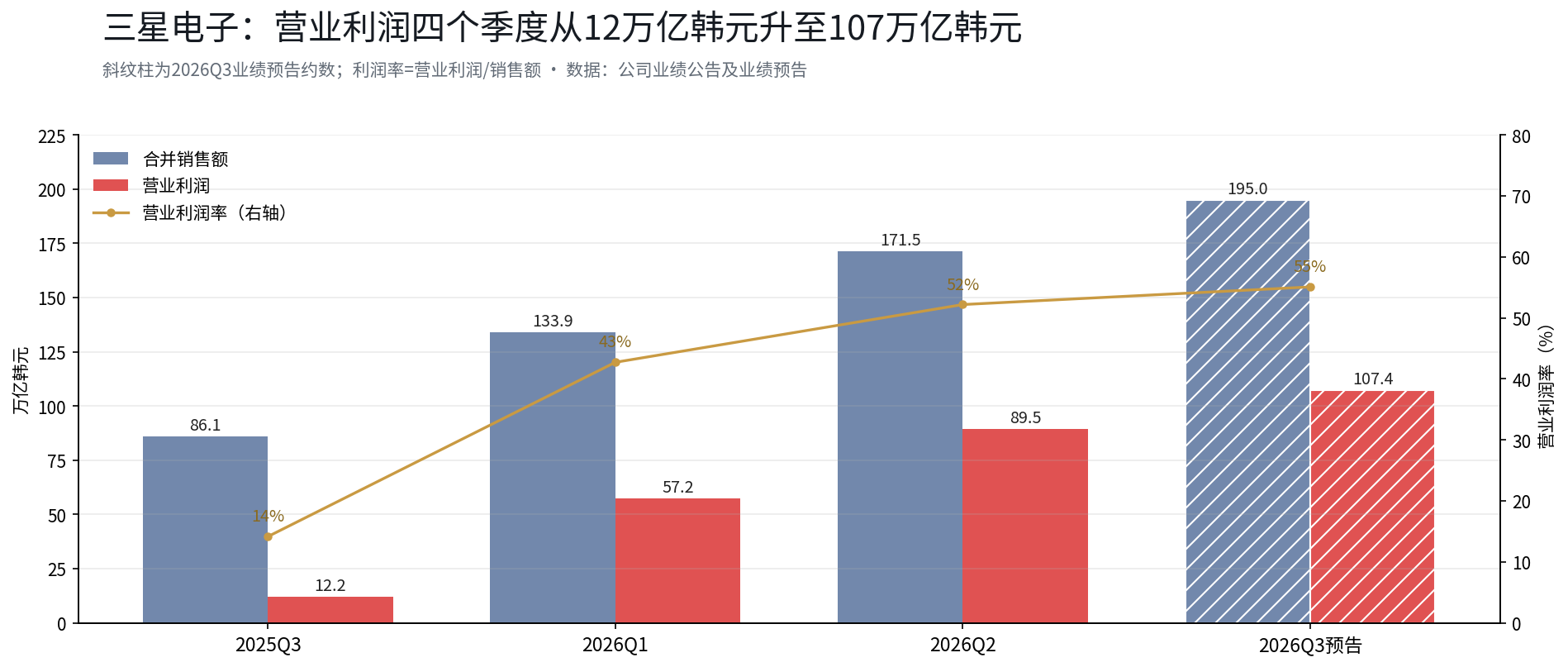
The recent quarterly sequence shows how sharply earnings have climbed. Operating profit stood at KRW 12.17 trillion in the third quarter of 2025, then rose to KRW 57.2 trillion in the first quarter of 2026, KRW 89.5 trillion in the second quarter, and KRW 107.4 trillion in the third-quarter preview. Operating margin moved from 14% to about 55% over that stretch.
Those same figures support two different readings. One is level: KRW 107.4 trillion is a record. The other is slope: year-over-year operating profit growth slowed from 1,813.8% in the second quarter to 782.5% in the third. The article notes that the huge annual growth rate was driven in large part by a low base in the same period of 2025. On a two-year stacked view, the memory industry remains in the middle of a historic upcycle, though past performance does not guarantee future results.
Semiconductors are generating the profit, while mobile and consumer electronics are under pressure
According to a Citi breakdown cited in the article, Samsung’s semiconductor division generated about KRW 107 trillion in operating profit in the third quarter, up from KRW 89.2 trillion in the second quarter.
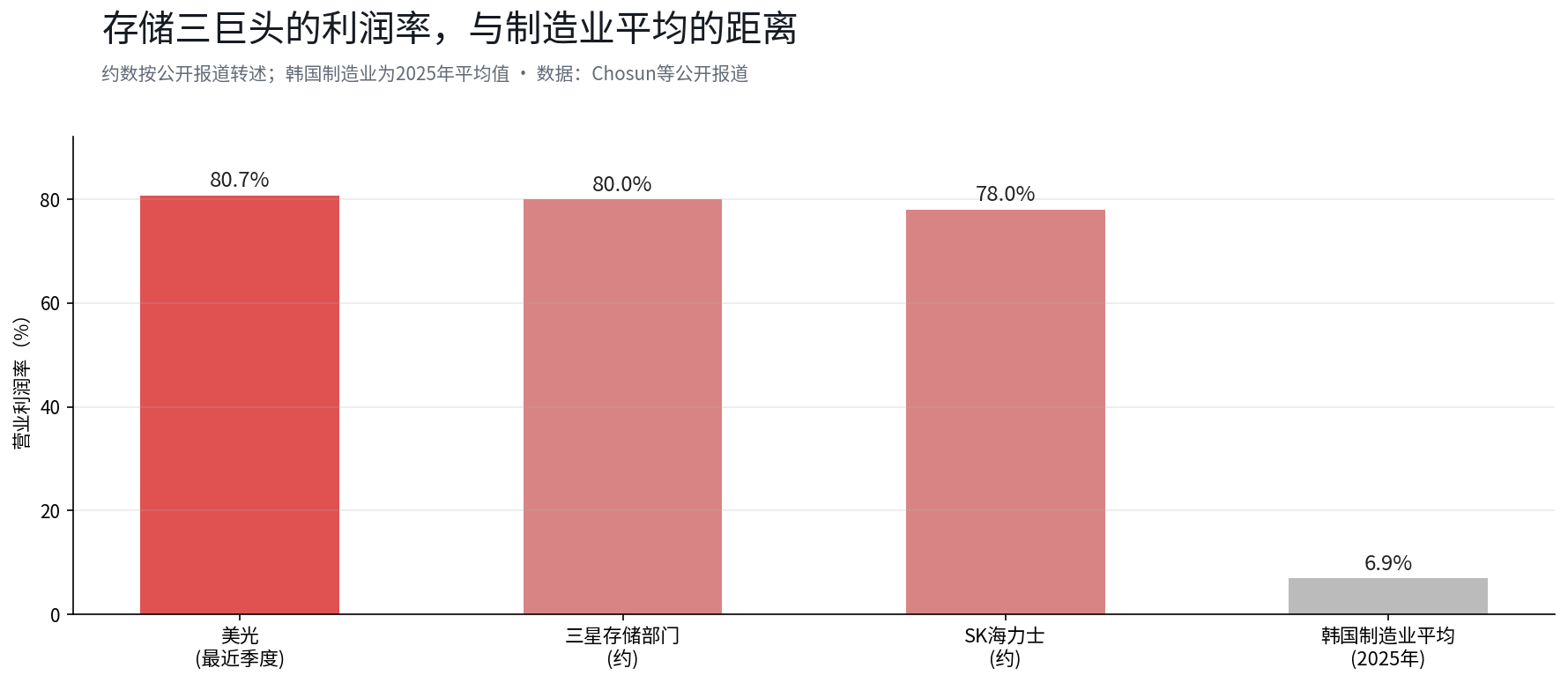
Public reports cited by the article show how far memory profitability has moved beyond normal manufacturing benchmarks. Based on reporting from Chosun and others, Micron posted an operating margin of 80.7% in its most recent quarter, Samsung’s memory business was around 80%, and SK hynix was about 78%. For comparison, the average operating margin for South Korea’s manufacturing sector in 2025 was 6.9%.
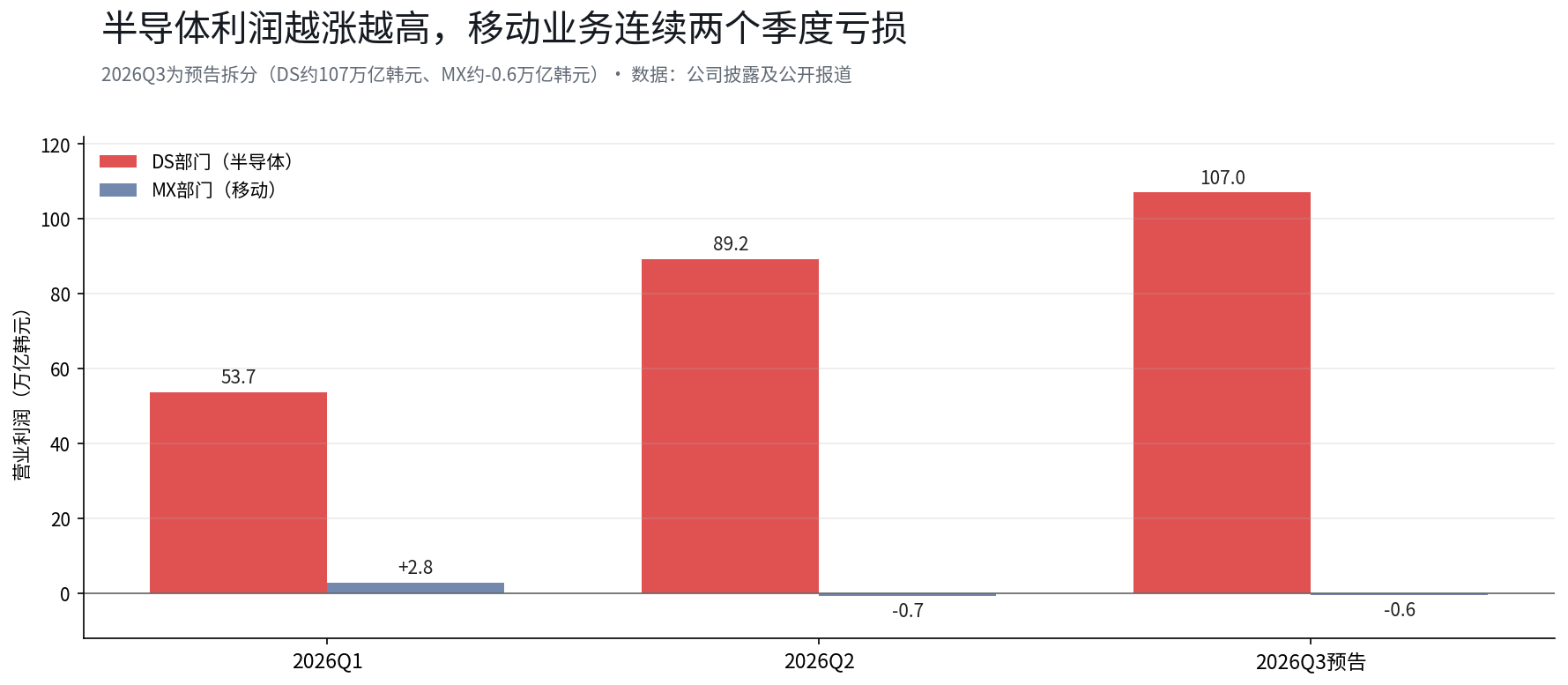
At the other end of the same income statement, Samsung’s mobile and consumer electronics businesses are losing money. The article says those segments were expected to post a combined operating loss of about KRW 0.6 trillion in the third quarter, marking a second straight quarterly loss. Smartphone shipments fell 9% quarter over quarter to 58 million units.
Supply-side adjustments are already under way. According to South Korean media reports cited in the piece, Samsung’s Mobile eXperience division has notified suppliers that it plans to cut smartphone production by 20% to 30% in the fourth quarter. At the same time, the company raised prices for the Galaxy S26 lineup. Reportedly, the starting price of the S26 increased by CNY 800 to CNY 7,799, while the S26+ and S26 Ultra each rose by CNY 1,000.
The article frames these as two ledgers inside the same company, with one affecting the other. Higher memory chip prices have pushed semiconductor margins to around 80%, but those same price increases are also driving up costs for Samsung’s handset business. Morgan Stanley, in an industry report dated July 21, estimated that Samsung’s mobile division could post cumulative operating losses of $16 billion from 2026 through 2028. In other words, part of the profit generated by semiconductors is being offset by losses in Samsung’s own device business.
Why the stock did not respond to record earnings
The fact that Samsung shares fell on the day of the earnings preview suggests that the market had already priced in the record quarter before the announcement. The release itself did not provide fresh upside momentum.
The article highlights three issues that investors are weighing at once.
- First, the results came in slightly below expectations. Third-quarter revenue of KRW 195 trillion was below broker estimates of about KRW 201.9 trillion, while operating profit of KRW 107.4 trillion was below estimates of about KRW 108.67 trillion. The miss was only around 1%, but when expectations are tightly clustered, even a small shortfall can carry outsized signaling value.
- Second, the growth slope is easing. Year-over-year growth slowed from 1,813.8% in the second quarter to 782.5% in the third. On a sequential basis, operating profit growth also slowed from the 56% increase seen in the second quarter.
- Third, inventory and earnings revision momentum are changing. A Morgan Stanley report from July said upward earnings revision momentum for memory makers was weakening. The net earnings upgrade ratio had fallen from a peak of 92% to 77%, year-over-year growth in DRAM contract prices had retreated from cycle highs, and both DRAM and NAND inventories rose in the second quarter.
Capital spending adds another layer of pressure. Samsung’s second-quarter capital expenditure was KRW 16.8 trillion, including KRW 15.4 trillion for semiconductors. To close capacity gaps, the company has already begun spending tens of trillions of won over the past year and plans to keep investing over the next two years to expand memory wafer fabrication capacity. If Samsung steps up construction and depreciation spending in the second half to accelerate HBM4 output, those costs could show up in the next one or two quarters. The market concern is straightforward: whether that spending could absorb a large share of incremental profit in a future quarter.
Citi’s bullish case on HBM4 meets a harder question on demand capacity
According to public reports cited in the article, Citi maintained a buy rating on Samsung with a 12-month target price of KRW 430,000. Based on Samsung’s Oct. 7 closing price of KRW 268,500, that implied upside of about 60%. The article also notes that this view represents the institution’s own judgment.
Citi’s core argument centers on HBM4 pricing power. Its estimates, as cited in the article, suggest the average selling price per GB for HBM4 12hi could rise from about $2 in 2026 to a range of $4 to $5 in 2027. HBM4 8hi could carry a further 20% to 30% premium on that basis. Samsung management also said on its second-quarter earnings call, according to the article’s account of the conference call, that HBM4 sales were expected to grow by more than three times in the third quarter and account for more than 60% of total HBM revenue in the second half.
The bullish case rests on pricing elasticity. The opposing question is whether demand can absorb it. Morgan Stanley estimated that global cloud service provider capital expenditure could reach $1.2 trillion in 2027, with more than half going to memory. At the same time, the ratio of capital expenditure to EBITDA for Google, Amazon, Microsoft, and Meta had already exceeded 70% in 2026, and for some companies, capital expenditure could surpass EBITDA in 2027.
That leaves a basic constraint. Pricing power may sit with suppliers, but supplier profit still depends on customer spending. If buyers’ capital expenditure approaches or exceeds their earnings capacity, the room for further price increases may depend on balance sheets that Samsung does not control.
Samsung’s earnings also reflect the broader AI hardware chain
The article places two opposing facts side by side. AI data center demand for HBM and DRAM is still surging, memory supply and demand may remain tight, and industry margins are near historic highs. At the same time, Samsung’s consumer electronics business is cutting production, raising prices, and posting losses, with higher memory prices squeezing profitability at the device end.
Those are not separate developments in the article’s framing. The latter is partly caused by the former: the more expensive compute becomes, the harder it is to make money in end devices. Similar pressure is moving through the broader AI hardware chain, though each segment absorbs it differently.
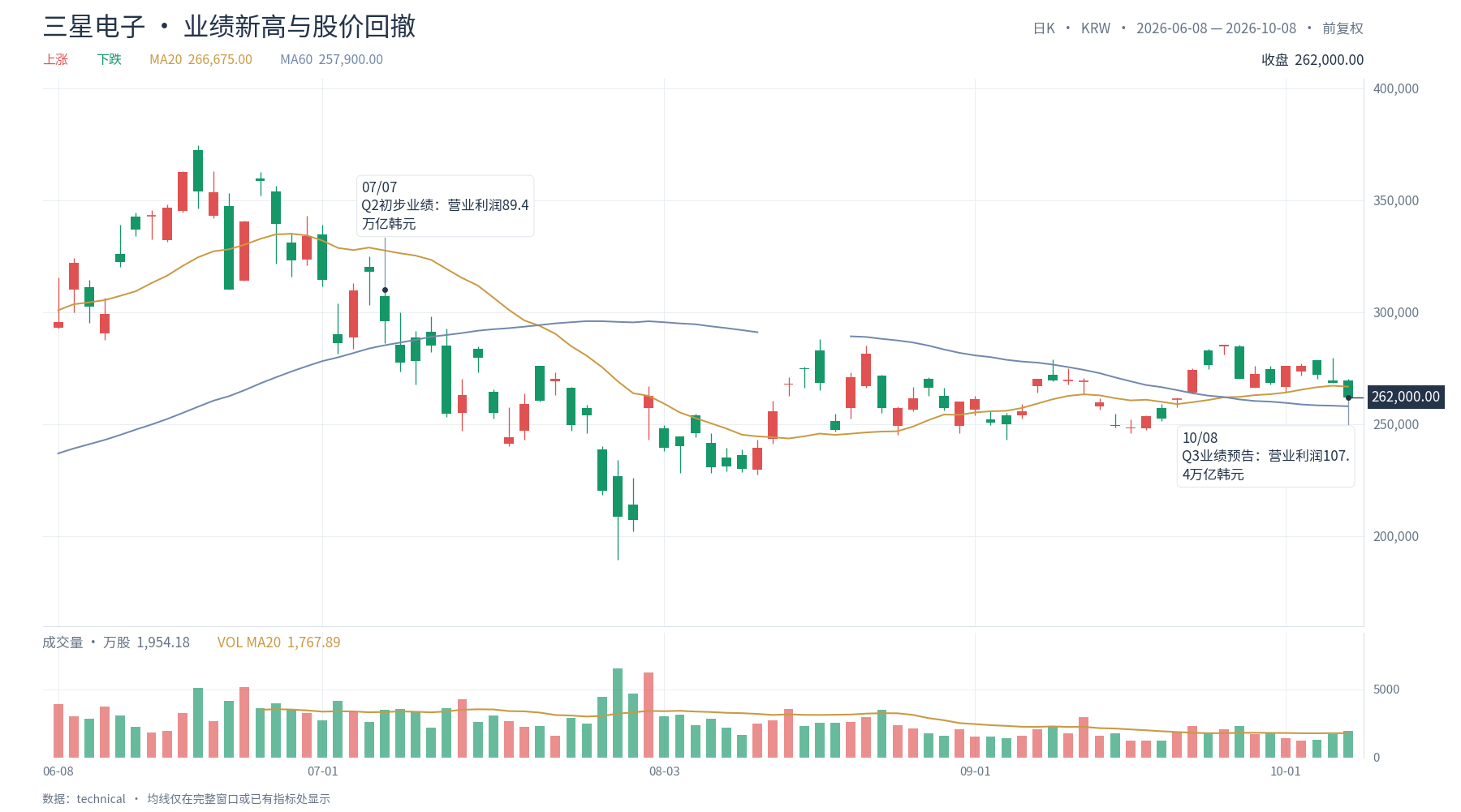
The article argues that the market is effectively pricing Samsung on growth rather than on the absolute profit level. The level has already been delivered; the slope remains part of valuation. That reading depends on cloud spending growth holding up. If 2027 capital expenditure guidance is revised down across the sector, both memory volumes and pricing could come under pressure. On the other hand, if Samsung’s Oct. 29 earnings briefing offers tighter guidance on long-term supply agreements and the 2027 supply-demand outlook, concerns about slowing growth could ease for a time.
For now, the article says the next checkpoints are threefold: the 2027 supply-demand outlook, progress on long-term contracts, and details on capital spending and shareholder returns. How much of this quarter’s profit is already reflected in the stock price remains an open question.
Sources and notes cited in the article
The article says Samsung earnings and segment breakdowns came from company announcements dated Oct. 8, July 30, and May 6, 2026. The comparison with the third quarter of 2025 and Samsung’s full-year 2025 operating profit came from company disclosures and Yonhap, dated April 7 and July 7, 2026. Share price and drawdown figures were based on public market data through the Oct. 8, 2026 close, with the June 18 high referring to an intraday level.
Citi’s view was cited from its research note as relayed by media reports. Morgan Stanley’s view came from its July 21, 2026 industry report as cited by media reports. Smartphone production cuts, shipment data, and Galaxy S26 pricing were attributed to South Korean media and TrendForce. Profitability figures for the three major memory makers were attributed to Chosun and other public reports.
The original disclaimer said the material was for general information and market commentary only and did not constitute investment advice, investment research, an offer, solicitation, or a recommendation regarding any security, investment product, or trading strategy. It also said historical performance and past market moves do not represent or guarantee future results.