
AI and large models
TechFlow’s daily intelligence roundup said Anthropic released Claude Haiku 5.5, pairing a jump in benchmark performance with a 75% price cut. The digest framed the move as a direct challenge to products in the same tier as GPT. It also noted that discussion around the launch quickly shifted to pricing pressure, with Hacker News users comparing the new pricing against GPT-4o mini from last year. Zhihu was also listed among the discussion venues.
OpenAI, meanwhile, introduced GPT-6 and what the digest called a “universal intelligent UI.” The point, as presented in the source, was not simply another chat window. OpenAI separated the interface itself and treated it as part of the AI capability stack. Hacker News discussion was described as unusually active, with part of the debate centered on whether this kind of interface could replace traditional SaaS products.
Another technical development came from the tooling layer. According to the digest, a project has ported the TypeScript compiler, checker and language server protocol tooling to Rust. The source treated that as a sign that AI is moving deeper into compiler infrastructure rather than staying at the level of web applications. Reliability questions around type-system migration drew repeated scrutiny in community discussion.
On chips, Broadcom is seeking more than $50 billion in financing for custom AI chips for OpenAI. The digest said that points to a clearer path for OpenAI as it tries to reduce dependence on Nvidia, while also showing how capital-intensive the custom-chip phase has become.
Samsung also appeared in the hardware section. The company’s third-quarter operating profit was said to be up nearly ninefold year over year, crossing 100 trillion won for the first time. The digest tied that result to AI memory demand and a strong quarter for HBM.
Crypto and Web3
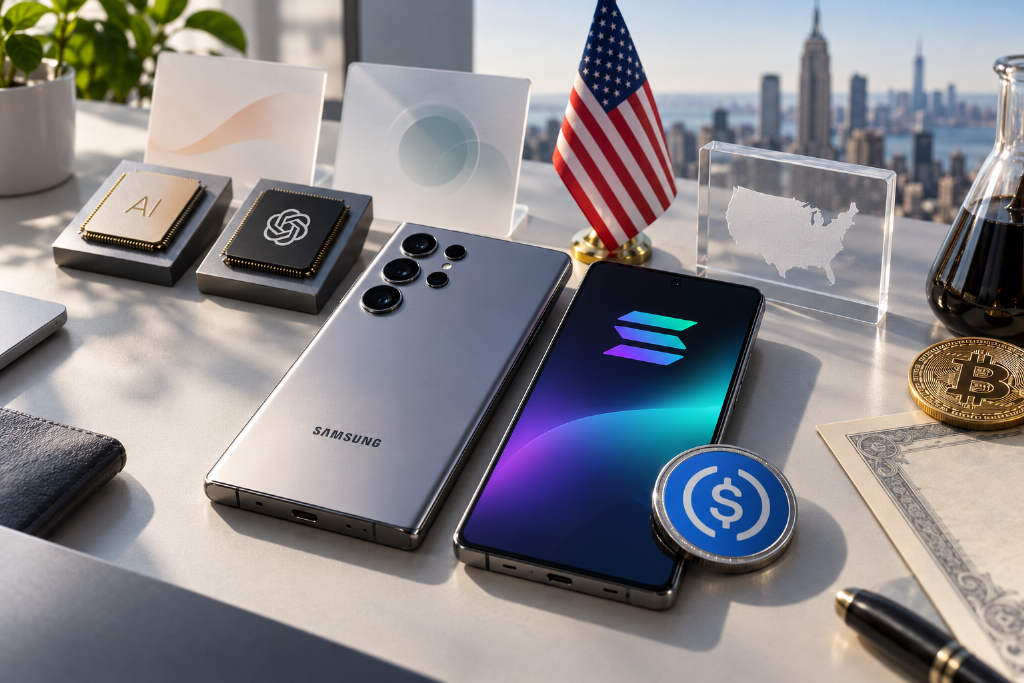
The biggest crypto item in the roundup was Samsung’s partnership with Solana. According to the digest, Samsung said it will work with Solana to bring USDC cross-border payments to 82 million Galaxy devices in the United States. Starting in the last week of October, Samsung Wallet users in the U.S. will be able to send cross-border transfers in USDC on Solana. The source described it as the first time stablecoin payments have been embedded at this scale into a mainstream smartphone maker’s system-level wallet.
Bitcoin fell below $83,000. The digest linked the drop to a broader risk-off move after reports about an Iran strike plan pushed Brent crude to $102 and sent U.S. Treasury yields close to their highest level since 2002. Crypto prices moved lower alongside that shift. The source cited FxPro as saying that once $83,000 gave way, the path toward $80,000 opened quickly.
Fund flows also weakened. U.S. Bitcoin ETFs recorded $485 million in net outflows in a single day, the largest since June. The digest said institutional money moved out quickly in the face of geopolitical risk and argued that the sell-off was not purely a crypto-specific event.
On exchange listings, Upbit and Bithumb both listed PONS at the same time, opening KRW, BTC and USDT markets. The digest said PONS had a market capitalization of $260 million and that attention rose quickly after the dual listing on South Korea’s two largest exchanges.
Another AI-themed token also gained a won-denominated trading venue. DeAgentAI’s AIA was listed in Bithumb’s KRW market, which the digest said adds to the role of won liquidity in trading AI concept tokens.
Technology companies
In the broader tech section, India denied Elon Musk’s claim that Starlink launches had faced discrimination. The digest said Musk and the Indian government publicly traded evidence, adding another complication to Starlink’s entry into the Indian market.
SpaceX plans to raise $40 billion to buy Nvidia chips. According to the digest, the money would go toward large-scale compute chip purchases for the Terafab AI chip complex, making SpaceX a major Nvidia customer.
Nvidia is also discussing another $1 billion investment in humanoid robotics company Figure. The source presented that as a sign that Nvidia continues to increase its exposure to humanoid robotics.
In gaming, a former PlayStation executive criticized Sony’s move away from discs. The digest said the dispute pushed digital ownership back into focus and split player opinion.
Stocks, finance and macro
Energy and rates remained the main macro drivers. The digest said Brent crude rose above $104 and WTI moved above $91 after attacks on Gulf shipping and production shutdowns tied to a U.S. hurricane. It also said a Saudi airport was hit by a Houthi missile strike, while Shell and Chevron evacuated staff from the Gulf of Mexico and halted production. The source put the daily refined-product shortfall at about 6 million barrels.
At the same time, U.S. Treasury yields climbed to their highest level since 2002, while U.S. equities stayed relatively resilient. The digest, citing Cailian Press, described a sharp contrast between stress in the bond market and continued high-level trading in stocks.
Safe-haven demand showed up in gold. Global gold ETFs drew $31 billion in the third quarter, a record, according to the digest. It also said central banks have increased gold holdings for 23 straight months, with institutional money continuing to flow in.
In private markets, Nous Research confirmed a $1.5 billion valuation and launched an enterprise AI agent product. The digest said the company, known for work on reasoning and personalized models, has moved into commercialization.
New products and trends
Robotics data startup Mecka AI raised $60 million from Sequoia, according to the digest. The source described robotics data as “fuel” for robotics and said Sequoia is still making large bets on the data layer of embodied AI.
The day’s throughline
Across the roundup, money and product activity showed up at the application, chip and payment layers at the same time. Samsung moved stablecoin transfers into a mobile wallet, Broadcom sought more than $50 billion for OpenAI chip financing, and SpaceX prepared a $40 billion raise to buy Nvidia GPUs. At the same time, Brent moved above $104, Bitcoin fell below $83,000, and Treasury yields reached levels not seen since 2002. The digest’s conclusion was straightforward: older infrastructure is under strain, while new infrastructure tied to AI and crypto is still attracting aggressive capital.