


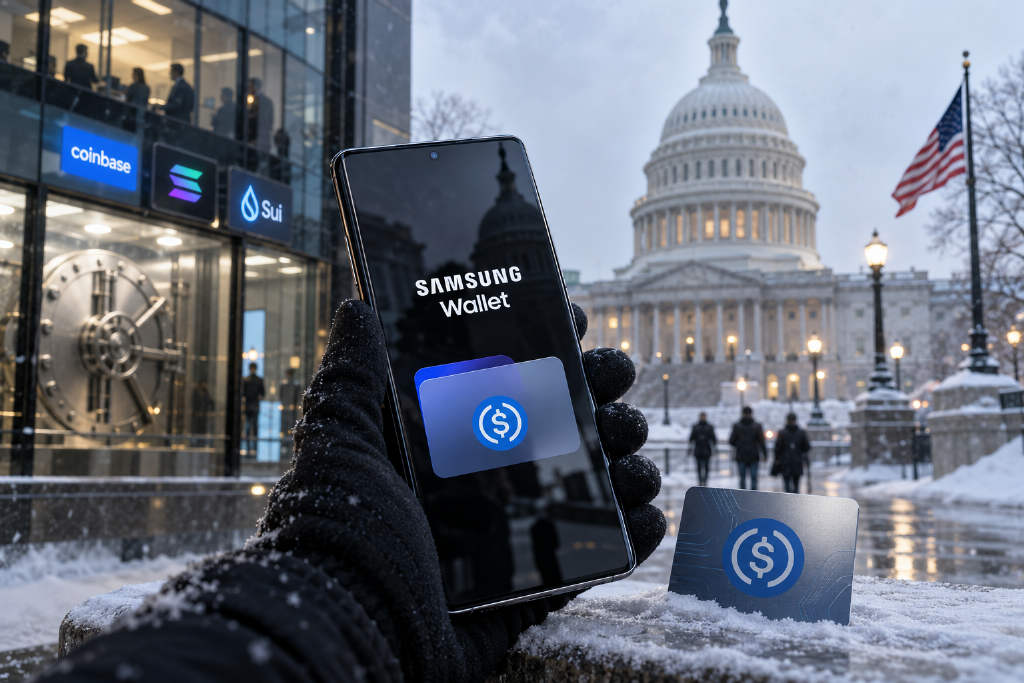
Samsung Electronics America said it plans to open USDC features to eligible U.S. Galaxy users in the last week of October 2026. The dollar-pegged stablecoin would be available inside Samsung Wallet for holding and transfers, and users would also be able to send money to eligible bank accounts in more than 60 countries, with recipients receiving local currency.
In a PANews article, author Shao Jiadian writes that the move puts stablecoin transfers inside a wallet interface users already know, removing the need to install a separate crypto wallet and manage private keys on their own. For handset makers, the model offers a way to expand payment and remittance services through devices, account systems and user entry points they already control. But the article says the core financial functions still sit with specialist providers, and a manufacturer’s legal exposure depends on which steps it joins and which markets it targets.
Who handles the money inside Samsung Wallet
The article says Samsung Wallet is the familiar front-end interface, while account services, asset safekeeping and fund movement are provided by regulated partners. According to Samsung Newsroom U.S. on Oct. 7, 2026, Bastion supports the relevant payments framework, Coinbase serves as sub-custodian and holds USDC through Coinbase Prime Vault, and Sui and Solana provide blockchain network support. Samsung does not hold customer funds.
That setup allows two transfer paths inside one wallet. If the recipient uses a digital asset wallet that supports the relevant network, they can receive USDC directly. If the recipient uses a supported bank account, they can receive local currency instead. In the second case, currency conversion and bank payout still need to be completed, but the recipient does not need to open a separate crypto wallet.
Fees differ by route. Samsung does not charge a transfer fee for sending USDC to an external wallet, though the receiving wallet or trading platform may charge one. Remittances to bank accounts carry fees that are shown before the user confirms the transaction. The article adds that Sui-supported gasless transfers remove the on-chain network fee only; currency conversion and bank payout fees are still calculated separately.
The service is planned to launch first for eligible adult U.S. residents, who must complete account opening and identity verification. The reference to bank accounts in more than 60 countries describes the remittance destination range, not sender eligibility. Senders still need to meet the U.S. onboarding requirements. Samsung also mentioned online shopping and tap-to-pay in stores as later plans.
Responsibility depends on how far a phone maker goes
The PANews piece says Samsung’s structure offers one template for other device makers, but the same transfer button can hide very different roles. In one model, the manufacturer simply sends users to a partner page, where the partner opens the account, quotes the transaction, receives funds and executes the transfer. In that case, the manufacturer mainly handles display and technical connectivity. In overseas markets that allow this kind of arrangement, the division of work is usually easier to define.
If the manufacturer collects transaction instructions, promises delivery, or takes commissions tied to transactions, the article says it must also consider local rules on transaction services, promotion and solicitation.
Some companies may go further and embed the partner account directly inside their own wallet so users can open accounts and transfer funds without leaving the page. That structure requires clear disclosure of who the service provider is, and users must accept the relevant terms. Back-end permissions also need to match the stated division of labor. Even if assets are nominally held by a third party, a manufacturer may still face custody or control-related responsibility if it can move assets through account recovery or administrator permissions. The label “non-custodial wallet” needs to be backed by the actual permission design.
The article also says that once a manufacturer connects several providers, compares quotes and chooses routes for users, it may become an aggregation service. Taking orders, setting execution terms, and automatically arranging conversion and transfers may trigger licensing questions tied to exchange, brokerage or payment services. If ranking or recommendations are influenced by commissions, that should be disclosed. Adding merchant acceptance would bring in collection and settlement issues as well, which would change both the partner’s service scope and the manufacturer’s own responsibilities.
Partner selection has to match the target market
The article says the access model has to fit the rules of the market being served. Samsung is starting with U.S. users. Other manufacturers, by contrast, need to assess where their users are located, which company provides account, custody, conversion and transfer functions, and whether each party holds the right authorization.
Cross-border remittances also depend on the receiving side. Whether the sender can open an account, and whether the receiving side can complete conversion and bank payout, both affect whether money can actually arrive. Samsung’s support for remittances to multiple countries relies on service arrangements for those routes. The article says manufacturers should verify the specific corridors they want to open rather than looking only at how many countries a partner claims to support.
Using the U.S. as an example, the article says companies need to consider federal money services business registration, anti-money laundering obligations, and state-level requirements for money transmission and digital asset activity. A common MSB registration is federal registration only and should not be treated as a nationwide payments license.
Singapore offers a separate warning for aggregation platforms. The article notes that even without holding customer funds, a platform may still fall under regulation. Revisions that took effect in 2024 brought some activities that facilitate token transfers and conversions into scope. Whether a manufacturer directly holds assets is only one part of the analysis; regulators may also look at whether it organizes or facilitates transactions.
Hong Kong has its own limits on stablecoin purchase channels and eligible tokens. The article says that under the Stablecoins Ordinance, effective from August 2025, a party offering specified stablecoins to users must fall within an approved category, and tokens offered to retail customers must meet licensed issuance requirements. A wallet displaying a stablecoin balance does not by itself mean that local retail users can be offered a purchase function for that token.
The article adds that one license held by a partner may cover custody but not exchange or remittance, and different entities within the same group may hold different authorizations. Manufacturers should map the contracting entity, service market and specific function step by step to confirm who is legally providing each part of the product.
Users will still call the wallet brand first
Even when the financial service is provided by a partner, the interface users see every day is still the phone maker’s wallet. If a balance is frozen or a transfer does not arrive, the article says the first contact point will likely be the wallet’s customer support. That means the manufacturer has to make sure not only that transactions can be completed, but also that problems can be handled.
The work starts on the onboarding page. Users should be told who provides the account, what asset the balance represents, how it can be converted back into fiat currency, and what fees apply before they begin using the service. The article notes that users usually depend on service providers for sale or conversion channels, while direct redemption with an issuer may be subject to eligibility limits and procedural rules. A stablecoin may be pegged to the U.S. dollar, but price deviations, address restrictions and service suspensions can still happen. Marketing should not describe it as a bank deposit or promise unconditional redemption at any time.
Whether users can recover their assets also depends on the custody arrangement. The article says partners should segregate customer assets from their own assets, define ownership and permitted uses, and set out extraction or migration procedures if an institution fails or a partnership ends. Assigning each user a separate wallet address is not enough on its own to solve legal questions around ownership and return of assets.
Account recovery is another sensitive point for phone wallets. Recovering a phone account may also restore the ability to move funds. If a company uses an ordinary after-sales recovery process, it may create an opening for account hijackers. The article says recovery procedures should include identity checks and security controls that match the asset risk, so convenience does not make funds easier to steal.
When a transfer fails, customer support also needs to explain where the money is stuck. If USDC has already been sent but a bank rejects the payout, someone has to determine who holds the pending assets, how they are returned, and who bears conversion differences and fees. The article says manufacturers and partners need agreed procedures and timelines in advance, or users may end up bouncing between several companies without getting an answer.
AML and data protection have to be built into the wallet flow
The article says service providers must keep identifying customers, sources of funds and transaction risks under applicable rules, handle transactions involving sanctioned persons, regions or addresses, and transmit payer and payee information where required. If the manufacturer runs the front end while the partner runs the money service, the information each side holds and the measures each side takes have to connect properly.
That connection has to show up in systems and day-to-day operations, not just in contracts. The article says there should be clear arrangements on who blocks a flagged transaction, who reviews it, who files reports when required by law, and how transaction status is synchronized to wallet support teams. Handing review work to a partner does not remove each party’s own legal obligations.
To complete reviews and transactions, the parties may process identity documents, bank account details and on-chain addresses. Linked with a phone account, that data can form a detailed personal financial record. The article says manufacturers and partners should limit collection and sharing under applicable data protection rules and address notice, consent and cross-border transfer requirements. Local fingerprint verification on a device is not, by itself, a reason to provide biometric data to a partner by default.
The article frames the issue as product design and compliance structure
In its closing section, the PANews article says Samsung’s approach gives phone makers a possible cooperation path: use an existing wallet to connect account, custody and fund services so stablecoins become easier for users to access. Whether that path works depends on transaction permissions, service markets and whether partner qualifications cover the functions a company wants to launch.
The article says manufacturers should walk through the full life cycle of a user’s funds before launch, from account opening and funding to final receipt, and then test what happens if an account is stolen, a transfer fails or a partnership ends. The front end can be simple. The responsibilities behind it need to be assigned to specific companies and actual operating processes. When users run into trouble, the wallet should be able to explain where the money is and what can be done next.
The article also states that its discussion of stablecoin integration in mobile wallets is for industry research only and does not constitute investment advice, product promotion or legal advice for any specific project.