
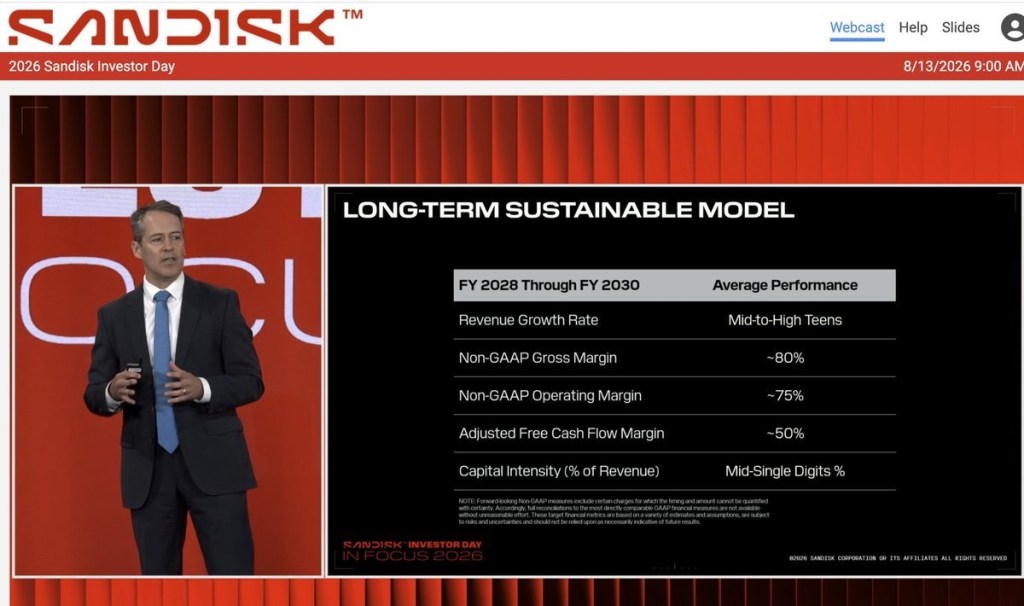
Sandisk (SNDK) used its Aug. 13 investor day to publish a long-term financial framework built around its in-house High Bandwidth Flash, or HBF, and the targets came in well above market expectations. The company’s Long-Term Sustainable Model is based on average performance from FY2028 through FY2030, with Non-GAAP gross margin set at about 80%, which management described as a floor.
Mizuho Securities kept its Outperform rating on Sandisk after the event and set a $1,900 price target. Its stance rests on the company’s new financial model, capital return plan, and the possible contribution of HBF to AI inference demand.
Long-term model targets FY2028 to FY2030 averages
Sandisk’s long-term sustainable model includes the following metrics for average performance across FY2028 to FY2030:
- Revenue CAGR in the mid-to-high teens, or about 15% to 19%
- Non-GAAP gross margin of about 80%
- Non-GAAP operating margin of about 75%
- Adjusted free cash flow margin of about 50%
- Capital expenditure intensity in the mid-single digits as a percentage of revenue
The 80% Non-GAAP gross margin figure was presented as a floor, with room to move higher depending on HBF penetration.
Mizuho estimated a roughly 17.5% CAGR for F28–30E. Using F28E revenue of about $59 billion as a starting point, the firm said F30E revenue could rise past $80 billion. Mizuho also said the upside from HBF is not yet included in Sandisk’s long-term model, leaving open the possibility of an additional valuation catalyst.
$15.5 billion buyback plan adds to the capital return case
On capital allocation, Sandisk management said 100% of excess cash would be returned to shareholders. The company has already authorized a $15.5 billion share repurchase program, equal to about 5% to 10% of shares outstanding, and said the amount will grow over time.
Mizuho estimates SNDK will generate about $30 billion in free cash flow in F27E and about $50 billion in F28E, which the firm sees as ample support for long-term repurchases.
For valuation, Mizuho derived its $1,900 target from roughly 9x F27E EPS. The firm said that compares conservatively with the SOX semiconductor index, which is trading around 16x earnings. Its bullish case includes NAND ASP staying above market expectations and supporting consumer market share gains, long-term growth in AI server eSSD demand, and synergies tied to Sandisk’s joint venture with Kioxia as BiCS8 moves into volume production.
Mizuho reiterated that SNDK remains a core beneficiary of AI data center buildout and inference demand, and it maintained its Outperform rating.
HBF is aimed at the memory bottleneck in AI inference
Sandisk also laid out the architecture and commercialization timeline for HBF. The product uses a 16-die stack and TSV, or through-silicon via, connectivity, and it can be placed next to a GPU, CPU, TPU, or SoC.
The company said HBF can deliver comparable read bandwidth to HBM at about one-eighth the cost while expanding capacity by 8x to 16x, with package area remaining similar to HBM.
During the presentation, Sandisk said leading AI models are pushing the market toward what it called memory-centric inference. Mixture of Experts, or MoE, architectures reduce compute needs per inference run, but they also raise absolute memory capacity requirements, which is where Sandisk places HBF.
The company also showed four HBF deployment configurations proposed by cloud and AI ecosystem partners: pure HBF replacement, HBM/HBF tiered cache, mixed HBF and HBM expansion, and a separate Prefill/Decode architecture. Sandisk’s pitch is not that HBF replaces HBM. It is meant to fit into existing systems and target read-intensive inference workloads.
Sandisk lifts its view of the Flash market opportunity
Sandisk also argued that the addressable market for NAND Flash is being reset. The company said industry revenue has hovered around an annual average of about $60 billion over the past decade and did not break above $80 billion even at cycle peaks. In its view, that reflected commodity-style pricing and a pattern of rising unit volumes paired with falling prices, leaving annual industry revenue growth at about 4%.
Sandisk said that framework no longer holds under continued data center buildout. The market, according to the company, is shifting away from a cyclical model of one-time purchases followed by depreciation and toward repeated phases of AI infrastructure expansion that favor higher-premium product lines.
Based on the company’s internal estimate, Flash industry revenue will exceed $300 billion in CY26 and could reach $500 billion in CY27.