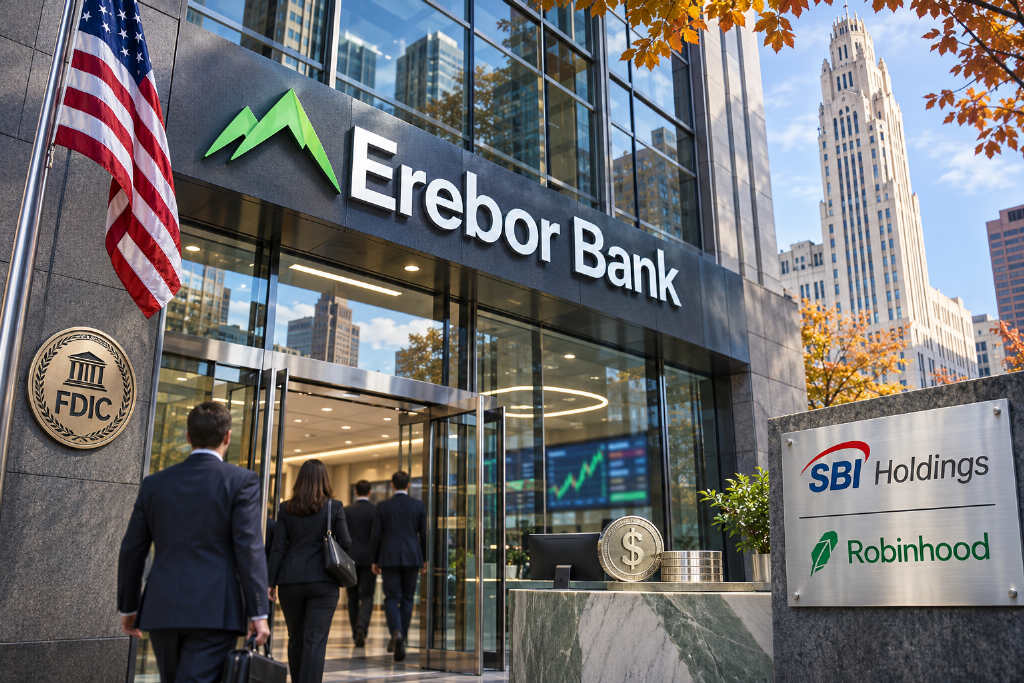
SBI Holdings plans to invest $100 million in Erebor Bank through SBI Holdings USA, according to a Nov. 3 announcement from the Japanese financial group. SBI said Erebor supports stablecoin deposits and withdrawals and that the two sides will explore broader cooperation.

Erebor Bank is headquartered in Columbus, Ohio. It is a nationally chartered bank with a national bank charter from the Office of the Comptroller of the Currency, or OCC, and deposit insurance from the Federal Deposit Insurance Corporation, or FDIC.
What Erebor does
Public information cited in the source says Erebor Bank was founded in 2025 by Palmer Luckey, Owen Rapaport, Jacob Hirshman, Aaron Pelz, and Trevor Capozza. The bank’s name comes from the Lonely Mountain in The Hobbit.
Luckey is best known as the founder of Oculus Rift, an original founder of Oculus VR, and the founder of defense technology company Anduril Industries. At Erebor, however, he serves in a strategic role on the board and is not involved in day-to-day operations.
The other co-founders include CEO Owen Rapaport, who previously founded crypto compliance company Aer Compliance; chairman Jacob Hirshman, a former Circle adviser who also worked at Sullivan & Cromwell; CTO Aaron Pelz; and Trevor Capozza, whose specific role has not been disclosed in public materials.
Luckey, described in the source as Erebor’s core founder and a key backer, has long supported Republican candidates and Trump-related political efforts. Citing OpenSecrets and The Guardian, the source says he has donated about $5.9 million to Republican candidates and groups since 2017, hosted multiple Trump-related fundraising events, and made large direct contributions to groups including the Trump 47 Committee.
During the 2026 midterm election cycle, Luckey continued donating to Republican federal candidates and committees. Based on analysis from LAist and others cited in the source, he gave more than $350,000 to over 70 campaigns in the cycle, almost all of it to Republicans, while cumulative contributions to GOP-related committees exceeded $1 million. In the summer of 2026, he also hosted a "Keep the Senate" fundraising event tied to the National Republican Senatorial Committee.
According to public reporting referenced in the source, Trump called Luckey "my friend" and "a very capable person" at an event in October 2026 at Anduril’s new shipyard in Maryland.
A bank built for the "innovation economy"
Erebor is positioned as a bank for U.S. innovation-economy companies. Its customer base is concentrated in defense, robotics, artificial intelligence, hard tech, energy, advanced manufacturing, and crypto. It offers deposits, loans, payments, and treasury management, while also supporting stablecoin deposits and withdrawals and 24-hour blockchain settlement.
That structure sets it apart from trust institutions focused only on custody. Erebor holds a full commercial bank license, which allows it to take FDIC-insured deposits and extend credit.
Robinhood said in an October announcement that Erebor obtained its full OCC national charter and FDIC insurance in February 2026. Since then, its deposit base has grown to more than $7 billion. Bloomberg reported on July 2 that the bank’s deposits rose from $1.1 billion to $4.05 billion over the prior three months, that it added nearly 400 customers, and that it expected to become profitable within the year. Sacra estimated annualized revenue at roughly $112 million in July, with customers concentrated in hundreds of capital-intensive companies and relatively high value per client.
Why SBI is investing
SBI Holdings is a diversified Japanese financial group that was spun out of SoftBank in 1999. Its businesses span securities, banking, asset management, venture capital, and digital assets.
The company has built a sizable crypto footprint. It invested in Ripple in 2016 and launched SBI Ripple Asia, invested in bitFlyer, and established licensed exchange SBI VC Trade. In June 2026, SBI launched JPYSC, described in the source as Japan’s first trust-structured yen stablecoin, and worked with Circle to distribute USDC in Japan while also working with Ripple on RLUSD. In October 2026, SBI completed its acquisition of Japanese exchange Bitbank. The source also notes investments in Web3 infrastructure names including Gauntlet, Morpho, and Elliptic.
For SBI, Erebor offers a U.S. dollar channel in the American market and stablecoin settlement capabilities. Erebor supports stablecoin deposits and withdrawals, runs a proprietary core system that can handle blockchain settlement on weekends and outside banking hours, and accepts crypto assets as collateral for loans. SBI said it will explore broader cooperation, pointing to possible links in dollar stablecoin flows, cross-border settlement, and institutional client services.
Robinhood has already bought in
SBI is not the only institution backing Erebor. According to a Robinhood announcement dated Oct. 21, Robinhood Ventures Fund I (NYSE: RVI) completed the purchase of $30 million in Erebor preferred stock on Sept. 17.
RVI is the first fund launched by Robinhood Ventures. It listed on the New York Stock Exchange on March 6, 2026. The fund is closed-end, invests mainly in a portfolio of private companies, and is open to retail investors without an accredited-investor requirement or minimum investment amount.
Sarah Pinto, president of RVI, said in the announcement that banking still has room for innovation and that Erebor has the potential to become core financial infrastructure for the U.S. innovation economy.
Valuation, fundraising, and stablecoin rails
In December 2025, Erebor raised $350 million at a $4.35 billion valuation, led by Lux Capital, with participation from Founders Fund, 8VC, and Haun Ventures, according to the source. Bloomberg reported on July 2 that Erebor was in talks with investors for a new round at a target valuation of at least $8 billion, nearly double the level from late last year. Its backers also include Andreessen Horowitz.
Erebor’s main point of differentiation is that it folds stablecoins into banking operations instead of limiting itself to crypto custody. It supports deposits, withdrawals, and settlement for major stablecoins including USDC and USDT. In April 2026, it integrated the Sui network for stablecoin deposits, withdrawals, and related services.
The bank holds a small amount of crypto assets for gas fees and wrapped stablecoin operations, but it is not itself a stablecoin issuer. The focus remains on access, settlement, and related banking services.
The Information reported on Sept. 16 that Erebor had tried to attract crypto clients this year by converting Circle and Tether stablecoins into cash for free. Some professional trading firms used the policy for arbitrage, causing losses for the bank. Erebor later tightened the terms.
Peers and criticism
Erebor’s direct competitors include Column, Lead Bank, and Cross River. Column is described in the source as a software-native, API-first U.S. nationally chartered bank whose customers include Mercury, Brex, and Ramp. Lead Bank has moved quickly on stablecoin services, offering USDC on- and off-ramps and cross-border payments. Cross River is a longer-established bank serving fintech and crypto companies, with customers including Circle, Coinbase, and Gemini.
Compared with those rivals, Erebor’s strengths are its own national charter, FDIC insurance, a high-touch service model, and a clear focus on innovation-technology and crypto clients. Its weaknesses, as described in the source, are that it is still young and remains in an early stage of scale-up.
Bloomberg Opinion columnist Paul Davies argued that Erebor is following the Silicon Valley Bank model of concentrating on a single volatile sector, creating concentration risk. Senator Elizabeth Warren has also raised concerns about how quickly Erebor obtained its charter and about its political connections.
Industry media have broadly treated Erebor as a sign of a revival in crypto-friendly banking, while also pointing to early operating challenges. One example was the bank’s free cash-conversion policy for Circle and Tether stablecoins, which was later revised after professional trading firms arbitraged it and the bank took losses.