
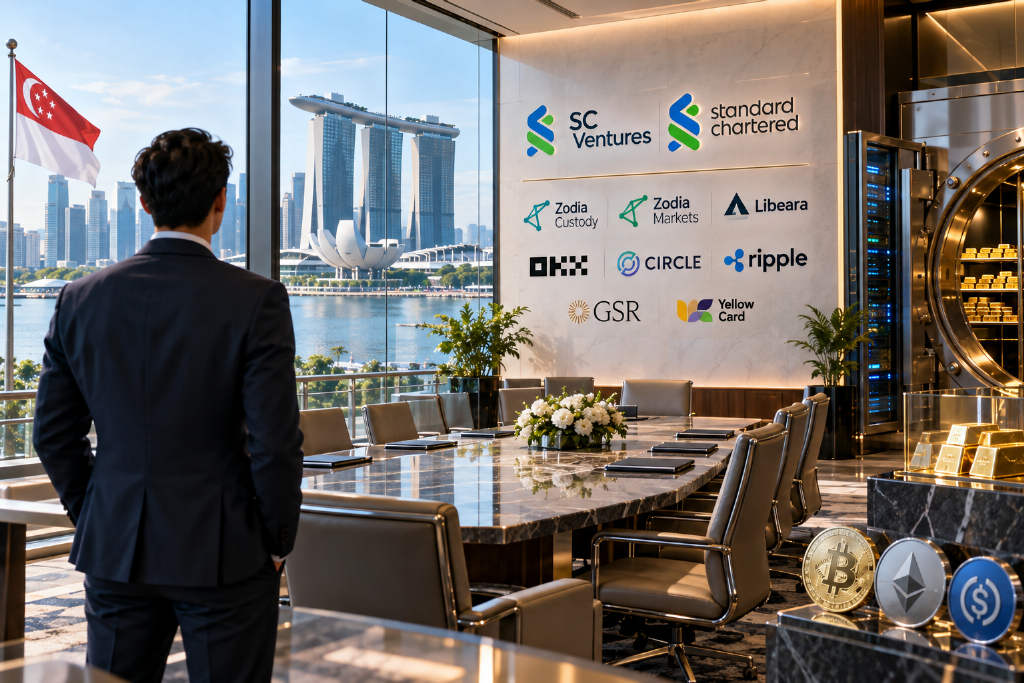
During TOKEN2049 in Singapore, Harald Eltvedt, an operations team member at SC Ventures, spoke with ChainCatcher about the firm’s digital asset investment strategy, the current AI cycle, and how traditional finance and crypto are moving closer together.
At the event, OKX said it had completed a new strategic financing round at a $25 billion valuation. SC Ventures joined Circle, Ripple and hedge fund QRT in that round, which ChainCatcher described as an extension of the financing led in March by Intercontinental Exchange, the parent company of the New York Stock Exchange.
From digital banking to digital assets
Eltvedt said SC Ventures was founded in 2018 as Standard Chartered’s venture building and investment arm. Its mandate, he said, is to invest in anything that can help build what the group sees as the bank of the future.
That idea comes down to flexibility for customers. In his description, the goal is to be the bank that can serve customers in the way they want, where they want, when they want and under the conditions they want.
He said the business started roughly eight years ago with digital banking and digital transformation. As one example, he pointed to Mox Bank in Hong Kong, which was launched with Standard Chartered and SC Ventures playing leading roles. From there, the group moved quickly into digital assets, not only crypto, because it believes digital assets are here to stay.
For SC Ventures, the appeal is practical: 24/7 availability, instant transfers, instant settlement and instant trading.
Building digital asset products to bank-grade standards
Eltvedt said SC Ventures approaches the sector with a bank’s responsibility in mind. When customers place trust in a bank, he said, that trust has to be protected to a banking standard.
That thinking shaped several businesses inside the group:
- Zodia Custody, a digital asset custody business;
- Zodia Markets, which offers crypto-to-fiat services and stablecoin-related services, including converting fiat into stablecoins or other crypto assets;
- Libeara, an internally incubated tokenization platform designed to put tokenized assets on-chain.
Alongside those operating businesses, SC Ventures has also made strategic investments. Eltvedt mentioned GSR and, more recently, OKX. The source material also lists Yellow Card among the projects SC Ventures has backed.
Usually early stage, but not exclusively
On investment pace and stage, Eltvedt said SC Ventures typically invests earlier, including seed, Series A and Series B rounds.
Still, he said the firm is willing to invest later if it has strong conviction in the opportunity, the company and the problem being addressed. He cited GSR and OKX as examples of that approach.
Transparency is the key filter for DeFi and Web3
Asked what a bank-backed venture investor looks for in DeFi and Web3, Eltvedt put transparency first.
He said SC Ventures needs a full understanding of how something works, whether compliance onboarding has been handled properly, and whether the firm truly understands who is behind a transaction. If those points are not clear enough, he said, SC Ventures may not be the right backer.
If the rules are clear and participants follow them, the firm is open to supporting the project. That can include young companies, young founders and DeFi teams, as long as the foundations are solid.
Flexible capital sources
Eltvedt said tighter fundraising conditions in the primary market do not leave SC Ventures with only one route for deployment. The firm uses several investment vehicles.
Sometimes it invests directly from the bank’s balance sheet. In other cases it invests through funds under its umbrella, and it also co-invests with partners. He gave SBI as an example, saying the two sides have completed several joint investments.
That structure gives SC Ventures flexibility across funds, balance-sheet capital and partner-led co-investment.
Hong Kong stablecoin plans are tied to Anchorpoint
On stablecoins in Hong Kong, Eltvedt said Standard Chartered’s Hong Kong banking entity is among the first institutions in the city to receive a Hong Kong dollar stablecoin issuance license.
He said the operating vehicle is Anchorpoint, a company formed by Standard Chartered Bank (Hong Kong), Animoca and HKT.
He expects money to become increasingly digital and said that trend should continue. In his view, Hong Kong sits in an interesting position at the center of capital flows and potentially cross-border flows, which makes digital currency especially relevant there.
Anchorpoint will focus on business clients at the start, he said, and could later expand into areas such as cross-border payments, depending on how the business develops.
AI as an extension of human decision-making
Eltvedt said it currently feels as if everything is about AI. Even so, he described that shift as a natural evolution for crypto rather than a threat that invalidates the sector.
He argued that digital assets create flexibility and bring new investors into new asset classes. Younger users, he said, are drawn to crypto both because it is an interesting asset class in its own right and because it trades around the clock.
Where AI becomes especially useful, in his view, is when a person is not present. If someone is asleep or misses a market move, an agent can carry out certain decisions as long as the right permissions and control mechanisms are in place.
His point was direct: AI does not replace people. It strengthens human decision-making.
Bubbles are likely, but agentic systems stand out
Eltvedt said bubbles are inevitable in AI. When valuations reach into the trillions of dollars, he said, that is "a bit crazy," though it also reflects the excitement around the sector.
He pointed to the United States, saying SpaceX, Anthropic and OpenAI together have already reached a combined valuation in the trillions of dollars. He also referenced China, where DeepSeek, in his words, showed that similar or even better results can be achieved at a fraction of the cost.
That means the market is likely to produce bubbles, large wealth effects and new challengers at the same time. He stopped short of making firm predictions, but said SC Ventures is eager to watch the space develop and take part in it.
TradFi and crypto are no longer opposing camps
On the relationship between traditional finance and crypto, Eltvedt said the old framing of DeFi versus TradFi no longer fits.
Crypto brings innovation, new ways of thinking and new ways of building. Traditional finance brings stability. In his view, the future lies in combining the two so the market can have innovation, scale and trust at the same time.
Those three elements need to work together, he said, not against one another.
What stood out at TOKEN2049
Looking back at conversations during TOKEN2049, Eltvedt said the strongest signal was still the level of excitement around AI.
But he also drew a distinction between this year and last year. AI was already a major topic in the previous year, he said, yet the discussion now contains less hype and more clarity. The focus has shifted toward agentic solutions, including deploying agents to handle trading, settlement and wealth management tasks.
AI remains the main theme this year, he said, but people now have a clearer sense of what it can do and what it should do. For him, the most compelling development is the push to make trading and markets more efficient.


