
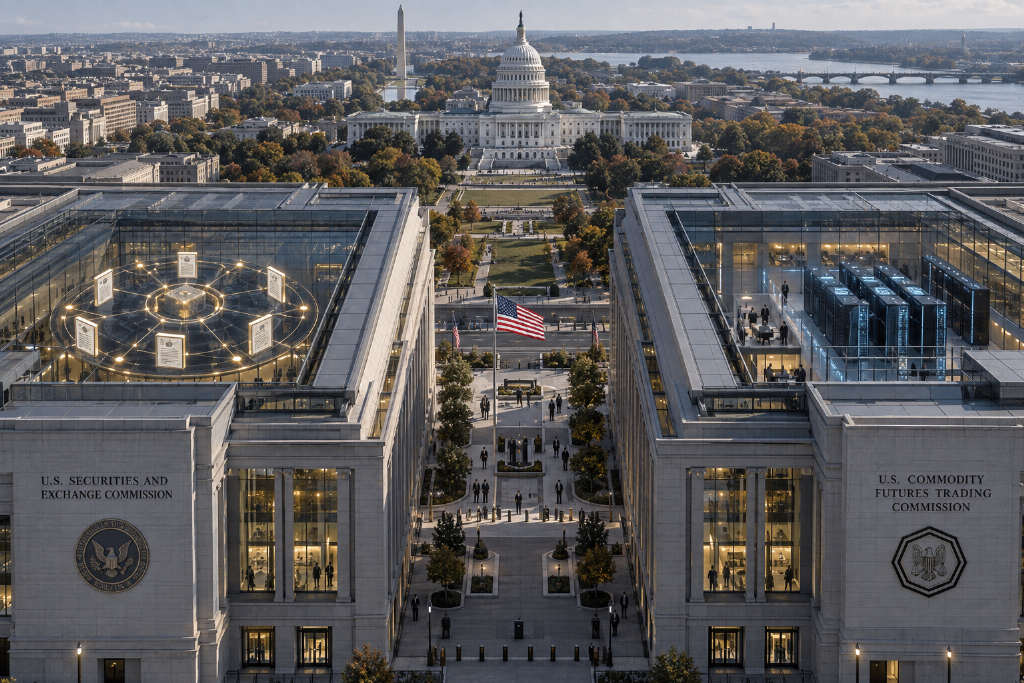
The Securities and Exchange Commission and the Commodity Futures Trading Commission issued crypto-related exemptions within hours of each other on Thursday, marking the first concrete use of existing authority that both agencies’ leaders had pointed to after the Senate failed to advance market structure legislation.
The SEC granted temporary, conditional relief from the definition of "exchange" to a new category called a Tokenized Securities Venue, or TSV. That clears a path for tokenized National Market System stocks to trade onchain through permissioned liquidity pools. The CFTC, through its Market Participants Division, issued a no-action position saying passive software providers do not need to register as introducing brokers.
Neither step came from Congress, and neither one is permanent. The SEC order expires five years after publication, though the agency can amend or withdraw it earlier. A staff no-action position at the CFTC binds only the division that issued it. The Senate rejected cloture on the motion to proceed to H.R. 3633 by a 49-50 vote on Tuesday, 11 votes short of the 60 needed.
In a statement released with the order, SEC Chair Paul Atkins said, "Congress was unsuccessful in advancing the CLARITY Act despite the tireless efforts of many." He said the Commission was "taking a significant step forward, within its statutory authority, to bring America's capital markets into the digital age," and added that "this interim measure must be followed by durable rulemaking to ensure that onchain markets remain a viable pathway."
What the SEC order does
The order, Release No. 34-106402, exempts qualifying venues from the definition of an exchange under Section 3(a)(1) of the Securities Exchange Act. It also exempts certain liquidity providers from the dealer definition in Section 3(a)(5).
The relief is limited. It does not waive antifraud provisions, does not relax compliance with sanctions administered by the Office of Foreign Assets Control, and does not exempt primary offerings from Securities Act registration. It also does not permit primary issuance.
Hard caps on symbols and volume
Trading under the exemption is capped. A venue may list 75 Tier 1 symbols. Under the Limit Up-Limit Down Plan, Tier 1 includes S&P 500 stocks, Russell 1000 stocks, and certain exchange-traded products. For each of those securities, trading is limited to 0.25% of the previous month’s average daily share volume.
Tier 2 covers the rest of the NMS stock universe. A venue may list 250 Tier 2 symbols, with trading capped at 2.5% of average daily volume for each one. If a venue breaches a volume cap, trading in that security must pause for three months.
Operational requirements for Tokenized Securities Venues
Venues operating under the exemption must use publicly auditable smart contracts on public ledgers. If the primary listing exchange halts the underlying stock, the tokenized version must halt as well.
The order also requires venues to publish 30 days of dollar-denominated transaction data in machine-readable form, updated within 10 minutes. The dataset must include symbol, price, size, time, and direction. A venue must notify the SEC at tradingandmarkets@sec.gov within one business day after publishing notice that it intends to operate under the exemption.
Participants still have to comply with SEC and self-regulatory organization registration rules where those rules apply.
Jamie Selway, director of the SEC’s Division of Trading and Markets, said, "Today's approval of exemptive relief for on-chain secondary trading on a TSV — known as the ‘Innovation Exemption’ — marks an important milestone for the Commission's work to open our capital markets for tokenized securities." Selway had outlined the framework and inter-agency harmonization work earlier this year.
Issuers can block third-party tokenized listings
The order covers stock tokenized by the issuer itself and stock tokenized by an unaffiliated third party. It excludes instruments in which "a third party issues a crypto asset representing its own security that provides synthetic exposure to an underlying security, such as a tokenized linked security or a tokenized security-based swap."
Before listing stock tokenized by a third party, a venue must send written notice to the issuer’s principal executive offices at the address shown on the cover page of its Exchange Act reports. Trading cannot begin until at least 30 calendar days after the issuer receives that notice.
If the issuer files a written objection on or before the 30th day, the listing is barred. The venue then has five business days to amend its public notice to disclose that it received a Notice of Issuer Objection.
Tokenized shares must carry the same dividend rights, voting rights, and claims on residual assets as the underlying stock. Third-party tokenizers must distribute proxy materials at no cost to the issuer or shareholders.
Peirce and Uyeda draw the limits of the order
Commissioner Hester Peirce said in a separate statement, "This order is not about decentralized finance." She added, "Truly decentralized systems that are driven by automated software do not give rise to the foundational concerns underlying securities regulation."
Peirce also said that "an investor does not need an exemption to avail herself of permissionless smart contracts that mediate peer-to-peer trading," and said the Commission is open to models beyond the one described in the order.
Commissioner Mark Uyeda said the relief would let the agency observe these venues before writing long-term rules. "The Commission should not impulsively attempt to limit emerging technologies by contorting them into legacy legal frameworks," he said.
Uniswap v4’s Permissioned Pools fit the model described
Uniswap Labs launched Permissioned Pools on v4 in July. The order describes a permissioned automated market maker structure of that kind. According to CoinGecko, UNI traded at $7.37 on Thursday afternoon, up 19.8% over 24 hours. Bitcoin was at $76,558, up 1.2%.
CFTC extends relief beyond a single company
The CFTC action broadens a position that had previously been available only to one firm. Staff Letter 26-25 says the agency’s staff will not recommend enforcement against passive software providers for failing to register as introducing brokers under Section 4d(g) of the Commodity Exchange Act. The letter also covers their personnel under the associated-person requirement in Section 4k(1).
The letter defines a passive software provider as a firm that develops and distributes front-end interface software that allows users to send orders directly to registered futures commission merchants, introducing brokers, and designated contract markets, without the provider participating in individual transactions.
There are 10 conditions. They include disclosure of the provider’s relationships with brokers and any conflicts, risk disclosure statements, compliance policies that match those of a registered introducing broker, a written undertaking establishing joint liability with the broker, and consent to a Commission investigation.
The Phantom route is now available to others
The new position follows Staff Letter 26-09, which the CFTC granted to Phantom Technologies in March. Because only the beneficiary of a no-action letter can rely on that letter, other software providers had needed a broader route. Staff Letter 26-25 supplies one, provided the conditions are met.
"In March, Phantom became the first passive software provider to receive no-action relief from the CFTC," Phantom co-founder and CEO Brandon Millman said in a statement. "Now the CFTC has opened that same path to other software providers, and that's a win for the whole industry."
Industry groups welcome the SEC order, while SIFMA raises a warning
Trade groups that had spent Tuesday reacting to the Senate vote welcomed the SEC move and said they planned to file comments.
Blockchain Association CEO Summer Mersinger said, "Blockchain Association welcomes the SEC's Innovation Exemption as a critical step toward modernizing U.S. capital markets and creating a pathway for responsible financial innovation to take place onchain." She added that the Commission was recognizing that new technology and new market structures may require fit-for-purpose regulatory treatment.
Ji Hun Kim, CEO of the Crypto Council for Innovation, said the order "keeps this activity inside the U.S. regulatory perimeter, and reflects the Commission's proven historical approach: targeted exemptive relief to accommodate innovative technology while comprehensive rules develop, the same model that built the ATS and ETF markets we have today."
Robert Leshner, CEO of Superstate and founder of Compound, wrote that the order "will open the door to the first onshore, compliant, 24/7 tokenized stock trading." Superstate, an SEC-registered transfer agent, said it helped shape the Permissioned Pools standard on Uniswap v4. "I expect over the coming weeks and months we'll see issuers rethink products to conform with these rules," Leshner said.
The Securities Industry and Financial Markets Association took the opposite side in a Nov. 26, 2025 letter to the SEC signed by president and CEO Kenneth Bentsen. Broad or categorical exemptions, SIFMA wrote, "risk creating parallel, but unequal trading ecosystems," and firms performing functions substantially similar to traditional securities intermediaries should face the same oversight. SIFMA said it could support an innovation exemption if it included investor caps, transaction limits, duration restrictions, and notice-and-comment procedures.
Next steps
The SEC is seeking comment on possible changes to the exemption and on next steps. The order will be published on SEC.gov and in the Federal Register, which will set the comment deadline.
The agency’s Regulation Crypto Assets proposal, which covers offering exemptions for crypto asset issuers, is open for comment until Oct. 20.