


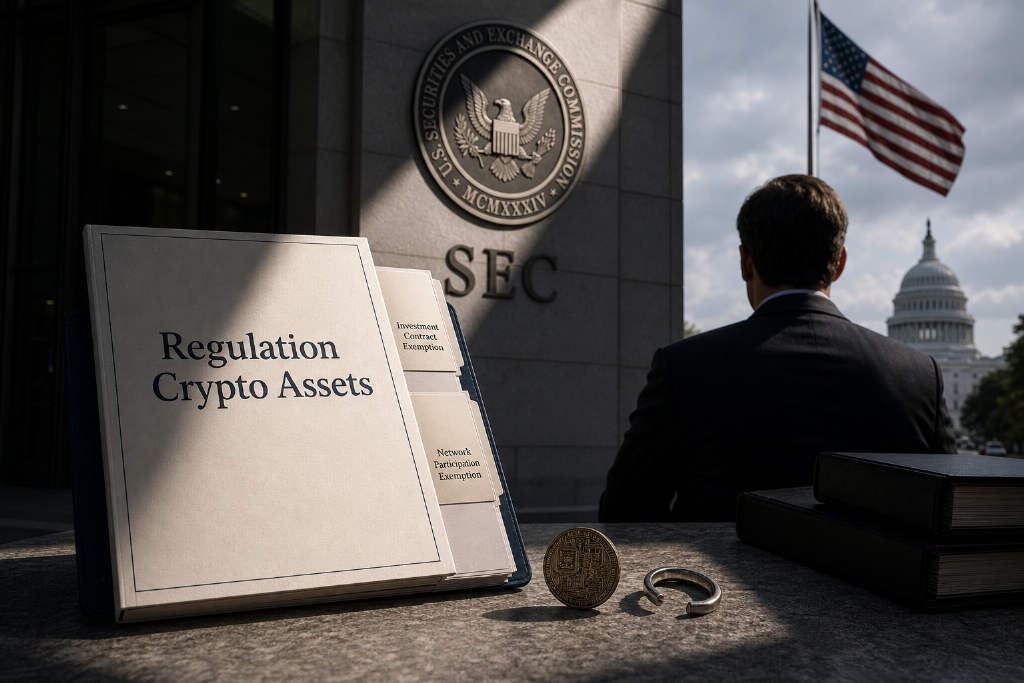
The U.S. Securities and Exchange Commission filed its Regulation Crypto Assets proposal on Aug. 18, setting off a burst of claims across crypto that token issuance in the U.S. no longer needs to be registered. The draft does not go that far.
What it does is carve out a crypto-specific fundraising route inside the existing U.S. securities exemption framework. It is meant to give projects a compliance path that is more predictable than the current patchwork. It does not erase SEC authority, and it does not suspend anti-fraud or anti-manipulation rules.
Three pieces sit at the center of the proposal
The proposal is built around two exemption paths, a safe harbor, and federal preemption over state registration requirements.
The first path is aimed at smaller early-stage projects. A team that raises no more than $5 million over four years could use what the source describes as a startup exemption, with a lighter process and no audited financial statements.
The second is for larger raises. A project could raise as much as $75 million in a 12-month period under a fundraising exemption, but that route would require financial statements and ongoing reporting obligations.
The safe harbor is the most closely watched part of the draft. Under the proposal, a token that is treated as a security at issuance could later separate from the investment contract analysis if the project finishes the core development work it promised, or permanently stops that work. The issuer would need to demonstrate that to the SEC. If successful, the token would no longer be treated as a security and would fall outside the SEC’s reach.
The proposal also says that if a project qualifies for the federal exemption, state securities registration requirements would give way. For Web3 teams, that matters because the current system can mean dealing not only with the SEC but also with separate requirements across all 50 states.
Registration relief is not a free pass
The line that matters here is simple: exempt from registration does not mean exempt from regulation.
The proposal leaves anti-fraud and anti-manipulation provisions in place. A project may be spared from filing a massive registration statement in advance, but the SEC could still act later if the offering involved false promotion, misleading statements, or market manipulation.
SEC Commissioner Uyeda said the framework would replace what he described as a guessing game with fixed thresholds, clear disclosure duties, and measurable conditions. That gets to the heart of the proposal. The agency is not stepping away. It is trying to draw cleaner boundaries for when and how crypto projects can operate.
The Howey problem is still the real issue
To understand why the safe harbor matters, the background is the Howey test.
In SEC v. W.J. Howey Co. in 1946, the U.S. Supreme Court set out a four-part standard for an investment contract: an investment of money, in a common enterprise, with an expectation of profit, derived mainly from the efforts of others. If all four elements are present, the offering falls under securities law.
That has left many token offerings in a gray zone for years. Early token sales often touch some or all of those factors. Projects argue a token is not a security; the SEC may see it differently. Registering like a traditional securities offering is costly and often poorly matched to how crypto networks develop.
The safe harbor in Regulation Crypto Assets is meant to address that tension directly. It offers a path for a token to stop being treated as a security once the project’s core managerial or development work is complete or has ended permanently.
Even so, SEC Commissioner Peirce said the exemption would not cover every type of crypto project. Which projects qualify and which do not remains unsettled. The next 60 days of public comments will be where much of that fight takes shape.
How it differs from Reg A, Reg D, and Form S-1
The proposal has invited comparisons to Regulation A, but the source argues the overlap is only partial.
Regulation Crypto Assets is aimed specifically at crypto assets. It carries fundraising limits of $5 million or $75 million per year depending on the route used, includes a safe harbor, and is built to address the question of whether a token remains a security after issuance.
Regulation A applies to smaller issuers. Tier 1 allows up to $20 million a year and Tier 2 allows up to $75 million a year. It does not include a safe harbor, and Tier 1 still requires compliance with state registration rules.
Regulation D applies to private placements. It has no fundraising cap, but sales are limited to accredited investors. It also does not include a safe harbor and still operates alongside state law.
Form S-1 is the standard public-company registration route. It has no fundraising cap and no investor restriction, but it comes with the most extensive disclosure burden and the highest cost.
Two differences stand out most clearly. First, Regulation Crypto Assets includes a safe harbor, while Reg A and Reg D do not. Those frameworks address how money is raised, not whether the token later exits securities treatment. Second, the crypto proposal expressly preempts state registration requirements, while Reg A Tier 1 can still require state-by-state filings.
The source also points to investor access. Reg D is limited to accredited investors. If the crypto proposal ultimately allows broader participation, its appeal to issuers would be on a very different scale.
Compliance costs remain substantial
Skipping registration does not make the process cheap.
Disclosure still costs money. The filing burden may be lighter than Form S-1, but projects will still need lawyers and finance professionals to prepare the required materials.
The $75 million route would require audited financial statements. For crypto issuers, that can be expensive on its own. Pricing tokens and recognizing revenue are already difficult accounting questions, and the source notes that finding an audit firm with crypto expertise will not be inexpensive.
There is also the cost of ongoing compliance. A project using the larger exemption would face continuing reporting duties, which means building an internal compliance function or paying outside law firms and auditors over time.
Legal fees run through every stage as well, from choosing the exemption route and drafting disclosures to communicating with the SEC and preparing for possible enforcement questions later.
The source gives a conservative estimate of legal and compliance costs in the range of hundreds of thousands of dollars to more than $1 million. That is a meaningful burden for smaller teams.
Three unresolved risk lines
The 60-day public comment period
The proposal has only just been released, and the SEC now moves into a 60-day comment window. Industry participants, law firms, and Wall Street institutions are expected to submit views. The agency could keep the proposal largely intact, revise it heavily, or abandon it.
The Sept. 15, 2026 Senate procedural vote
One reason this proposal matters is that the CLARITY Act has faced obstacles in Congress. But the bill is not dead. The Senate has scheduled a procedural vote for Sept. 15, 2026, and it would need 60 votes to move forward.
Ripple Chief Legal Officer Alderoty has called that date a key point for the bill’s future. If the legislation passes, it would establish the legal status of much of the crypto sector through statute, and Regulation Crypto Assets could be replaced or adjusted. If it fails, the SEC’s administrative rule may become the main framework.
That leaves two tracks moving at once: rulemaking by the SEC and legislation in Congress. It is still unclear which one will prevail.
Possible opposition from Wall Street
The third risk comes from potential legal and political resistance. SIFMA, which represents major Wall Street institutions, has opposed broad regulatory exemptions for crypto firms. Its position is that such a large shift should come through legislation rather than unilateral SEC rulemaking.
If SIFMA were to sue the SEC and win, the legal footing of the proposal could be weakened.
GSR Chief Legal Officer Riezman also warned that the next administration could bring something like a Gensler 2.0 environment. In practical terms, that means even a finalized rule might not be durable if the political direction changes.
What projects should take from it
The practical takeaway is not that token issuers can suddenly act without constraints. Anti-fraud and anti-manipulation rules still apply, and the proposal does not protect bad conduct.
Projects also cannot afford to watch only one policy channel. Regulation Crypto Assets and the CLARITY Act are moving at the same time, and neither has settled the field yet. The source suggests preparing for both possibilities rather than making plans around just one of them.
The safe harbor deserves especially close attention because it is the proposal’s most original feature. But the exact standards tied to decentralization and disclosure depth have not been finalized. Those details will decide whether the mechanism is genuinely usable or only looks good on paper.
Cost planning matters too. If compliance spending could run from hundreds of thousands of dollars to over $1 million, that needs to be built into fundraising strategy early rather than after capital is raised.
For now, the broader shift is from enforcement-first to rule-first. That is not a free era for crypto. It is an attempt to replace uncertainty with a framework that is clearer, but still enforceable. Whether the proposal survives will depend on the 60-day comment period, the Sept. 15, 2026 Senate vote, and any legal challenge that may come from Wall Street.