
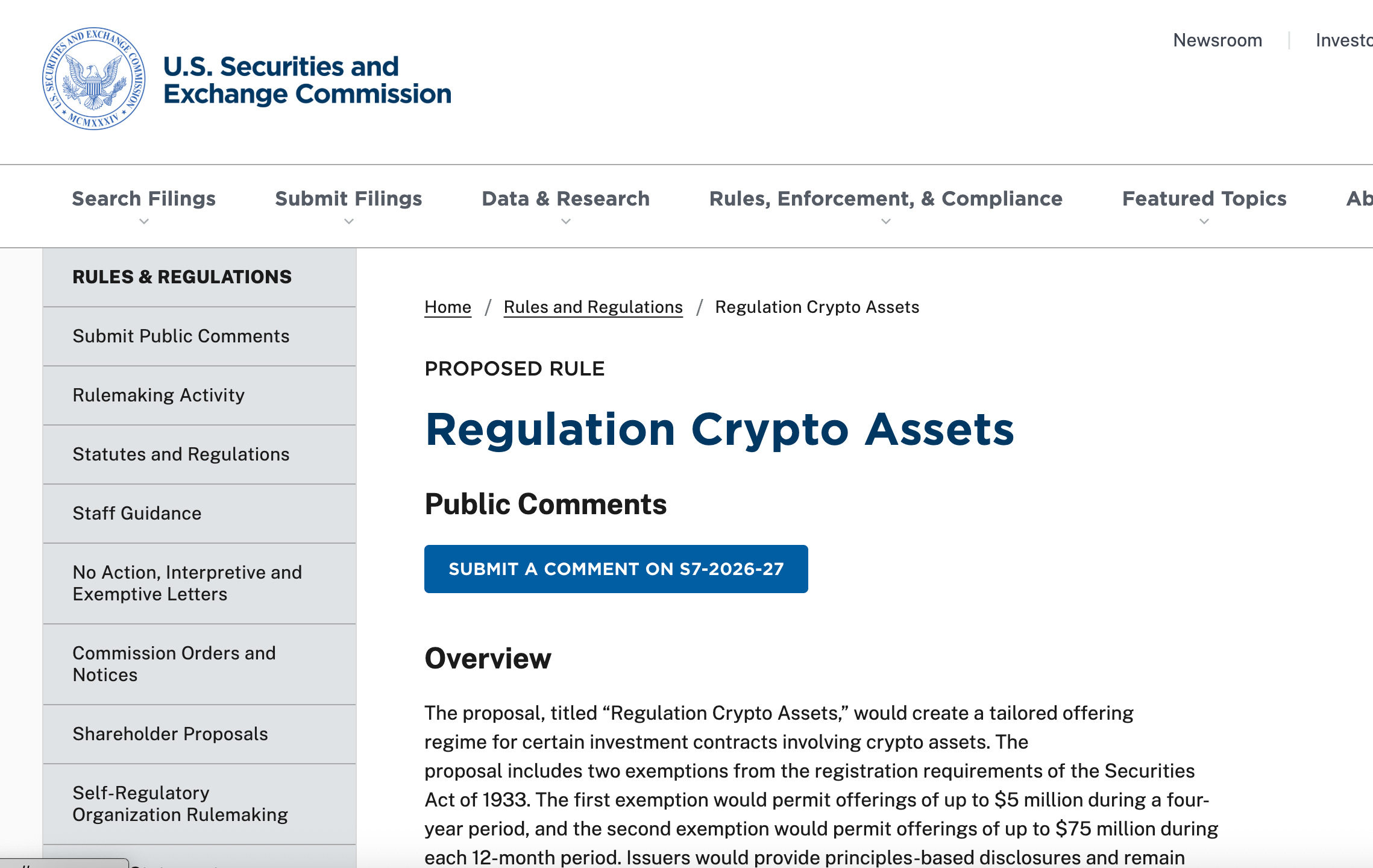
The U.S. Securities and Exchange Commission on Aug. 18 released a proposed rule titled Regulation Crypto Assets, laying out a tailored issuance framework for investment contracts tied to crypto assets. The proposal is being framed as the most consequential crypto regulatory step taken under SEC Chair Paul Atkins so far, and it lands while the CLARITY Act remains stuck in Congress.
Two registration exemptions and a safe harbor
According to the SEC, the proposal centers on two exemptions from Section 5 registration requirements under the Securities Act of 1933, along with a conditional safe harbor.
Startup Exemption
The first path, called the Startup Exemption, would let early-stage projects raise up to $5 million in total over a period of as long as four years without going through the full registration process. Issuers would instead provide principle-based narrative disclosures, in a process described as much closer to a notice filing than a conventional approval track.
In practical terms, a small project selling tokens on a limited basis to fund development could use this route if it stays within the proposed cap and time window. Audited financial statements would not be required under this exemption.
Fundraising Exemption
The second path, the Fundraising Exemption, would allow issuers to raise up to $75 million in any 12-month period. The structure borrows heavily from the existing Regulation A+ model and is split into two tiers. In addition to narrative disclosures, issuers would need to provide audited financial statements and take on ongoing reporting obligations.
That makes it the more demanding option for projects seeking to raise from a broader public base at larger scale. The SEC also made clear that issuers using either exemption would still be subject to the federal securities laws' anti-fraud and anti-manipulation provisions.
Under the proposal, token issuers would be able to choose between the two exemptions based on the amount they plan to raise, rather than defaulting to the full SEC registration route. Odaily's reading is that, if an issuer follows these rules, token issuance in the U.S. would have a lawful path.
When a crypto asset could stop being treated as a security-linked contract
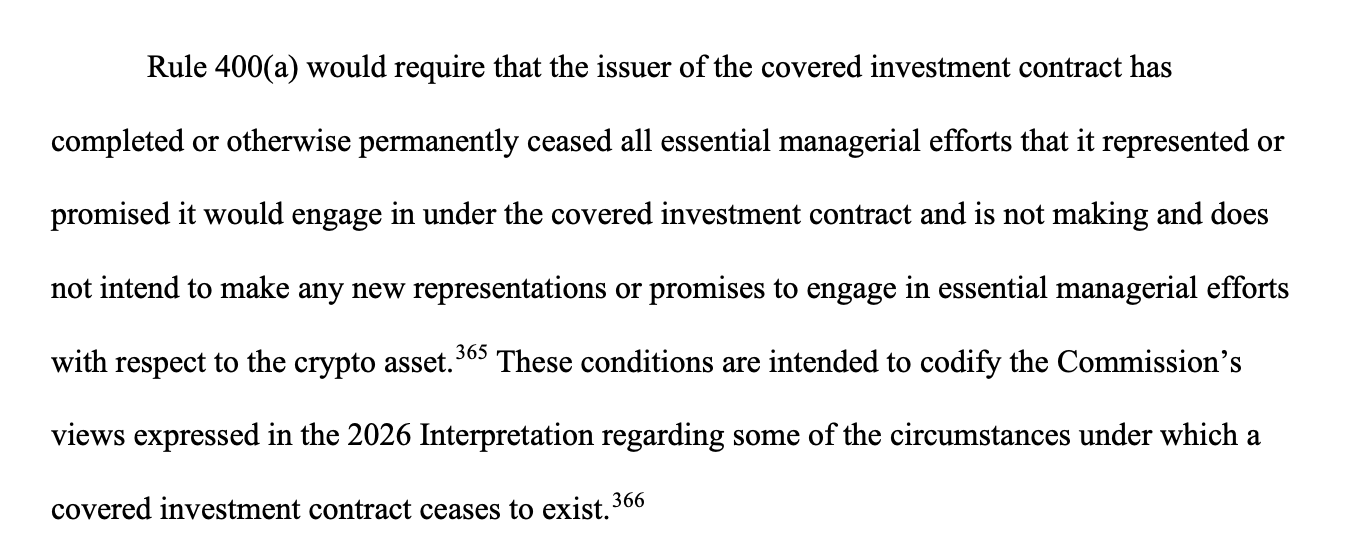
The proposal's third major element is an Investment Contract Safe Harbor. Under that provision, once an issuer has completed, or permanently ceased, the “essential managerial efforts” it previously committed to investors, the related crypto asset would no longer be treated as subject to investment contract status.
The filing also redefines the term “qualified purchaser.” That matters because securities issued under the proposed Regulation Crypto Assets exemptions, and related secondary-market transactions, would be exempt from state securities registration and qualification review requirements through federal preemption.
In effect, a token that was originally sold as part of an investment contract could later fall outside securities treatment if certain conditions are met. The trigger would be that the project team has either completed the essential managerial efforts it promised, or has permanently stopped carrying them out. Put differently, once investors can no longer reasonably rely on the team to keep doing the work that was expected to create value, the token may detach from investment contract treatment.
The article illustrates this with a simple progression: at launch, the token is treated as a security because the team is promising to build, maintain, or operate the network. Later, once those commitments are fulfilled, or permanently abandoned, the token may be treated as an ordinary asset no longer constrained by securities law.
Once those conditions are satisfied, secondary trading would no longer be handled as securities trading. Registration would not be required, resale restrictions would no longer apply, and exchanges would have more room to list the asset.
At the same time, the SEC drew a narrow boundary around a new term, “covered investment contract.” To qualify, the arrangement must meet all three conditions below:
- It involves a crypto asset.
- The crypto asset itself is not a security.
- The investment contract does not involve any asset other than that crypto asset, whether securities or non-securities assets.
That definition is important because it limits the two exemptions and the safe harbor to a narrow set of crypto issuance cases. It does not extend to offerings involving securities-like assets or tokenized securities.
Why the SEC moved now
Odaily describes the proposal as the latest step in a policy sequence that has developed over roughly the past year and a half.
- January 2025: Donald Trump signed an executive order titled “Strengthening American Leadership in Digital Financial Technology,” creating the President’s Working Group on Digital Asset Markets.
- Early 2025: The SEC formed its Crypto Task Force, led by Commissioner Hester Peirce, and collected more than 300 public comment letters.
- July 2025: The presidential working group issued a report recommending that the SEC use its rulemaking and exemptive authority to build tailored registration exemptions for securities offerings involving digital assets, a time-limited safe harbor, and exemptions covering airdrops. Atkins later announced the launch of “Project Crypto.”
- March 17, 2026: The SEC and the Commodity Futures Trading Commission jointly issued the 2026 interpretive guidance, which for the first time organized crypto assets into five categories: digital commodities, digital collectibles, digital utilities, stablecoins, and digital securities. It also described when non-security crypto assets could fall into, or exit, investment contract treatment. Odaily says that guidance is the direct theoretical foundation for the new proposal.
- Aug. 18, 2026: Regulation Crypto Assets was formally released as a rule proposal and entered a 60-day public comment period.
In the proposal, the SEC acknowledged that its historical approach to crypto oversight relied heavily on the Howey test established by the Supreme Court in 1946. It said that approach has two major shortcomings. First, Howey is difficult to apply to crypto assets whose rights and characteristics can evolve over time. Second, existing disclosure regimes such as Regulation S-K and Form 1-A often ask for information that does not line up with what crypto investors actually care about, including tokenomics, governance structure, and source-code security. That is why Rule 103 in the proposal puts notable weight on principle-based disclosures.
The CLARITY Act remains unresolved
The timing also tracks the stalled legislative path in Washington. The CLARITY Act, which parts of the industry had viewed as a long-term answer, has repeatedly run into trouble in the Senate this year. The article points to disputes between the crypto industry and the banking sector over stablecoin reward provisions, along with ethics debates tied to Trump’s own crypto-related conflicts of interest.
On Polymarket, the contract on whether the CLARITY Act would be signed into law in 2026 fell from nearly 82% at its February peak to a range of 18% to 21% by mid-August. The Senate majority leader submitted a cloture motion on Aug. 8 and set Sept. 15 for a procedural vote, but that vote would require 60 votes to pass. Based on the current number of Republican seats, roughly 10 Democratic senators would still need to cross over.
At the SALT conference, White House crypto policy adviser Patrick Witt said the administration was “giving the Senate and Congress every opportunity” but “will not wait forever.” If the September legislative window fails, regulators will move forward on their own, he said. Odaily presents Regulation Crypto Assets as the concrete expression of that position.
The result is a stopgap regulatory framework being built through the SEC's existing authority while Congress remains unable to finish legislation.
What comes next
For now, Regulation Crypto Assets is only a proposal and has not taken effect. The next milestones are already laid out.
- Aug. 18, 2026: The SEC formally released the proposal under file number S7-2026-27.
- Within 60 days after publication: The public comment process is open, and comments can be submitted through the SEC website or by email. The exact deadline will be set after the proposal is published in the Federal Register.
- After the comment period: The SEC must review and respond to substantive comments before deciding whether to adopt a final rule, and in what modified form, through an adopting release. There is no statutory deadline for this process. Historically, similar rules have taken months or more than a year to move from proposal to final adoption.
- November 2026: Hester Peirce is expected to leave the SEC, which could affect the internal momentum behind the framework.
On the current timeline, the proposal is unlikely to become an effective rule within the next few months. At the same time, the CLARITY Act remains uncertain on the legislative track. For the crypto industry, that leaves U.S. issuance rules in a transitional phase where regulation and legislation are running in parallel, without a final outcome yet.