


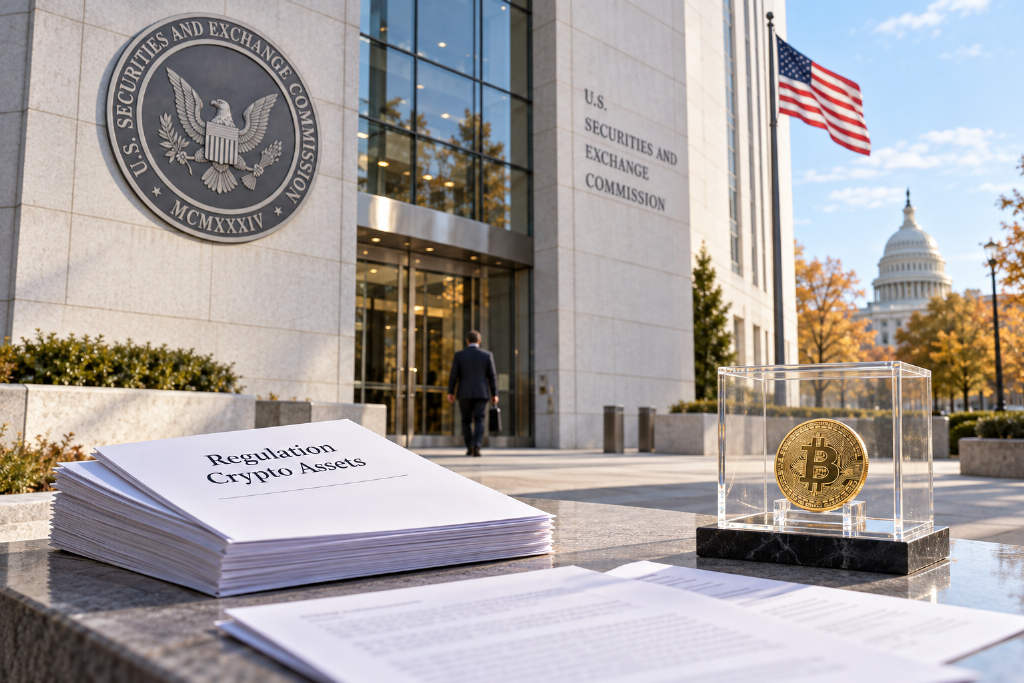
The U.S. Securities and Exchange Commission’s proposed Regulation Crypto Assets has completed its public comment phase, marking a key step in an effort to replace years of token oversight driven mainly by enforcement with a dedicated framework for crypto fundraising.
The proposal was introduced on Aug. 18, 2026. The comment period ended on Oct. 20.
If adopted, the rule would give the U.S. crypto industry a defined legal route for public token fundraising, a formal process for leaving securities treatment, and a more unified line between federal and state oversight.
Four major changes sit at the center of the proposal
The draft rule contains four headline changes.
First, it would create a registration exemption for startup projects, allowing them to raise as much as $5 million over four years without an audit or a licensed intermediary.
Second, it would create two fundraising exemptions for more mature projects, with annual caps of $20 million and $75 million, each tied to different levels of disclosure, financial reporting, and audit requirements.
Third, it would establish a Safe Harbor for exiting securities status. After completing, or permanently ending, promised development work, a project could file Form TR so that the related token would no longer be treated as a security because of the original investment contract.
Fourth, the federal rule would displace state-level securities registration requirements in certain areas, lowering compliance barriers for cross-state issuance and trading.
171 comments were submitted, 165 were coded
Public reaction has been tracked through an open website built by Mert Erinc, a researcher at BI Norwegian Business School. The site uses three independent AI reviewers to classify comment letters one by one.
As of Oct. 20, the SEC had received 171 comments, and 165 had been coded.
- Clearly supportive: 8, or 5%
- Conditionally supportive: 115, or 70%
- Clearly opposed: 14, or 8%
- Mixed: 3, or 2%
- Procedural or off-topic: 25, or 15%
The article notes that the 70% figure for conditional support does not mean 70% backed the proposal as written. Most of those letters accepted the direction of reform while asking for changes to specific provisions.
Who supported it, and who pushed back
Nasdaq explicitly backed the proposal, calling the Safe Harbor a 「carefully designed mechanism」 and saying the tiered disclosure structure was appropriate. A letter under SkyBridge Capital described the proposal as 「thoughtful, measured, and long overdue」. The Hyperliquid Policy Center urged the SEC to move quickly, while asking the agency to make clear that filing Form TR would not amount to admitting the token had previously been a security. Ava Labs called the proposal an 「important first step」 but said the definition of 「crypto asset」 was too broad.
Opposition came from several directions. Securities law scholars Coates, Coffee, Cox, Fox, and Seligman argued in a joint letter that the proposal had fundamental flaws. In their view, the startup exemption breaks with nearly a century of securities law tradition, and fundraising relief could be handled by revising Regulation A instead. John Reed Stark and Duke University’s Lee Reiners called for the proposal to be withdrawn in full. Public Citizen said the Safe Harbor was a 「regulatory loophole」 and argued that replacing state law would shelter bad actors. The Independent Community Bankers of America, or ICBA, said the rule should not be finalized unless the SEC can show that each accommodation is grounded in risk assessment, and it asked for an automatic sunset clause.
Davis Polk took a middle position, saying there was 「a better way, and it does not require starting over」.
The revision debate centers on four issues
Looking more closely at the direction of requested changes, 44 comments, or 27%, asked for looser rules. Another 49, or 30%, asked for tighter rules. A further 23, or 14%, asked for both loosening and tightening in different areas. The rest mainly sought clarification, retention of the draft as written, or did not fit the classification.
Supporters argue that existing securities rules do not fit every token offering. In their view, the proposal could lower fundraising costs for startups, give ordinary investors a lawful way to participate, and clarify when a token can leave securities regulation.
Opponents split into two very different camps. One side says the proposal still regulates too much and pulls decentralized projects into a traditional securities framework. The other says the exemptions are too loose and could weaken investor protection or open the door to fraud and insider dumping.
Fundraising limits
Those seeking looser treatment want the $5 million startup cap raised and want non-fundraising token distributions, such as airdrops and staking rewards, excluded. Those seeking tighter treatment say the exemptions are already too large.
Disclosure requirements
This is the area with the strongest push for tighter standards. The looser camp stresses lower compliance costs. The tighter camp wants disclosure routed through the SEC’s EDGAR system, along with stronger audits and ongoing reporting.
On this issue alone, 83 letters asked for tighter rules, while only 8 asked for looser ones. The main requests were that startup disclosures should also be filed through EDGAR and that Tier 1 financial statements should be audited.
On state-law preemption, 19 letters asked for looser treatment. On issuer eligibility, 15 letters asked for looser treatment, with one key question being whether DAOs without legal entity status could qualify.
Insider sales
The proposal does not impose a mandatory lock-up period. Audit groups including the Center for Audit Quality also raised additional concerns. On insider resale, 20 letters asked for tighter rules, including holding periods or lockups.
Safe Harbor design
The most contested issue is the mechanism for exiting securities status. A total of 97 comments addressed the exit framework, with 36 asking for looser treatment and 28 asking for tighter treatment.
The looser side wants broader exit conditions and stronger recognition of network functionality and decentralization. The tighter side wants independent verification so that projects cannot permanently leave securities regulation based only on their own statements. Bitwise said exit should be judged through externally observable facts. Public Citizen and others said the threshold for exit was too low.
The article’s assessment: likely to advance, but not unchanged
The article’s author, Meng Yan, argues that the proposal has a relatively high chance of moving forward, though revisions are likely, and estimates that the final rule may be only months away.
That view rests on the idea that the policy direction is already fairly well established and that most substantive comments focus on how to revise the framework rather than whether to reject it outright. Even so, the SEC still has to deal with investor protection, legal authority, and possible judicial challenges, leaving the final timetable uncertain.
What adoption would change for the U.S. crypto market
If the rule is finalized, the article says the U.S. crypto industry would see three major changes.
- A dedicated legal path for public token fundraising, effectively reopening the idea of a regulated ICO
- A clear procedure for projects to exit securities regulation
- A more unified boundary between federal and state oversight
At a deeper level, the reform is an attempt to build a full regulatory path for crypto projects, from fundraising to development to a mature network. In the article’s framing, the simplest way many people in the industry will understand it is this: the return of the regulated ICO.
The piece also stresses that regulatory certainty is not the same as investment safety. It says the quality of the final rule will hinge on three lines of defense: disclosure, insider constraints, and the conditions for leaving securities status.